
Your FDA Approval Is a Starting Line, Not a Finish Line
June 1, 2026
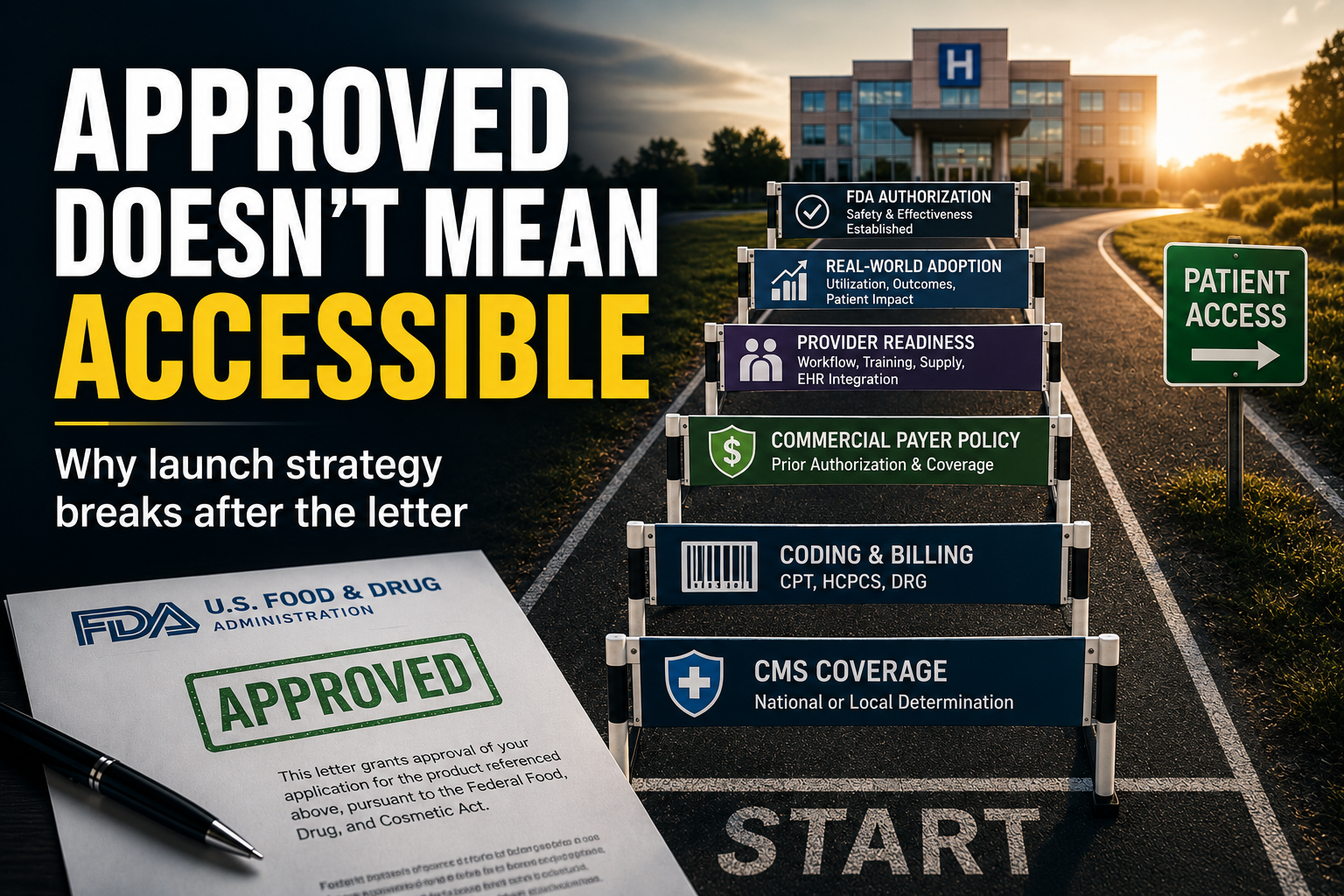
Picture the moment. Your team has just received an FDA approval letter. The lab pops champagne. Investors light up the group chat. And somewhere in a hospital, a patient who could benefit from your product still has no way to get it.
That gap between approved and accessible is where most launch strategies break. It is also where serious market intelligence work should actually begin.
For decades, we have treated FDA authorization as the moment a product enters the market. The deeper truth is different: FDA approval is a starting line, not a finish line. The race is everything that comes after.
What FDA Actually Decides (and What It Does Not)
FDA answers a narrow question. It asks whether a specific product, used in a specific way, meets a defined evidentiary standard for safety and effectiveness. That is not the same as proving the product is the best option, that it will be paid for, that clinicians will adopt it, or that real-world use will look like the trial.
In 2025, CDER approved 46 novel drugs. 72% used at least one expedited pathway. 24% received accelerated approval based on surrogate endpoints, with confirmatory evidence still pending. Each of those decisions is a regulatory yes. None of them is a guarantee of clinical superiority, payer coverage, or operational readiness.
Different products also carry different labels of authorization. Drugs are approved. Devices are typically cleared via 510(k). Biologics are licensed. Some emergency products are authorized under EUAs. The legal weight and evidentiary bar behind each is distinct. Treating them as interchangeable is one of the fastest ways to misjudge an opportunity.
The Chain Between Approval and Adoption
There is a sequence that every approved product must run, and it is rarely linear in practice:
- FDA authorization: the regulatory yes.
- CMS coverage: Medicare’s national or local determination.
- Coding and billing: CPT, HCPCS, and DRG assignments that decide whether a claim can even be submitted.
- Commercial payer policy: which often follows CMS, but not always, and not at the same pace.
- Provider operational readiness: workflow, training, supply, EHR integration.
- Real-world adoption: the only step that actually delivers patient impact.
A product can be approved and still take 18 to 36 months to reach broad coverage. It can be covered and still be blocked by prior authorization. It can be authorized and covered and still fail because a Medicare Administrative Contractor interprets the policy differently across regions. Strategy has to plan for all of it, not just the FDA milestone.
The encouraging signal in 2026 is that some of this is starting to align. CMS’s TCET pathway and the new TEMPO pilot connecting digital health to the ACCESS care model show what tighter coordination can look like. For Breakthrough Devices and AI-enabled software, the gap between authorization and coverage is narrowing. For most products, it is still a chasm.
What Smart Teams Do Differently
The teams that win post-approval treat FDA strategy as one component of a wider plan, not the whole plan. A few habits show up consistently:
- Build evidence for two audiences at once. FDA wants to know if the product works. Payers want to know what it displaces, what it costs, and what it improves. Trials, registries, and real-world studies should be designed to answer both.
- Map the reimbursement path before pivotal data reads out. If you discover a coding gap after approval, you have already lost a year.
- Treat postmarket data as a strategic asset. Accelerated approvals and software-based products now live or die by what real-world evidence shows after launch. The companies that invest early in registries, longitudinal outcomes, and cybersecurity monitoring are the ones still standing in year three.
- Plan for operational fit. A new device or AI tool that does not slot into existing workflows, EHR systems, and staffing patterns will not be adopted, no matter how good the data looks.
- Watch the regulatory perimeter. LDT oversight, AI guidance, and device cybersecurity expectations are all in motion. The vacating of FDA’s LDT final rule alone reshaped the diagnostics landscape.
FDA’s FY 2026 budget request is about $6.8 billion, with more than half from user fees. That is a small agency with outsized reach across drugs, devices, biologics, and digital health. The signals coming out of that agency are not just gating decisions. They are the architecture of the market itself.
The Bottom Line
FDA authorization opens the door. It does not walk the patient through it.
Companies and investors who keep treating approval as the finish line will continue to be surprised by access friction, coverage delays, and adoption gaps that the FDA letter said nothing about. The ones who treat approval as a starting milestone, with reimbursement, evidence generation, and operational readiness built in from day one, will be the ones whose products actually reach patients.
If your strategy depends on an FDA decision, the most important question is not whether you will get approved. It is what you will do the day after.
Want to talk through how regulatory, reimbursement, and adoption strategy should connect for your portfolio? Get in touch and let’s map the full path from approval to access.