
Your Competitive Advantage Has to Pass Two Tests. Most Fail One.
September 11, 2026
Walk into any strategy offsite and you will hear the word advantage used a dozen times before lunch. We are faster. We are more innovative. We have better technology, better service, better people. Each claim is offered as proof of competitive advantage.
Most of them are not advantages at all. They are just things the company happens to be good at.
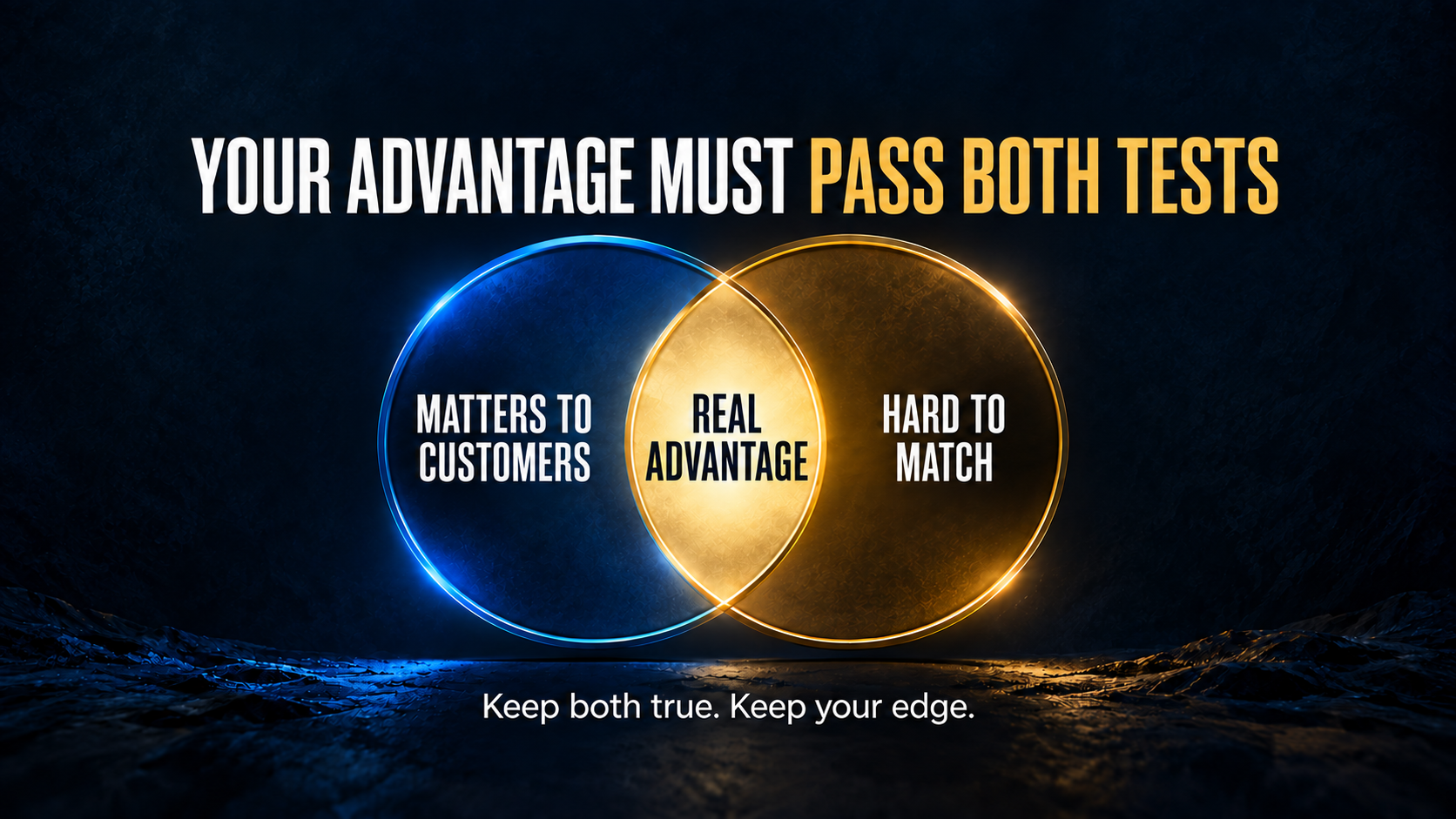
The difference matters, and there is a clean way to tell them apart. A real competitive advantage has to pass two tests at the same time. It must matter to customers, and it must be hard for competitors to neutralize quickly. Fail either one and what you have is not an advantage. It is a strength that will not hold.
This two-part test is not new. It echoes decades of strategy research. Jay Barney’s resource-based view of the firm argued that a sustained advantage requires resources that are both valuable and hard to imitate. What follows is that same idea, translated into the language of customer behavior and the systems that produce it.
The Two Conditions
Start with the two tests, because most confusion about advantage comes from checking only one.
The first condition is that the advantage must matter. It has to solve something customers genuinely care about, something that shows up in what they do, not just in what your marketing says. If customers do not change their behavior because of it, if they do not choose you more readily, renew more easily, or hesitate less, then whatever you built does not matter enough to be an advantage, however clever it is internally.
The second condition is that the advantage must be hard to neutralize quickly. If a competitor can erase your edge with a single feature release, a price cut, or a marketing campaign, then you never had a durable advantage. You had a temporary lead that happened to be visible at the moment.
Both conditions have to hold. And the reason so many strategies quietly fail is that leaders fall in love with an edge that passes one test and never check it against the other.
Four Things That Get Called Advantage
It helps to lay the two tests against each other, because doing so reveals four very different situations that all get called advantage in the hallway.
When something does not matter to customers and is easy to copy, it is simply noise. A feature nobody asked for that anyone could build. Harmless, but irrelevant.
When something does not matter to customers but is hard to copy, it is a moat around nothing. Companies build these more often than you would think: a genuinely defensible capability that customers do not value. Impressive engineering, no commercial return.
When something matters to customers but is easy to copy, it is a temporary lead, and it is the most dangerous of the four, because it feels exactly like an advantage. Customers love it. The numbers look great. Then a competitor ships the same thing and the edge evaporates, because nothing underneath it made the edge hard to take.
Only when something both matters to customers and is hard to neutralize do you have a real, durable competitive advantage. Most organizations spend their lives in the temporary-lead box, mistaking a good quarter for a moat.
Why Hard to Neutralize Almost Always Means a System
So where does the second condition actually come from? What makes an advantage hard to neutralize?
Almost never a single feature. Michael Porter made this point decades ago in his work on strategy: durable advantage comes not from any one activity but from a whole system of activities that fit together and reinforce one another. A competitor can copy one activity. Copying the entire interlocking system, all at once, while running a business that was built differently, is enormously harder. The fit is the defense.
Consider a piece of enterprise software that has been woven deep into a customer’s daily operations. A rival appears with a genuinely better individual feature. On paper it should be easy to win the account. It is not, because the incumbent’s advantage was never the feature. It was the integration: the data that already lives there, the workflows built around it, the training, and the handoffs between the vendor’s implementation, support, and product teams that keep the whole thing running. To neutralize that, a competitor does not have to beat a feature. It has to replace a system. That is a far taller order, and it is why the account does not move.
That interlocking, coordinated system has a name in the EdgeFinder lens: the Pack. The Pack is the smallest complete set of capabilities and handoffs that must move together to keep a promise to a customer. It is not the org chart, and it is not a single department. It is the coordinated whole that delivers the promise reliably under pressure.
This is the deep reason features get copied and systems endure. A feature is one thing. A Pack is people, processes, incentives, and infrastructure aligned and tuned over time. The alignment is precisely what a rival cannot quickly reproduce, which is exactly what the second condition requires.
Both Conditions Decay, So Advantage Is a Verb
Here is the part that makes competitive advantage genuinely hard: passing both tests once is not enough, because both conditions erode.
The condition that an advantage still matters decays as customer needs shift. What customers cared about deeply three years ago may be table stakes now, or simply irrelevant. An advantage can quietly stop mattering while your dashboards still look fine. Rita McGrath has argued that advantages have become increasingly transient, eroding faster than the old models assumed. Treating any advantage as permanent is now a mistake.
The condition that an advantage is hard to neutralize decays too. Competitors learn. Technology lowers the cost of imitation. The system that took you a decade to build becomes something a well-funded rival can approximate in two.
This is why sustained competitive advantage is not a possession. It is a practice. And the EdgeFinder lens describes that practice as a loop.
Picture a company that built a real advantage and then simply enjoyed it. It stopped watching whether the edge still mattered, and stopped reinforcing what made it hard to copy. That is the failure this loop is designed to prevent. Find is the discipline of continuously sensing change, treating variance, the early shifts in what customers value and what competitors are doing, as signal rather than noise. Advance is acting on what you sense, adjusting the advantage before it decays. Fortify is the move most organizations skip: relentlessly reinforcing the system so the advantage stays hard to neutralize, making what works the standard rather than letting it quietly erode.
Find and Advance without Fortify is the most common failure mode in business, and in the context of advantage it is brutal. The company senses the shift, even makes the move, but never does the unglamorous work of hardening the new system. So the advantage that was briefly real slips back into being a temporary lead, and a competitor takes it. Advantage that is not fortified does not hold. It fades.
How to Audit Your Advantages
For leaders, this becomes a concrete discipline: run every claimed advantage through both tests, honestly, and keep running it.
Start with the first test, and look at behavior rather than opinion. Do customers actually act differently because of this edge? Do they default to you, renew without renegotiating, refer you without being asked, treat price as less central? If not, the thing you are protecting may not matter as much as you think.
Then apply the second test with equal honesty. If a competitor decided to neutralize this next quarter, what would they actually have to do? If the answer is ship a feature or run a promotion, you are holding a temporary lead, and you should be building the system that would turn it into something durable. If the answer is rebuild an entire coordinated system, you have a real advantage, and your job is to keep fortifying it so it stays that way.
Because both conditions decay, this is not an annual exercise. It is continuous. The advantage that passes both tests today is being eroded on both fronts right now, by shifting customer needs and by competitors learning to copy you. Sensing that erosion early, while you still have room to respond, is the whole game.
Related Video: What Is A Competitive Advantage?
The Bottom Line
A competitive advantage is not something you are good at. It is something that both matters to your customers and resists your competitors, at the same time, and over time.
One without the other is a trap. An edge that matters but is easy to copy is a lead on a stopwatch. An edge that is hard to copy but does not matter is a monument to wasted effort. Only the intersection is real, and even the intersection does not stay real on its own.
Sustained competitive advantage is the ongoing work of keeping both tests true as the world tries to make them false. The companies that endure are not the ones with the cleverest edge. They are the ones who keep proving, quarter after quarter, that their advantage still matters and still cannot be quickly taken.
If you want to know which of your advantages are real and which are temporary leads you are still coasting on, get in touch. I can help you test each one against both conditions, find where your Pack makes an advantage genuinely hard to neutralize, and identify what to fortify before a competitor does the neutralizing for you.