
Why Your Most Durable Advantage Looks Boring From the Inside
September 24, 2026
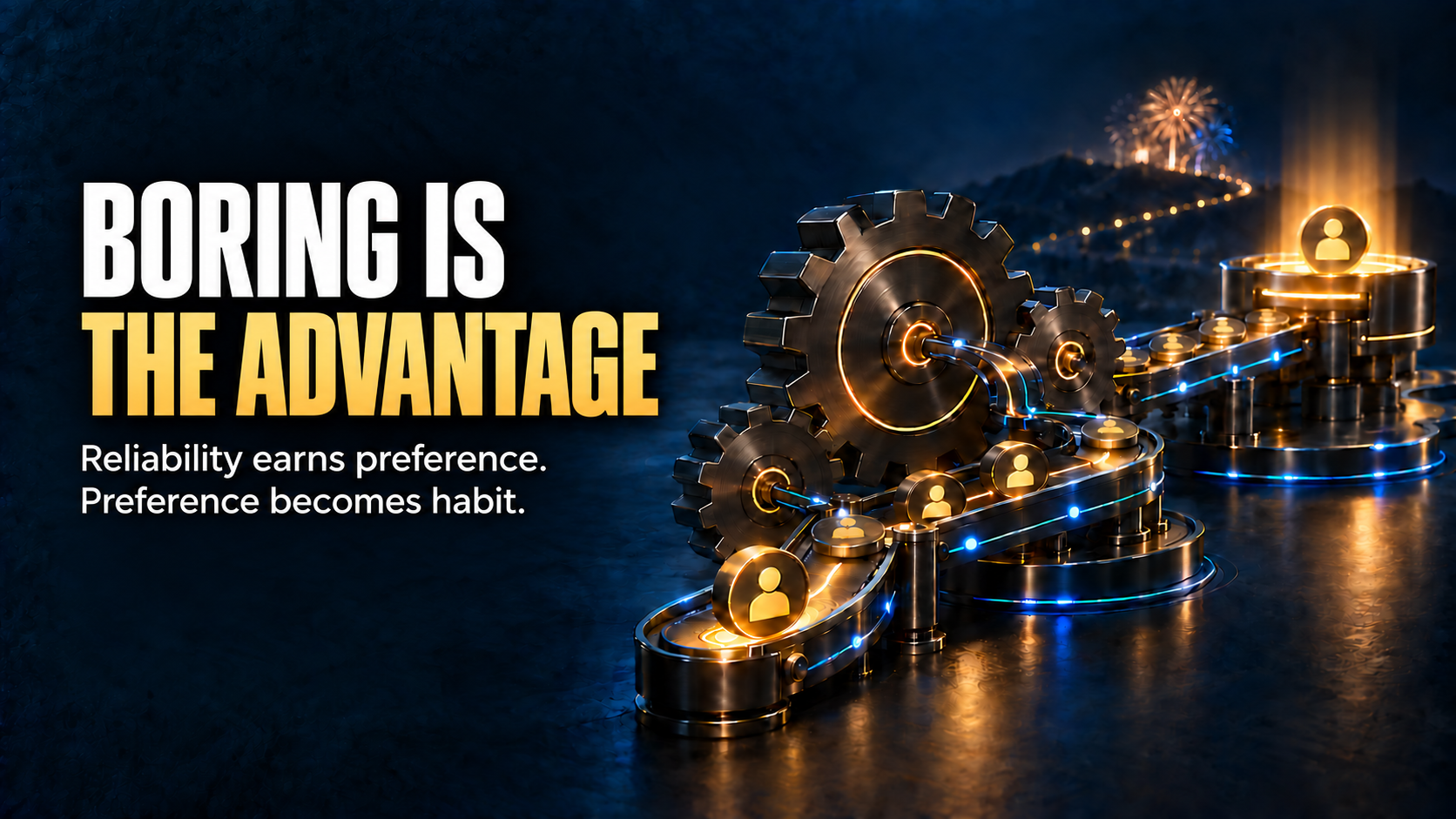
Most leadership teams spend their strategy time chasing the remarkable. The bold new feature. The launch that will make customers say wow. The differentiator no competitor has. The unspoken assumption is that competitive advantage must be exciting, or it is not advantage at all.
The evidence points the other way. In a large body of customer research summarized in The Effortless Experience, the strongest predictor of loyalty was not delighting customers or exceeding their expectations. It was reducing the effort required to do business with you. Customers do not reward dazzle nearly as reliably as they reward ease.
That finding is uncomfortable, because ease is boring. It does not photograph well in a board deck. And yet the most durable competitive advantages, the ones that quietly compound for years, almost always look boring from the inside. This article is about why, and about what leaders should build instead of the next exciting thing.
What Customers Actually Experience
Start with a simple correction. Customers do not experience your strategy. They never see the positioning document or the competitive analysis. What they experience is far more mundane: ease or friction, confidence or confusion, reliability or risk. And on the basis of those feelings, they make choices.
Competitive advantage exists only where those choices become predictable. If customers regularly hesitate, re-shop, or second-guess, there is no advantage, no matter how compelling the internal story sounds.
Here is the mechanism behind that. True advantage reduces cognitive effort. When a choice is genuinely easy, customers stop deliberating and simply default. The behavioral research on this is deep. Daniel Kahneman’s work on cognitive ease shows that options which are familiar and easy to process feel safer and more trustworthy, almost automatically. Studies of choice overload, most famously Sheena Iyengar and Mark Lepper’s supermarket experiment with jam displays, show that more options and more deliberation often lead to fewer decisions, not better ones. And decades of research on status quo bias show that people, once comfortable, strongly prefer to keep choosing what they already chose.
Put those together and a pattern emerges. The winning position in a customer’s mind is not the most exciting one. It is the one that feels safe, familiar, low-risk, and predictable. What feels ordinary on the inside can feel extraordinarily reliable on the outside.
Advantage Lives in Behavior, Not in the Story You Tell
This is why internal metrics are such a dangerous place to look for advantage. An organization can improve its efficiency, its utilization, its conversion rates, and its margins, and still be losing competitive advantage, because none of those numbers tells you whether customers feel a meaningful difference.
The metrics that actually prove advantage live outside the organization, in customer behavior. Do customers choose you again without re-evaluating? Do they select you by default? Has their re-shopping decreased? Are they willing to commit further, to integrate you more deeply into how they operate? Those behaviors are the proof. If customer behavior does not change, advantage is assumed, not real.
This reframes what advantage even means. It is not a feature you possess. It is a preference customers act on, repeatedly, with less and less deliberation each time. And preferences of that kind are rarely built on excitement. They are built on the accumulated experience of being reliably, unremarkably well served.
The Boring Advantage Is Usually an Experience of Coordination
If reliability is what wins, the next question is where reliability comes from. It is worth being precise, because most organizations look in the wrong place. They look for a single heroic feature. The real source is almost always coordination.
Consider Kaiser Permanente. Its competitive advantage does not come from offering radically different individual services than other health systems. It comes from the fact that the system feels coherent to the patient. Care feels connected. Information moves between providers. Handoffs work. Fewer things fall through the cracks. From the customer’s side, the advantage is not any one service. It is the experience of coordination, and that experience is exactly what earns trust.
That coordinated whole has a name in the EdgeFinder lens: the Pack. The Pack is the smallest complete set of capabilities and handoffs that must move together to keep a promise to a customer. It is not the org chart, and it is not a single department. It is the interdependent system that delivers the promise when the pace picks up.
Now the reason the advantage looks boring from the inside comes into focus. A well-functioning Pack is nearly invisible. When coordination works, nobody notices it; the experience simply feels smooth. Customers only notice the seams when they fail: the dropped handoff, the information that did not travel, the promise that broke. So the very thing that produces the advantage, seamless coordination, produces no internal drama when it is working. It looks like nothing is happening. In reality, the hardest and most valuable work in the business is happening, and its reward is that the customer gets to stop thinking.
Why Leaders Underinvest in Boring, and What It Costs
If the boring advantage is so powerful, why do so few organizations build it? Because building and maintaining reliability is unglamorous, and the incentives inside most companies reward the opposite.
Consider how organizational change typically unfolds. A team identifies an opportunity and gets excited. It launches something new, moves fast, and celebrates the win. That sequence, seeing the opportunity and acting on it, has a name in the EdgeFinder lens: Find and Advance. Find is the discipline of spotting what matters. Advance is committing and moving. Both are energizing, visible, and rewarded.
There is a third move, and it is the boring one. Fortify means making the gain hold across the whole organization: turning a new capability into a reliable standard, embedding it so it works every time without heroics. Fortify is thoroughness, repetition, and closure. It is the least exciting work in the building, and it is precisely the work that produces the seamless, reliable experience customers default to.
Find and Advance without Fortify is the most common failure mode in business. It is the company that keeps launching exciting new things while the reliability of its core quietly decays. For a while, the launches mask the erosion. Then customers start to feel the seams. The handoffs that used to be smooth begin to slip. The default choice stops feeling safe, and customers who had stopped comparing you start comparing again. Each broken promise spends a little of the trust that made you the easy choice in the first place, and trust, once spent, is slow and expensive to rebuild.
The uncomfortable truth is that the boring work is the advantage. Fortification is not overhead sitting on top of the real strategy. It is the strategy, expressed as reliability the customer can feel.
What This Means for Leaders
For leaders, the reframe is significant, and it starts with the questions they ask.
The usual question is some version of “how do we wow them?” The better question is “how do we make choosing us, and staying with us, effortless and safe?” The first chases moments of delight. The second builds the durable, low-effort reliability that customers actually reward.
That shift changes where attention goes. It means judging the business by customer behavior, repeat choice and reduced re-shopping, rather than by internal applause for the latest launch. It means treating coordination, the health of the Pack, as a first-class strategic asset rather than an operational afterthought. And it means protecting the budget and the status of Fortify work, the unglamorous maintenance of reliability, against the constant organizational pull toward the next shiny thing.
None of this means novelty is worthless. New offers and fresh experiences can create real advantage. But novelty is a moment. Reliability is a capability. And it is the capability, not the moment, that compounds into an advantage competitors find very hard to dislodge, because a default position built on years of being reliably well served is not something a rival can copy with a feature.
Related Video: What Is Sustainable Competitive Advantage?
The Bottom Line
Real competitive advantage looks boring from the inside because that is exactly what it is supposed to look like. It is the quiet, coordinated reliability that lets a customer stop thinking and simply default to you.
The flashy move earns attention. The reliable system earns preference. And preference, repeated until it becomes a habit, is what sustained competitive advantage actually is. Leaders who chase the remarkable and neglect the reliable win the occasional moment and lose the long game. Leaders who make the boring work the center of their strategy build something rivals struggle to copy and customers rarely leave.
Boring, done relentlessly well, is the most durable advantage there is.
If you want to know whether your competitive advantage is real reliability or just an exciting story you tell internally, get in touch. I can help you see where your Pack is quietly dropping the coordination customers depend on, and what to fortify so being the easy, safe choice becomes an advantage that holds.