
When Speed Breaks Trust: What Boeing Teaches Us About the Gains That Don’t Hold
April 23, 2026
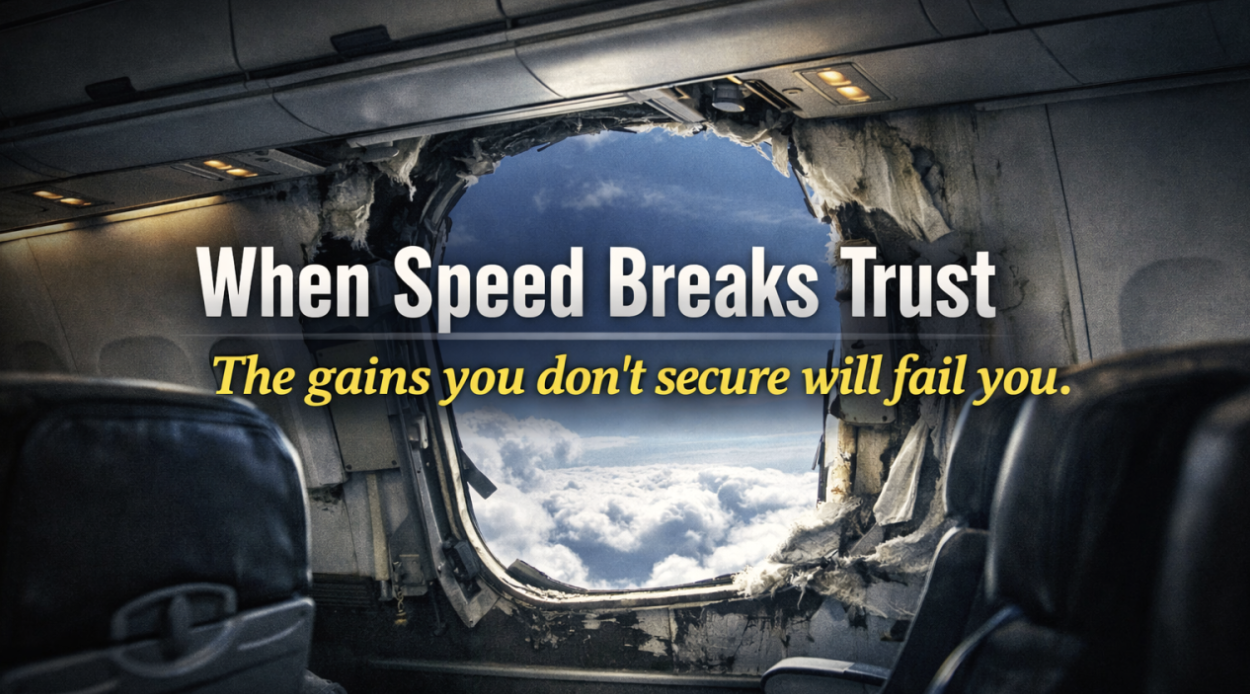
On January 5, 2024, a door plug blew off an Alaska Airlines 737 MAX at 16,000 feet. One hundred and seventy-one passengers stared at open sky where a wall used to be.
The cause was not a design flaw. It was not a freak material failure. Four bolts had been removed during a factory repair and never put back. A routine maintenance step, skipped. An inspection process that should have caught it, didn’t.
Boeing’s leadership knew about quality problems. Whistleblowers had been raising alarms for years. Internal auditors flagged defects. The FAA later found Boeing failed 33 out of 89 quality tests on the 737 MAX production line.
None of that stopped the planes from shipping.
This is not a story about bad engineering. It is a story about what happens when an organization’s strategy, its people, and its operations stop moving together. And it holds a lesson for every enterprise leader, in every industry.
The Promise That Broke
Every organization makes a promise to the people it serves. Boeing’s promise is as simple as it gets: the plane is safe to fly.
Keeping that promise requires a tightly coordinated set of capabilities and handoffs: design engineering, manufacturing, quality inspection, supplier management, regulatory compliance, and post-delivery surveillance. I call this set of interdependent capabilities the Pack: the smallest complete system that must move together for the promise to hold, especially under pressure.
The Pack is not the team. The team operates the Pack. And when the Pack breaks down, the promise breaks with it.
At Boeing, the Pack broke down because speed overwhelmed the system’s ability to hold. Production targets increased. Supplier oversight loosened. Quality inspectors were pressured to move faster. Whistleblower Sam Salehpour testified before the U.S. Senate that Boeing’s culture “prioritizes speed of production over safety and quality,” and that employees who spoke up were “ignored, marginalized, threatened, sidelined, and worse.”
The strategy said go faster. The operations could not keep up. The people who saw the gap were silenced.
They Found the Problem. They Never Made the Fix Hold.
Here is what makes the Boeing story so instructive: they were not blind to the variance. The signals were everywhere.
Quality auditors flagged defects. Whistleblowers filed formal complaints. Internal data showed manufacturing nonconformances piling up. The FAA itself issued findings. Boeing’s leadership found the problems. In many cases, they even pushed fixes.
But the fixes did not hold.
This is the most common failure pattern I see in organizations, and it is not limited to aviation. Leaders detect a problem and push a response: a new process, a policy update, a reorganization. But they stop there. The gain is never embedded. The system reverts to its old behavior the moment pressure returns.
I describe this as the decision loop of Find, Advance, Fortify. Find detects the variance. Advance commits to the move that matters. Fortify makes the gain hold so the organization can repeat it under pressure.
All three are required. And the primary failure mode is Find and Advance without Fortify.
Boeing found the quality issues. They advanced fixes. But they never fortified: never rebuilt the inspection culture, never restructured the incentives, never made the quality system hold under production pressure. When speed increased again, the same failures returned. Four missing bolts. Open sky at 16,000 feet.
What This Looks Like in Your Organization
You do not need to manufacture aircraft to recognize this pattern. It shows up everywhere:
- The sales team closes a transformational deal, but operations cannot fulfill it at that scale. Leadership celebrates the win. Six months later, the customer is frustrated and the account is at risk.
- A digital transformation launches with fanfare, but the teams running it are doing double duty. Bain’s 2024 research found that 88% of business transformations fail to achieve their original ambitions, often because organizations overload their best people instead of building the capacity for the change to hold.
- A quality issue surfaces, gets patched, and resurfaces six months later. The patch was an Advance. The organization never Fortified: never changed the underlying process, the training, or the incentive structure that allowed the issue to recur.
In every case, the organization was not incompetent. It was moving too fast for its own system to hold. The strategy said accelerate. The operations could not sustain it. And the people in between were left absorbing the gap.
The Real Question
Competitive advantage is not hard to create. Most organizations can find an edge and push toward it. The hard part is making the advantage hold.
Sustained competitive advantage requires that the Pack holds together under speed. When it does, trust compounds: with customers, with regulators, with the market. When it does not, speed turns into fragility and advantage decays.
Boeing’s market cap dropped by tens of billions of dollars. The FAA capped production at 38 jets per month. A three-year independent safety monitor was appointed. The reputational damage will take a generation to repair.
All because the gains from previous fixes never held.
The Bottom Line
The next time your organization identifies a problem and pushes a fix, ask one question: Will this hold when the pressure comes back?
If the answer is no, you have not Fortified. You have only Advanced. And the same issue will return, often at the worst possible moment.
The organizations that sustain their advantage are not the ones that move fastest. They are the ones whose gains hold.
Want to talk about how your organization can make its gains hold under pressure? Get in touch and let’s explore what Fortify looks like in your context.