
When Everyone Can Build It, What Do You Compete On?
November 5, 2026
Two years ago, connecting a client’s CRM to their billing system was a project you could build a quarter around. Today an operations manager with no coding background can point an AI agent at both systems and have the connection running by Friday.
The work did not get less valuable to the client. It got cheaper to produce. Those are different problems, and the second one is yours.
I have spent my career watching technical moats drain, in medical devices, in health IT, in software services. The pattern repeats. What changes is the speed.
The Floor Is Rising
A talk I watched recently on competitive strategy through 2030 put a name on the mechanism: inflation. When AI raises what a baseline professional can produce, the standard output of your industry rises with it. The deck that took your team a week now takes a day. So the client expects it in a day, and expects the week to buy something more.
Standing still under those conditions is not neutral. If your offer in 2027 is your offer from 2025, you did not hold your position. The floor came up and swallowed it.
The uncomfortable part: the skill that eroded is the one you were selling. Knowing how to build the integration, configure the system, write the code. That knowledge is becoming a utility, and utilities get priced like utilities: by the unit, against the cheapest reliable alternative.
What Replaces the Technical Moat
The same talk, by Nick Saraev, argued that general business mechanics (sales, marketing, delivery) are now worth far more than the ability to operate the tools. His multiplier was one hundred times. His underlying argument: knowing how to point an AI agent at an API is no longer the scarce skill; knowing what to build and how to sell the business outcome it produces is. I will not defend the number. I will defend the direction.
When the how gets cheap, advantage moves to the what. Which problem is worth solving. Which outcome the buyer will pay for. How to describe it so a buyer with a budget recognizes it. How to deliver it so they buy again.
Selling the outcome is a different job than selling the build. A build is scoped in hours and features. An outcome is scoped in the buyer’s numbers: the quota their sales team missed, the four days a proposal sits in review, the churn report nobody acts on. If you cannot name the number your work moves, the buyer prices you like a vendor, because a vendor is what you gave them to price.
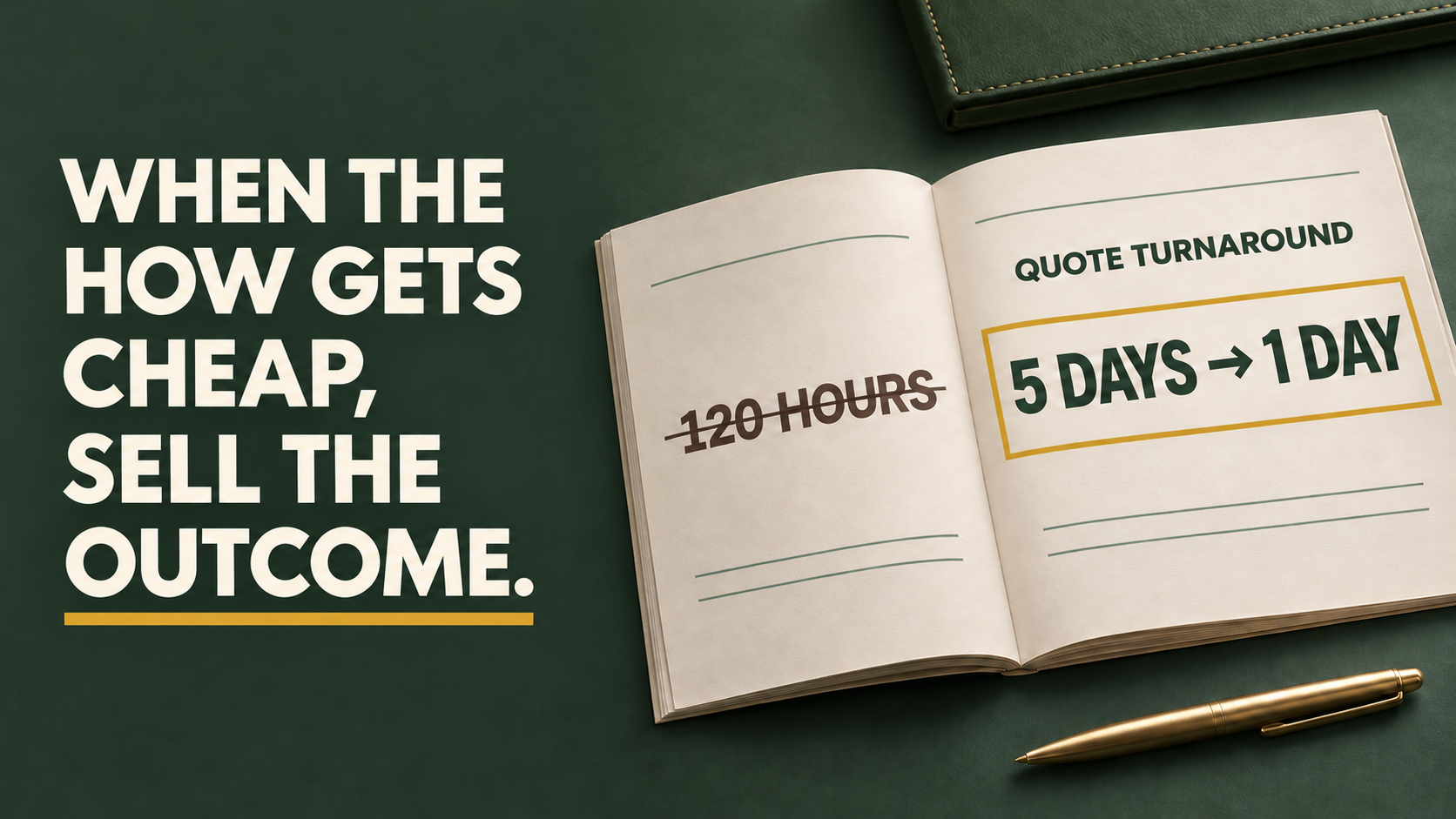
Here is the rewrite in practice. The before line on the proposal reads: “Build and configure a quoting workflow, 120 hours.” The after line reads: “Cut quote turnaround from five days to one, measured against last quarter’s log.” Same work. Different thing purchased. The first line invites a rate comparison. The second invites a conversation about what a four-day delay costs them. One caution: the second line only works if the turnaround can be measured, so the rewrite sometimes forces a scope change, adding the baseline measurement the buyer never had.
The talk also pointed to where the demand is heading: away from pure implementation, toward workshops, team training, and embedded advisory work. If that holds, clients are no longer short of systems. They are short of people who can make their teams and the AI work as one unit.
Spot the Shift Before It Spots You
Say three clients in a row cancel the build phase of an engagement and ask for training instead. Or prospects start arriving at the first call with a prototype they built themselves, asking you whether it is any good. Most firms book the smaller invoice, answer the question, and move on. Neither pattern is bad luck. Each is intelligence about where the market is going, arriving early enough to act on.
I use a lens called EdgeFinder for exactly this. It treats variance, the gap between what you expected and what happened, as signal rather than error, and it runs on a continuous loop of three disciplines: Find, Advance, Fortify.
- Find is slowing down to examine what is happening in your business: where demand drifted, which requests stopped coming, what buyers now ask for instead.
- Advance is doing something about it: committing real resources to a new offer, not running a side experiment.
- Fortify is making the whole firm adopt the gain, so the new offer becomes the standard way you sell and deliver, not one partner’s pilot.
All three are required, and the most common failure is Find and Advance without Fortify. The firm spots the shift. One partner launches a workshop offer. It sells. A year later the rest of the firm is still quoting builds, the workshop lives in that one partner’s calendar, and a competitor who made the same offer standard across their firm owns the category. The gain was real. It never held.
Fortify, in practice, is a list of unglamorous decisions. Put the new offer on the price list. Write the delivery playbook so an associate can run it, not just the partner who invented it. Train everyone who sells to sell it, and pay them on the outcome sold, not the hours staffed. Publish the case study, written around the number that moved, not the system that was built. Assign one owner for the offer’s language and materials, so five partners do not describe it five ways. None of this is strategy. All of it is what makes the gain the firm’s, instead of one person’s.
On a rising floor, that failure is fatal rather than embarrassing. Any gain you do not lock in gets absorbed into the baseline, and you start over against a higher standard.
Run the loop on a calendar, not on a mood. A quarterly review of what clients asked for, what they declined, and what they paid a premium for will catch most shifts while they are still cheap to act on. Waiting for the revenue line to confirm the shift means acting a year late, at full price.
Related Video: How Information Technologies Are Used To Gain A Competitive Advantage
The Goal Is Advantage That Holds
The point of the loop is sustained competitive advantage: converting an early signal into a gain you can repeat under pressure, again and again. Sustained is the part buyers are purchasing when they hire an advisor in a fast-moving market. A client who believes you will still be competitive in three years writes you into next year’s budget. A client who suspects you are one tool release from obsolete keeps you on a short contract.
The Bottom Line
The technical barrier that protected your business is not coming back. Compete on knowing what to build, on selling the outcome, and on a discipline that turns early signals into gains that hold. Find the shift. Advance on it. Fortify it before the floor catches up.
Want to pressure-test where your own offer sits against the rising floor? Get in touch and we can map where your next advantage lives and what it will take to make it hold.