
The Strategic Storyboard: Why Great Organizations Tell the Truth About Requirements
September 9, 2026
The Budget Meeting Everyone Has Attended
The leadership team gathers around the conference table. They agree on the targets:
Revenue growth by 15 percent. Launch a new product line. Improve customer retention. Execute a major strategic initiative.
The vision is clear. The commitment is stated. The CFO nods.
Then budget season arrives.
Resources are reduced. Not by 15 percent. By 5 or 10. But reduced nonetheless. Headcount is cut. Projects are deferred. Timelines slip.
Yet the targets remain unchanged.
The leadership team absorbs the contradiction as though it were normal. Nobody asks the question that should be asked:
Which boxes should we remove?
Instead, the organization simply decides to do more with less. Again. And again. And again.
This is where organizations fail. Not because they lack ambition. But because they separate the ambition from the requirements that would make it real.
The Hidden Assumption Behind Most Strategic Plans
Most strategic plans operate on a hidden assumption.
The assumption is simple:
Desired outcomes will somehow occur.
This assumption is never stated. It is never tested. It is simply embedded in how organizations think.
But beneath every outcome is a chain:
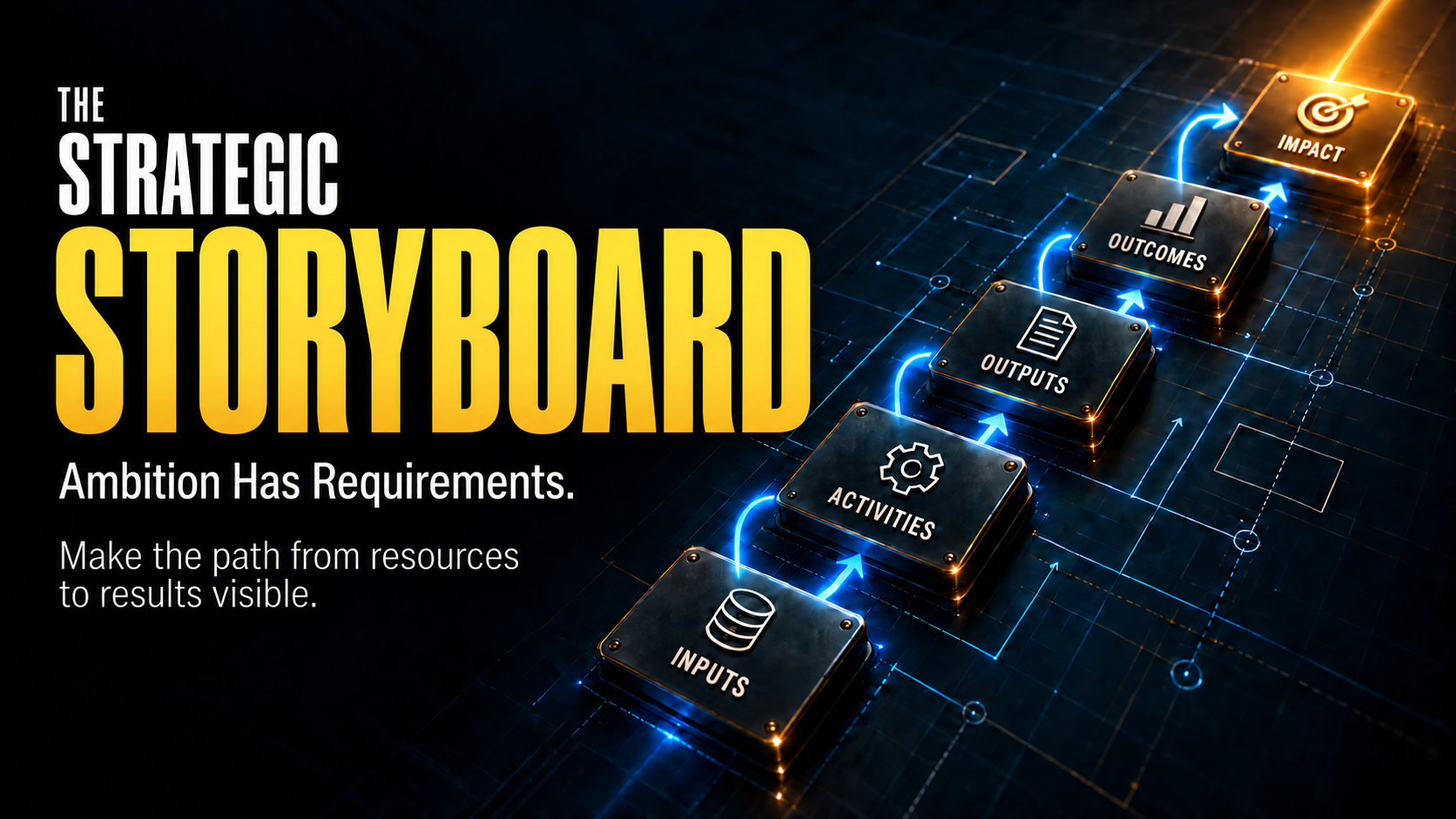
Inputs → Activities → Outputs → Outcomes → Impact
The organization wants the impact. The impact at the top. But does not want to discuss what sits below it.
The resources required. The activities that must occur. The outputs that must be delivered. The outcomes that must be achieved before impact is possible.
When that conversation is avoided, organizations end up here: wanting the result without wanting to discuss what the result requires.
Why Outcomes Have Requirements
This is not philosophy. This is operational reality.
Every commitment has requirements.
Market share requires investment. Innovation requires experimentation and the willingness to accept failure. Quality requires process discipline. Culture change requires leaders to model the behavior they seek. Strategic advantage requires capabilities that do not yet exist.
The desired future does not create itself.
And here is the harder truth:
Desired outcomes do not create requirements.
Requirements create outcomes.
An organization cannot wish its way to a result. Cannot hope its way. Cannot simply announce the outcome and expect reality to cooperate.
The outcome is determined by what the organization is actually willing to invest, what activities it actually executes, what outputs it actually delivers, and what capabilities it actually builds.
Everything else is aspiration masquerading as strategy.
Requirement Truth Becomes Operational
The first articles in this series established Requirement Truth as a principle: that there is a truth about what organizations require to achieve their missions.
This article establishes how leaders expose that truth.
Requirement Truth becomes operational when leaders connect desired outcomes to the resources, activities, outputs, and capabilities required to produce them.
This is the transition from philosophy to management practice.
Until this connection is made visible, leaders can simultaneously believe contradictory things: more outcomes and fewer resources, greater ambition and reduced investment, strategic transformation and stable budgets.
The moment the connection is made visible, one of three things must happen:
Increase inputs. Reduce outcomes. Change the assumptions about how outcomes are achieved.
One of those three. No fourth option exists.
The Strategic Storyboard
The Strategic Storyboard is a visual representation of how resources become impact.
The underlying structure comes from the Program Logic Model, a framework widely used in government, nonprofits, healthcare, and long-horizon initiatives where leaders must connect resources to impact. But the Program Logic Model is technical language. What leaders remember is simpler: the Strategic Storyboard.
It forces visibility across the entire chain from inputs to impact.
Inputs: The resources committed. Capital, people, technology, partnerships, leadership attention, time.
Activities: The work actually performed. Product development, customer engagement, training, process improvement, strategic initiatives.
Outputs: The direct deliverables. Products launched, people trained, customers reached, systems implemented.
Outcomes: The behavioral or performance changes that result. Higher retention, faster adoption, improved productivity, cultural shifts.
Impact: The mission-level result. Sustained competitive advantage, market leadership, better outcomes for customers, mission fulfillment.
The storyboard connects them visually. It shows how inputs flow into activities, how activities produce outputs, how outputs drive outcomes, and how outcomes create impact.
When a leader looks at a storyboard, one thing becomes immediately clear:
If you remove an input, something downstream must also be removed. If you reduce an activity, an output disappears. If an output is missing, the outcome cannot occur. If the outcome is not achieved, the impact will not follow.
The chain is visible. The dependencies are clear. The contradictions cannot hide.
The Truth Tool
This is the core of the article.
The Strategic Storyboard is not primarily a planning tool. It is not primarily a communication tool.
It is a truth tool.
The storyboard does not create truth. It exposes truth.
Most planning systems are aspiration tools. Organizations state what they want to achieve and then hope the gap between aspiration and reality will somehow close.
The Strategic Storyboard is different. It forces the conversation from aspiration into reality.
It makes leaders confront a simple question: What is actually required for this outcome to occur?
And then it makes them defend every contradiction.
You can always cut five percent and absorb it. Efficiency gains. Process improvements. Shared resources. Five percent is abstract. Five percent feels safe.
Beyond that, the question becomes concrete:
Which boxes do you want to remove?
Which revenue stream would you like to sacrifice? Which customer segment would you like to abandon? Which capability would you like to let atrophy? Which strategic initiative would you like to defer indefinitely?
When that question is asked, the conversation changes.
Because now the contradiction is visible. Not abstract. Visible.
And visible contradictions cannot remain unresolved. They must be addressed.
That is the power of the storyboard. Not that it is clever. But that it exposes truth.
Why Leaders Resist
Leaders often resist the storyboard because it exposes what leaders already know but have not yet articulated:
There is a contradiction between what we want and what we are willing to invest.
As long as the contradiction is implicit, as long as it lives in spreadsheets and quarterly reports, it can be managed. Lived with. Absorbed.
But the moment the storyboard is drawn, the moment the chain from inputs to impact is visualized, the contradiction becomes explicit.
And explicit contradictions demand resolution.
This is uncomfortable. So leaders sometimes resist.
But the contradiction existed before the storyboard. The storyboard did not create it. The storyboard simply exposed it.
The question is not whether to face the contradiction. The contradiction will face itself eventually. The question is when.
Better to face it in a conference room with a storyboard than to face it in the market when customers leave, when retention drops, when quality fails, when initiatives stall, when culture decays.
Requirement Truth and Mission Alignment
Mission defines what matters.
The Strategic Storyboard reveals what must be true for that mission to be achieved.
Together they create operational clarity.
A mission without a storyboard is aspiration. A storyboard without a mission is simply management rigor applied to the wrong outcome.
But a mission with a storyboard is something different. It is a commitment backed by rigor. A vision backed by requirements. An ambition backed by the resources, activities, and capabilities required to achieve it.
This is where organizations move from planning through aspiration to planning through Requirement Truth.
Why Storyboards Come Before Training
This is a subtle sequencing decision, but it matters.
Most organizations reverse the order. They invest in training, in leadership development, in capability building, and hope the capability will somehow generate the right outcomes.
The stronger organization does it differently.
The storyboard reveals the capabilities required to achieve the mission. Once the storyboard is clear, once the requirements are visible, Strategic Meta Skills development focuses on the specific capabilities necessary to execute those requirements.
Capability without clarity is training for training’s sake. It develops capability in a vacuum.
The sequence is:
Mission clarifies what matters. Storyboard clarifies what is required. Strategic Meta Skills develops the capabilities to execute those requirements.
That is the architecture.
The Relationship to EdgeFinder and Variance
Mission tells us what matters.
The Strategic Storyboard tells us what must be true to achieve it.
Variance tells us what changed relative to what we expected.
Together, they create a management system.
When variance occurs, EdgeFinder provides the lens to recognize it. But recognize it relative to what? Relative to the requirements in the storyboard. The storyboard is the baseline. When reality deviates from the storyboard, variance is signal.
Then Find, Advance, Fortify kicks in. The organization detects the variance, adapts, and institutionalizes the learning.
The storyboard is updated. The requirements shift. The capabilities are renewed. The organization adapts while keeping mission intact.
This is how organizations sustain advantage. Not by following a fixed plan. But by understanding the requirements beneath the plan, detecting when reality changes, and adapting coherently.
The Economic Consequences of Ignoring Requirements
This is not merely a management philosophy issue.
Ignoring requirements has economic consequences.
Organizations that ignore the storyboard—that pretend outcomes will occur without corresponding inputs and activities—experience:
Burnout. People asked to do more with less eventually burn out. Recurring effort. Energy is consumed maintaining broken systems rather than building new ones. Missed commitments. Promises are made. Promises are not kept. Trust erodes. Trust decay. The organization loses credibility with employees, customers, and investors. Cultural scars. Broken commitments leave organizational scars. They distort how people interpret future commitments.
The costs are real. Even when they are not immediately visible on a balance sheet, they accumulate. They compound. They eventually show up as higher turnover, lower customer satisfaction, weaker innovation, slower growth.
The organization that ignores requirements eventually pays for it.
The organization that confronts requirements, makes hard choices, and invests accordingly stays competitive.
Related Video: What Is Competitive Advantage In Entrepreneurship?
The EdgeFinder Principle
Organizations often treat planning as an exercise in choosing outcomes.
We want to grow. We want to innovate. We want to lead. We want to transform.
The stronger organization treats planning as an exercise in understanding requirements.
What must be true for this outcome? What resources does it require? What activities must we perform? What capabilities must we build? What must we give up to make room for this?
These are not pleasant questions. They require trade-offs. They expose contradictions. They demand honesty.
But they are the questions that separate organizations that win repeatedly from organizations that aspire repeatedly.
Mission defines what matters. The Strategic Storyboard reveals what must be true. Requirement Truth exposes the gaps. EdgeFinder detects when reality changes.
Together they allow organizations to adapt without losing sight of the destination.
The question is not: What outcomes do we want?
The question is: What must be true for those outcomes to occur?
That is where strategic leadership begins.
Ready to turn your strategy into action? Get in touch.