
The Startup’s Hidden Edge: Why Coordination-Free Wins, and Why Scaling Kills It
May 4, 2026
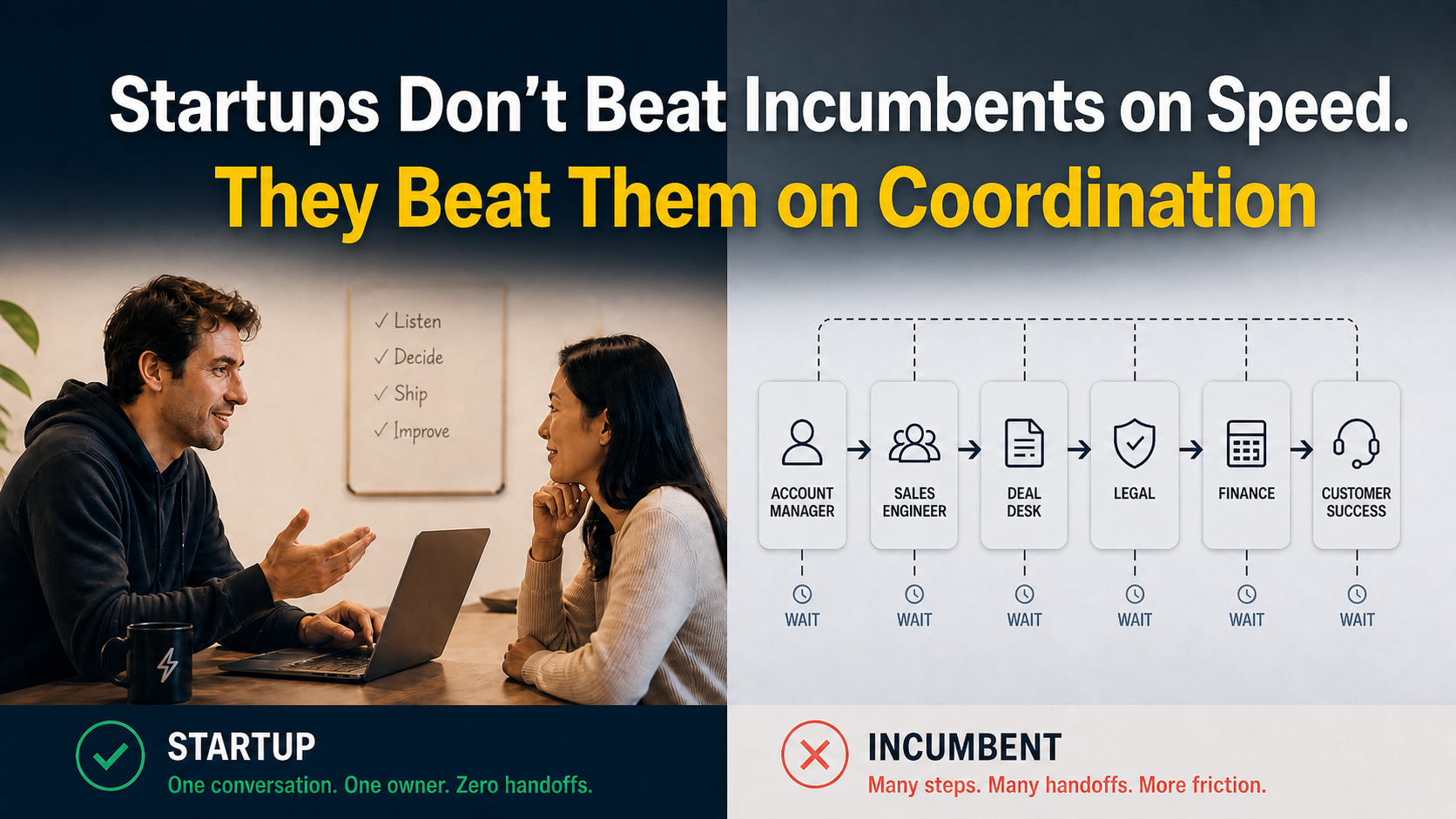
Walk into any early-stage startup and the first thing you notice is how staggeringly inefficient it is.
The founder is taking support calls. The product is duct-taped together in ways that would horrify any competent engineering VP. The pricing changes every third conversation. There is no CRM discipline. Nobody has written the playbook because there is no playbook. And somehow, this company is winning customers that a 5,000-person incumbent cannot hold onto.
Most people explain this with the wrong story. They say startups are faster, or hungrier, or more innovative, or willing to break things. All of that is partly true and none of it is the real mechanism. The real mechanism is that early-stage companies are, by structure, free of the thing that makes incumbents beatable: the coordination burden their customers quietly carry.
Inefficiency Is a Feature, Not a Bug
Paul Graham’s most durable piece of advice to founders is four words long: do things that don’t scale. Most people hear it as permission to hustle. What he actually meant is deeper. You should not optimize a process until you know it is the right process. Optimization before product-market fit is a highway to the wrong destination.
Sam Altman put the same thought this way: it is much easier to build something people want than to build something efficient that nobody wants. Efficiency is the art of removing variance from a known process. If the process is not yet known, efficiency does not help you. It hardens your wrong guesses into infrastructure.
This is why good early-stage founders resist process religiously. They are not lazy. They are protecting their ability to change shape around the customer. Every premature SOP, every early hire for “operations,” every tool purchased before the pattern is proven, is a bet that you already know how to serve the customer. Most of the time, you do not. And once the concrete sets, it is extremely expensive to break.
The efficiency startups do care about is completely different. They are ruthless about capital and time, because runway pressure is real and mortality is close. What they deliberately defer is operational efficiency. Those are not the same thing, and conflating them is one of the most common mistakes new operators make when they arrive from a mature company.
The Real Edge Is Coordination-Freedom
Here is the insight most founders feel but cannot articulate: the startup’s biggest advantage is not speed, it is the absence of internal seams.
When a customer calls a ten-person startup, they are speaking to someone who owns the outcome. No ticket queue. No escalation path. No “let me loop in my colleague.” The founder does sales, onboarding, support, and product feedback in a single conversation. The company can turn around a fix, a price concession, or a product change in the same afternoon because there is no organization in between.
To the customer, this feels like magic. Nothing has to be chased. Nothing has to be repeated. Nothing falls through the cracks, because there are no cracks. The coordination tax they pay to do business with this vendor is zero.
This is the structural advantage that incumbents, for all their scale, cannot replicate. A large company with twenty customer success tiers and a nine-stage deal desk is paying for stability and coverage, but it is forcing the customer to navigate that complexity on its behalf. Every handoff the enterprise adds is a handoff the customer has to manage. Every approval layer is a wait state the customer has to absorb.
Startups do not beat incumbents because they are faster in the abstract. They beat them because the customer pays no coordination tax for dealing with them. That is a different claim, and it points to a different strategy.
The Moment Efficiency Kills the Edge
The dangerous stretch in any company’s life is the one where it starts “maturing.”
The first ops hire arrives. Sales adopts a CRM and begins enforcing stage discipline. Customer success gets tiered. Approval thresholds get formalized. A deal desk appears. Internally, every one of these moves looks like good news. The dashboards improve. The board is pleased. Revenue per employee finally starts climbing.
Externally, something else is happening that nobody is measuring. The customer is starting to wait. The person who used to call them back the same afternoon is now “routing their request to the appropriate team.” The pricing conversation that used to take one call now takes three. Small changes that used to happen in hours take weeks. The experience that was winning them deals is being replaced, piece by quiet piece, with the experience their incumbents were offering all along.
This is how companies lose the reason they were winning. Not through a dramatic mistake, but by installing the coordination burden on themselves and calling it operational excellence.
The discipline required here is not “stay small forever.” You have to scale. The discipline is to be deliberate about which efficiencies you install and which you refuse. Install the ones that reduce internal friction without adding customer-facing seams. Refuse the ones that hand the customer a new layer to navigate. When the two conflict, protect the customer experience and absorb the operational cost. That is the principle most scaling companies get exactly backwards.
The Bottom Line
Startups do not win because they are better companies. They win because they have not yet built anything for the customer to bridge.
That advantage is temporary by default and permanent by design, depending on what you do with it. If you are scaling and your customers are starting to say things like “it used to be easier to work with you,” the efficiency project you are celebrating internally is the reason. The moment you install a process that the customer has to navigate, you have begun recreating the trap you were beating.
Protect the coordination-free experience like it is the product. In most cases, it is.
If your company is scaling and customers are starting to say, “it used to be easier to work with you,” that is not nostalgia. It is signal. The question is which new layers are protecting the business and which ones are killing the edge that made customers choose you. Get in touch and we can work through it together.