
The Pack: Why the People Closest to the Work Usually See the Signal First
July 21, 2026
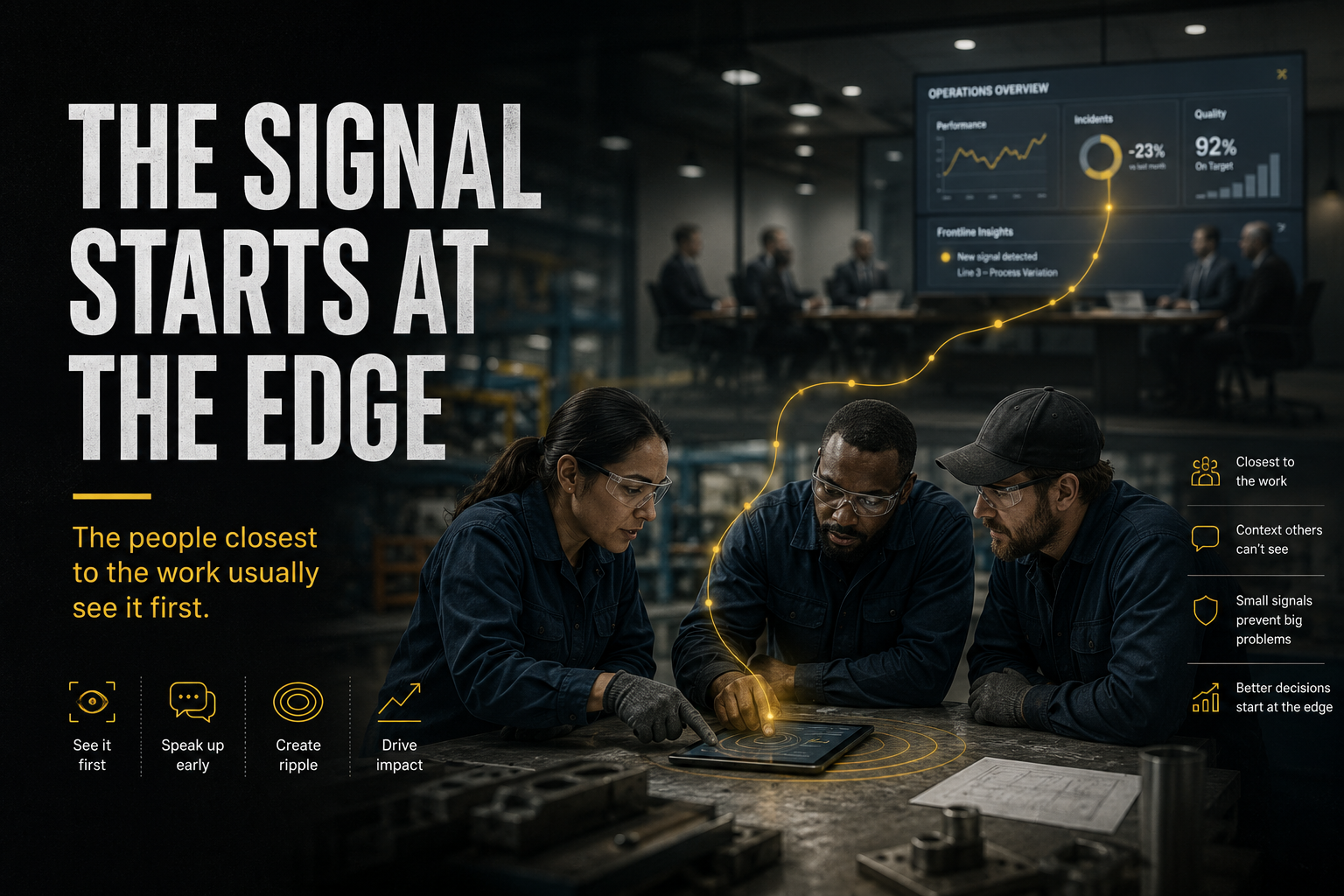
When a customer changes behavior, the change appears somewhere first. It appears where reality meets the work. Not in a dashboard. Not in a monthly review. Not in an executive briefing. It appears with the person who answered the call, with the operator on the line, with the salesperson in the conversation. The question is not whether organizations detect this signal. The question is whether they have designed themselves to hear it. Most have not. And it costs them.
The Executive Dashboard Problem
Information is believed to flow upward in organizations. This is one of the most persistent myths in leadership. In practice, reality usually enters the organization through the edges. Customer complaints reach the support team before revenue reports show a decline. Sales objections surface in conversations before forecasts miss. Operators develop workarounds before quality metrics fall. Vendors signal demand shifts before planners revise their models.
Executive dashboards are valuable, but they are often one step removed from where reality first appears. They convert history into numbers and deliver it upward on a schedule. By then, the moment to respond early may have passed.
The people experiencing the work in real time see signals that dashboards cannot. A customer’s tone changes. A partner’s inventory moves. A process breaks and someone rebuilds it on the fly. These are the moments when variance becomes visible. These are also the moments most organizations suppress the signal rather than amplify it.
Most leaders believe that senior leadership discovers reality and communicates it downward. In practice, reality usually enters the organization first at the edge, where work meets customers, where systems meet people, where promises are tested and trust is earned or lost. The strategic question is not whether signals exist. The question is whether the organization is designed to receive them.
Organizations Do Not Deliver Value. Packs Do.
Every promise made to a customer is fulfilled by a Pack, whether the organization recognizes it or not.
Most organizations think in functions, departments, and reporting structures. Marketing owns brand. Sales owns pipeline. Operations owns fulfillment. Finance owns metrics. But customers do not experience organizations that way. Customers experience a chain of promises. Every promise moves through a series of people, systems, partners, and capabilities that must work together. That series is what EdgeFinder calls a Pack.
What Is a Pack?
A Pack is the smallest complete system capable of keeping a promise. It is not the team. The team operates the Pack. The Pack operates regardless of the org chart.
Consider a new product launch. The Pack includes the engineers who designed it, the marketers who positioned it, the sales team that sells it, the operations team that manufactures or delivers it, the customer service team that supports it, the vendors who supply materials, the partners who distribute it, and the customers who adopt it. Some are employees. Some are external. Some appear on no org chart. All are required. All must move together. That interdependent system is the Pack.
Consider a customer onboarding process. The Pack is not just the onboarding team. It includes the salesperson who set expectations, the implementation team that configures the solution, the support team that answers early questions, the account manager who monitors adoption, the product team that iterates based on customer feedback, and the billing system that tracks the relationship. When one element breaks, the promise breaks. Until all elements move together, the customer experience remains fragmented.
The Pack ignores reporting lines and follows value creation. An operator in manufacturing is part of the customer fulfillment Pack. A contract negotiator is part of the business development Pack. A system architect is part of the strategic infrastructure Pack. The Pack is not defined by who reports to whom. It is defined by what keeps the promise.
This distinction matters because most organizations manage by the org chart. They optimize departments. They measure individuals. They create reporting structures. But the Pack does not respect any of that. The Pack is the system that actually creates value. When the Pack is strong, promises hold and customers are satisfied. When the Pack is weak, individual brilliance does not matter. The promise breaks somewhere.
Why Signals Appear at the Edge First
Variance always appears somewhere first. Most of the time it appears where reality meets the work.
A customer changes behavior before revenue declines. An operator develops a workaround before quality falls. Sales hears an objection before the forecast misses. A vendor signals a capacity constraint before the delivery delay shows up. A support agent notices a pattern in customer questions before the product team sees it in the data.
The people experiencing variance in real time see it before anyone else. They feel it. They respond to it. They often fix it without formally reporting it.
This is not because these people are smarter or more observant. It is because they are proximate. They are in the conversation. They are operating the system. They see the moment when reality deviates from design. They see it first because they are where the signal originates.
The Pack feels reality before leadership measures reality. This is the strategic advantage that most organizations waste.
A manufacturing operator sees a trend in machine behavior that will cause a breakdown three weeks from now. A frontline sales agent hears three customers in a row ask about a competitor’s feature. A support team member notices that customers are calling with the same question over and over. These are signals. They are also actionable intelligence. They are also where adaptation usually begins.
Organizations that treat these signals as information to suppress, ignore, or delay reporting waste the one advantage they have: early warning. Organizations that treat these signals as the primary intelligence they receive gain adaptation cycles. They move faster. They adjust before the market forces them to.
The Front of Pack and Back of Pack
Every Pack has a front and a back. These are not departments. They are positions relative to the work being done.
The Front of Pack is where the customer experience is tested. Where the promise is kept or broken. Where trust is earned or lost. Examples include the sales team in a customer conversation, the operator executing a manufacturing line, the support agent answering a question, the service team implementing a solution. The front is proximate to reality.
The Back of Pack is where capacity, integrity, and continuity are built and maintained. It includes the teams and systems that enable the front to execute. Finance, HR, IT, planning, governance, infrastructure. The back is often invisible to customers, but it sets the sustainable pace for everything the front can do.
Most organizations overmanage the back and underlisten to the front. They create elaborate governance, process, and reporting structures aimed at the back of the Pack. Compliance committees, budget reviews, project management offices, quality gates. These serve a purpose. They ensure that capacity is available and integrity holds.
But the front is where variance appears first. And the front is usually the least heard in leadership discussions. An operator reports a workaround and is told to follow the documented process. A customer service agent reports hearing similar complaints and is told that product changes take quarters to implement. A salesperson reports that customers are asking for a different capability and is told that the roadmap is locked.
The organizations that move faster are the ones that have inverted this. They listen hard to the front. They treat the front as the primary sensing system. They treat the back as the system that supports what the front needs to do, not the other way around.
Why Organizations Miss Signals
Signals are not absent. Organizations are designed to suppress them.
Not deliberately. Not with malice. Organizations suppress signals through patterns of thinking and behaving that made sense at some point and have calcified into assumptions. Common suppressors include:
Success Bias
“We’ve seen this before.” When an organization has been successful, it learns to trust the approaches that worked. When a signal appears that suggests change is needed, success bias leads the organization to interpret the signal as noise. “The last time market conditions shifted, we adjusted pricing and it worked fine. This will too.” Confidence born of success becomes blindness to change. The organization keeps doing what worked before until it stops working.
Hierarchy Bias
“That person is too junior to be right.” A frontline employee brings a signal. It contradicts what senior leadership believes. Rather than investigating the signal, the organization dismisses it based on the rank of the person who reported it. Hierarchy bias assumes that authority correlates with accuracy. But the operator on the line sees reality more clearly than the executive in the meeting. When hierarchy bias is strong, the most accurate signals are the ones least likely to be heard.
Metric Bias
“It isn’t in the dashboard.” An operator reports a pattern that is not yet visible in formal metrics. A customer service team reports hearing concerns that have not yet turned into complaints. A sales team reports sensing hesitation that has not yet shown up as lost deals. Metric bias trusts only what can be counted and reported. But signals always appear before they are visible in metrics. By the time something shows up in the dashboard, the opportunity to adapt early has passed.
Cultural Scars
“Last time someone raised a concern, it hurt their career.” An organization has a history of rewarding loyalty and punishing dissent. When an employee brings a signal that suggests something is not working, the organization’s response is to blame the messenger. The employee learns that raising concerns is dangerous. The next signal gets suppressed. The one after that does not surface at all. The organization loses not just one piece of information. It loses access to all future information from that person and anyone who witnessed what happened to them.
Each of these patterns is self-reinforcing. They protect the organization against uncertainty. They also cut it off from reality.
The Pack as a Sensing System
Most leaders think of organizational sensing as technology, analytics, or dashboards. They invest in more sophisticated data collection, more advanced AI, more frequent reporting. These serve a purpose. But they are not the organization’s primary sensing system.
The organization’s primary sensing system is the Pack.
The people closest to the work observe variance before systems record it. They experience friction before processes document it. They notice anomalies before algorithms detect them. They feel shifts before metrics confirm them. This is not mystical. This is proximate to reality.
When a customer’s objection pattern shifts, the salesperson hears it in the conversation. When a manufacturing process begins to drift, the operator sees it in the equipment. When customer frustration is building, the support team feels it in tone and word choice. These observations are real signals. They are also the most time-sensitive intelligence available.
The problem is that most organizations treat the Pack as a subordinate source of information. The real data comes from systems and dashboards. The Pack is anecdotal. The Pack is incomplete. The Pack is biased. These judgments are sometimes true. But they also guarantee that the organization will be slow to adapt. By the time the Pack’s signals make their way into a formal system and up to leadership, the advantage of early detection has been lost.
Organizations that treat the Pack as the primary sensing system see it differently. Yes, the signals are incomplete. So the organization learns to triangulate. Yes, they are sometimes biased. So the organization learns to listen for patterns across multiple voices, not individual opinions. Yes, they are sometimes wrong. So the organization learns to test signals rather than overcommit to them. But the organization that hears the Pack remains connected to reality in ways that data systems alone cannot provide.
Why the Pack Needs a Shared Language
Even if the Pack sees the signal, can the organization understand it?
A manufacturing operator reports “the equipment is acting strange.” How strange? In what way? Is this a maintenance issue, a design problem, or a demand signal? Different diagnoses lead to different responses. Without a shared language, the operator’s signal becomes subject to interpretation and argument rather than action.
A support team reports “customers are asking about a different feature.” Is this a product gap, a positioning problem, or a competitor threat? Again, the signal means different things depending on how the organization frames it. The signal gets lost in debate about its meaning.
This is where the EdgeFinder diagnostic language becomes useful. EdgeFinder recognizes that organizations see variance in different ways and calls the difference by type. When a manufacturing operator says the equipment is “acting strange,” the question becomes: Is this an Operational Variance (how the work flows vs. how it is designed to flow), a Market Variance (something changing in customer demand or competition), or a Pattern Variance (changes in rhythm and timing that signal deeper stress)? When the support team reports on customer questions, the question becomes: Is this a Behavioral Variance (unexpected patterns in how people act), a Market Variance (shifts in customer preference), or a Strategic Variance (misalignment between what was promised and what is being delivered)?
The Pack provides the observation. Diagnostic language provides the precision.
When a leadership team walks into a room to discuss a signal, everyone has a different read. One person believes it is an execution problem. Another sees a market shift. A third thinks the strategy is wrong. Without a shared way to name what they are seeing, the first hour is spent debating the problem rather than solving it. With diagnostic language, the team can align quickly on what kind of signal they are looking at and move to the question that matters: What move should the organization make?
This is not about perfect diagnosis. It is about speed. It is about moving from “we see something” to “we agree on what kind of something” to “what should we do about it” without spending weeks in debate.
The Strategic Advantage of Listening Earlier
The goal is not merely better communication. The goal is earlier adaptation.
Organizations that detect change earlier adapt earlier. They learn earlier. They act earlier. This compounds.
A competitor launches a new feature. All organizations in the market eventually see it. The organizations with strong Packs hear about it from customers and partners weeks or months before it becomes visible in market share. They have time to understand it, test responses, and adjust. They move while response is still possible.
A customer’s priorities shift. All organizations lose the deal eventually. The organizations with strong Packs hear the shift in conversations with the sales team. They understand that the problem is not the product but the customer’s changed needs. They adjust scope, pricing, or approach. They keep the customer. The organizations with weak Packs discover the shift when the deal is lost. They move too late.
A regulatory environment begins to change. All organizations will eventually have to comply. The organizations with strong Packs hear from legal teams and customer advisors that pressure is building. They shape their response before compliance is forced. The organizations with weak Packs discover the requirement when the deadline arrives.
Competitive advantage belongs to the organization that hears reality first. Not because the reality is different. But because the time to respond is different. The organization that detects change earlier has more runway. More runway means more options. More options means better choices.
This advantage is not mysterious. It is structural. It comes from treating the Pack as a sensing system rather than a reporting hierarchy. Related Video: What Is Your Business Growth Strategy?
Conclusion: The EdgeFinder Principle
Most organizations believe leadership discovers reality and communicates it downward. This is the logic of the org chart. The CEO knows what is happening. The CEO tells the executives. The executives tell the managers. The managers tell the frontline. Information flows downward. Everyone gets aligned.
In practice, reality usually enters the organization the other direction. The frontline experiences change first. The Pack feels the variance first. The question is not whether the signal exists. The question is whether the organization is designed to hear it.
Organizations that treat the Pack as a primary sensing system discover opportunities, threats, and emerging patterns while response is still possible. They adapt before the market forces them to. They learn from early signals and build responses that compound advantage.
Organizations that ignore the Pack often discover the same signals later, after they have become problems. A market shift becomes a crisis. A customer need becomes a lost deal. A process breakdown becomes an operational incident. By the time leadership sees it, the moment to respond early has passed.
The difference between the two is not intelligence or luck. The difference is design. It is the choice to listen to the Pack or ignore it. It is the choice to treat signals from the edge as noise or as information. It is the choice to suppress the Pack or to amplify it.
Sustained competitive advantage belongs to the organization that hears reality first. And reality lives where the work is done.
How is your organization listening to the Pack right now? What signals might you be missing? Get in touch and let’s discuss what a Pack-centered sensing system could change about your competitive position.