
The FDA Isn’t a Gatekeeper. It’s Infrastructure.
May 28, 2026
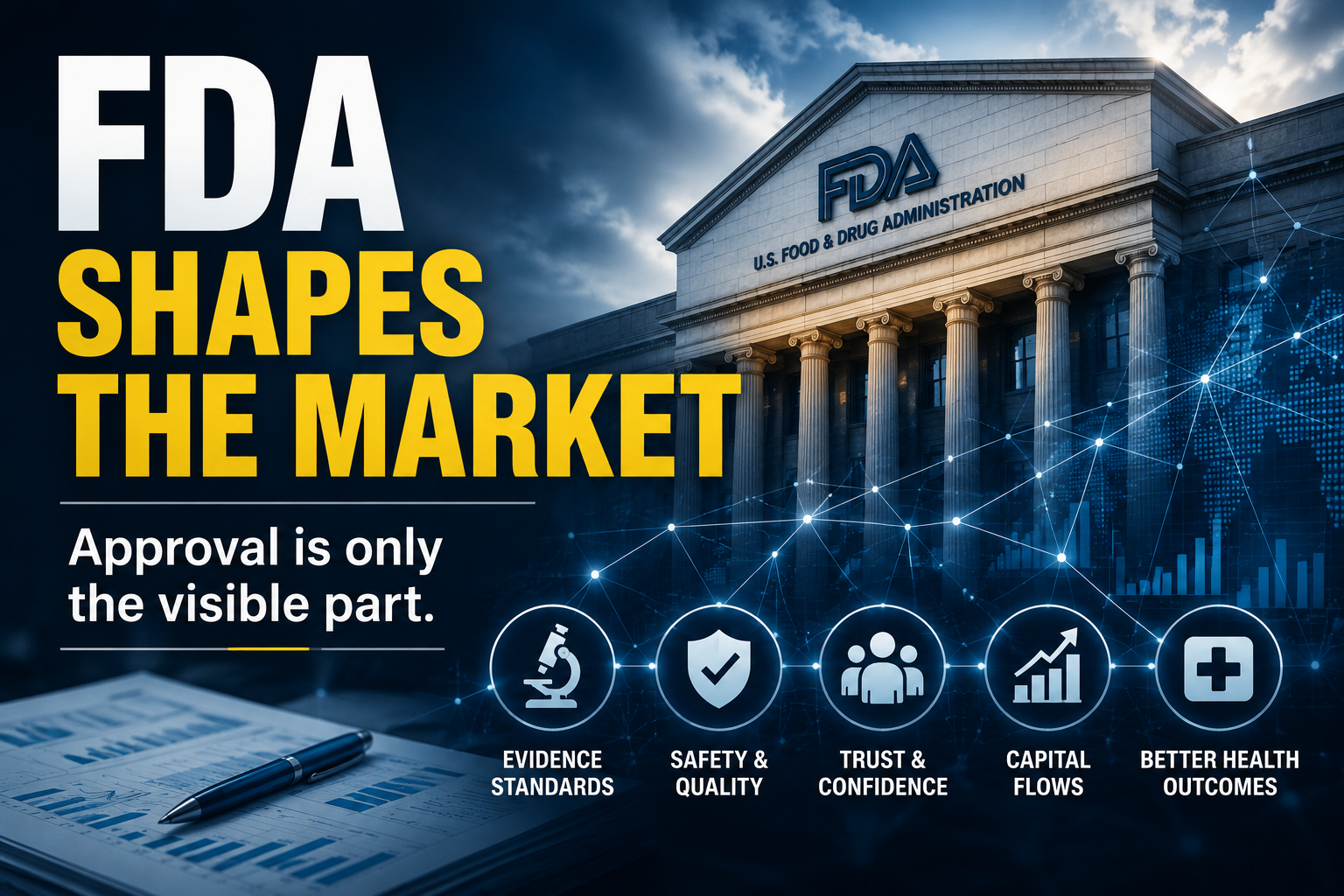
We talk about FDA the way we talk about a velvet rope. Approved or not. In or out. Pass or fail.
That framing is convenient. It is also wrong.
FDA does decide what comes to market. But the bigger truth is that FDA functions as infrastructure for the entire health system. It shapes how evidence is built, how risk is priced, where capital flows, and which kinds of innovation become economically possible in the first place. The approval letter is the visible part. The deeper effect is structural.
If you only see the gatekeeper, you miss the architecture.
Infrastructure That Closes the Information Gap
Markets fail when buyers cannot tell good products from bad ones. In healthcare, that information gap is enormous. A clinician cannot run a private pivotal trial before prescribing. A patient cannot inspect a sterile barrier or read raw manufacturing records. A hospital cannot audit a machine-learning model for bias on its own.
FDA closes that gap by setting a public standard. It defines what evidence counts, what manufacturing controls are acceptable, what labeling must disclose, and what postmarket reporting is required. The output is not just a yes-or-no decision. It is a shared baseline that lets everyone else (payers, providers, patients, investors) make their own calls with less uncertainty.
That work is unglamorous and easy to overlook. It is also what lets the rest of the system function. Without FDA, every prescription, every device deployment, every diagnostic result would carry a risk premium that most patients could not pay and most providers could not justify.
Infrastructure That Shapes the Flows
Infrastructure does more than enable. It also directs.
Roads decide which neighborhoods grow. Power grids decide which industries are viable. FDA, in the same way, decides where healthcare capital and effort can flow. Three flows are worth naming:
- Costs. Evidence requirements set the floor for what it takes to bring a product to market. A drug with a hard outcomes trial costs hundreds of millions. A 510(k) device leveraging a predicate is dramatically cheaper. Those cost contours decide which conditions get attention and which get neglected.
- Investment patterns. Venture and corporate capital follow regulatory paths. Breakthrough Device designation, fast-track, accelerated approval: each one is also a market signal that pulls dollars toward specific categories. The 24% of 2025 novel drug approvals that received accelerated approval is not just a regulatory statistic. It is a map of where capital concentrated.
- Innovation direction. When FDA published its first AI/ML guidance, it did not just clarify a process. It told an entire ecosystem that this was a category worth building in. When the LDT rule was vacated, the diagnostics field absorbed a different signal entirely. Regulatory clarity, or its absence, is one of the most powerful inputs into what gets invented.
This is the part most strategists underweight. FDA is not just deciding which products win or lose. It is shaping the pipeline of what gets attempted at all.
How to Build Strategy Around Infrastructure
If FDA is infrastructure, the strategic implications change. A few practical shifts follow:
- Read FDA’s roadmap as a market signal. Guidance documents, public meetings, and pilot programs like TEMPO, TCET, and the AI/ML action plan tell you where the system is steering. Companies that read those signals early help shape categories instead of reacting to them.
- Plan for the cost contour of your pathway. A 510(k) and a PMA are not just different forms. They are different economies, with different investor expectations, timelines, and competitive dynamics. Pick deliberately.
- Treat user-fee funding as a structural fact. FDA’s FY 2026 budget of $6.8 billion, with more than half from industry fees, ties the agency’s capacity directly to the industry it regulates. That coupling shapes review pace and program priorities, which is why every PDUFA and MDUFA reauthorization is consequential.
- Watch the infrastructure boundary. LDT oversight, AI guidance, device cybersecurity, real-world evidence standards. These are not edge cases. They are the agency expanding or retreating from infrastructure roles, and each shift reshapes a market.
Companies that treat FDA as a wall to get past keep getting surprised. The ones that treat it as infrastructure plan around it the way good builders plan around utilities: understanding capacity, anticipating upgrades, and routing around constraints.
The Bottom Line
A gatekeeper says yes or no. Infrastructure shapes what is possible.
FDA does both, and the second job is the more important one. It is the reason American healthcare has a functioning information layer, and it is also the reason capital, talent, and innovation flow in the patterns they do. Treating the agency as a hurdle to clear obscures the more useful question: what is FDA building, and how does my strategy work with that grid?
Once you start reading the agency that way, every guidance document, advisory committee decision, and public meeting becomes a market signal. And the kind of company you choose to build looks different.
Curious how the infrastructure lens applies to your portfolio or category? Get in touch and let’s map the regulatory architecture against your strategy.