
The Efficiency Trap: Why Doing Everything Right Isn’t Enough
April 27, 2026
Here is a question that makes most operating leaders uncomfortable: if you are doing everything right, why isn’t the market moving toward you?
You have standardized the process. You have rolled out the new software. You have cut the handling time, trimmed the cost stack, and run the belts through three waves of training. The dashboards are greener than they were a year ago. And yet. Your pipeline looks the same. Your win rate has not improved. Your customers still stall at the same friction points they always have.
This is the efficiency trap, and most enterprises walk into it with their eyes open. The assumption is seductive: if we get better inside the walls, the market will reward us outside them. It rarely does.
Efficiency Is Not Advantage
Internal improvements, by themselves, almost never move a customer. That statement sounds wrong the first time you read it. Of course a faster process is better. Of course a cleaner handoff is better. Of course a lower unit cost is better. But better for whom?
Efficiency is a tax you stop paying yourself. It is not a gift you hand to a buyer.
The tools that drive most of today’s productivity gains are not proprietary. Your competitors can license the same software, hire from the same talent pools, and read the same consulting deck you just bought. If the only thing separating you from them is execution on shared playbooks, your advantage has a shelf life measured in quarters, not years.
What actually differentiates the winners is not the tool in their hands. It is the organizational belief that shapes how the tool gets used. Two companies can buy the same CRM and build two entirely different customer experiences from it, because one treats it as a reporting asset and the other treats it as a commitment engine. The software is identical. The belief is not. The belief is the edge.
Improvement Is Scored by the Customer, Not the Org Chart
Here is the second move in the trap. We measure our improvements in isolation, but customers score them in context.
You can cut your response time by 40 percent, which is a genuine internal accomplishment, and still lose the deal, because your three competitors also cut their response times in the same window. The customer does not experience your forty percent. The customer experiences a category-wide acceleration and simply expects faster response now as table stakes.
Leaders get stuck here. They have a room full of metrics that all moved in the right direction, and they cannot figure out why the market has not moved with them. The answer is almost always that they are improving in isolation when customers are evaluating them relative to alternatives. Excellence in a vacuum is invisible.
This is why “we are better than we were last year” is a dangerous sentence in a strategy meeting. The only comparison that matters is the one the customer is doing in their head the moment they pick a vendor, renew a contract, or close the browser tab.
Reduce the Coordination Burden
If the efficiency trap is the problem, the coordination burden is where most of the real advantage actually lives, and almost nobody is measuring it.
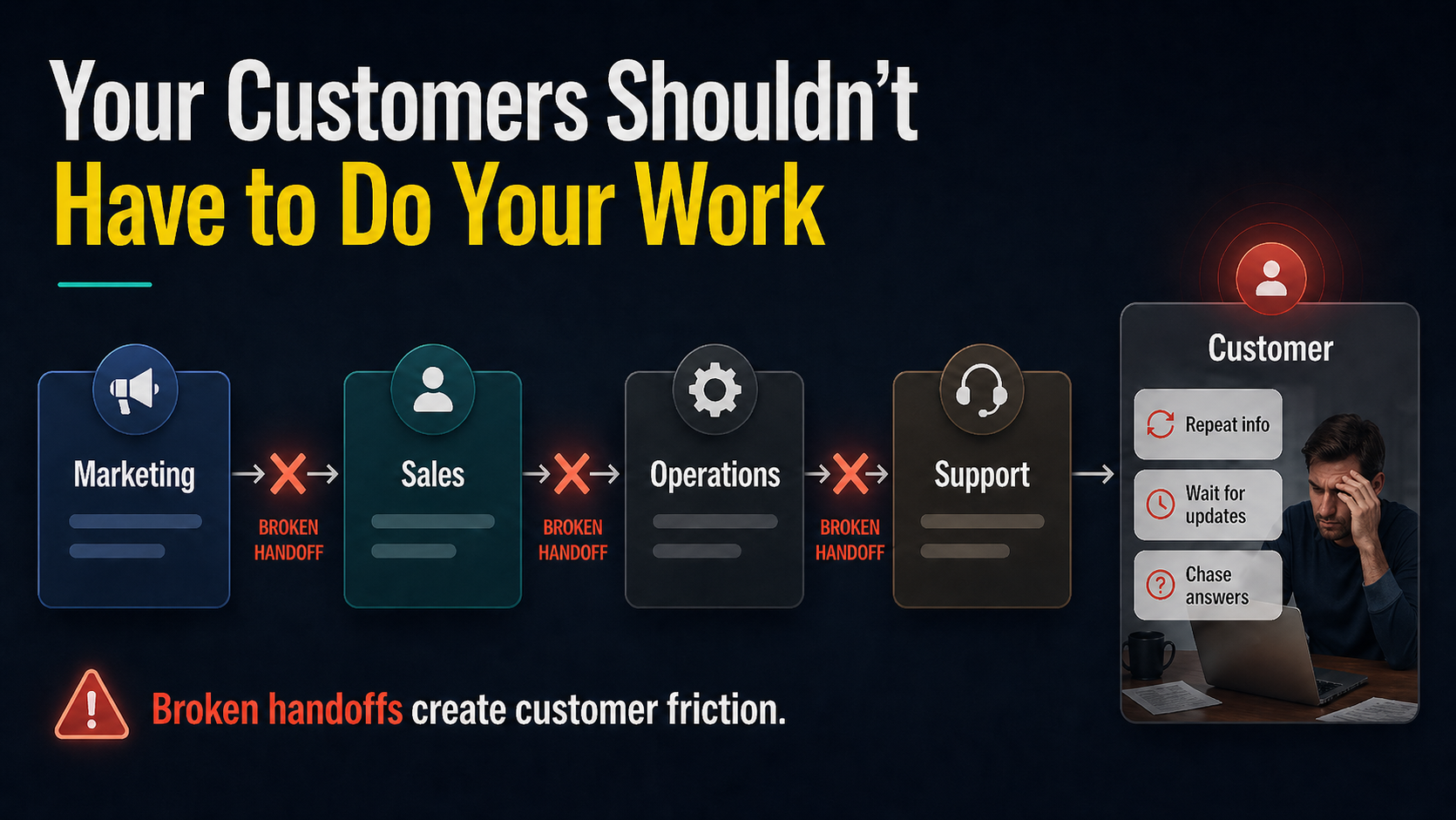
Every time a customer has to manage your internal disconnects, they pay a tax. They chase the update that should have come automatically. They repeat information across three of your teams. They become the project manager of their own purchase. They build workarounds because your systems do not talk to each other. This is coordination the customer is doing for free, on your behalf, and it is the quiet killer of trust.
Three patterns are worth watching:
- Customer coordination. When internal handoffs fail, customers bridge the gap. Every bridge they build is a signal that you have outsourced your operations to them.
- Trust erosion. Every follow-up a customer is forced to initiate is a small withdrawal from the trust account. The balance is invisible until the renewal conversation.
- Silent switching. Customers rarely tell you they left because of coordination pain. They tell you a competitor had a better price, a better feature, a better rep. Underneath, they left because you made them work too hard.
Advantage grows when fewer explanations and follow-ups are required. That is the sentence I keep coming back to. A customer who does not have to chase you, translate for you, or manage your internal seams is a customer who chooses you again without thinking about it. Loyalty is often just the absence of coordination pain.
The operational efficiency you fought so hard to win becomes an advantage only when it is translated into a seamless experience the customer can trust without maintenance.
The Bottom Line
Competitive advantage is not what your operation does for itself. It is what your operation stops asking the customer to do.
Efficiency that never reaches the buyer is an accounting win, not a strategic one. The enterprises pulling ahead right now are not running better tools. They are running the same tools with a stronger belief, measuring their improvements relative to the market, and ruthlessly removing the coordination burden their customers have been silently carrying. That combination is what turns operational gains into durable advantage.
If your customers still have to do your work, you do not yet have an edge. You have overhead they are politely absorbing, for now.
If your customers are still chasing updates, repeating information, or managing your internal seams, the issue may not be service quality. It may be coordination burden. That is one of the first places I look when helping leaders find where advantage is leaking. Get in touch and we can map it together.