
The Denials Your Enterprise Isn’t Counting
June 29, 2026
I recently wrote about denied insurance claims as the overlooked revenue lever in physician practice economics. The numbers are striking: one in ten claims denied, 60 to 70 percent recoverable with the right tools, a 7 percent revenue lift sitting inside the backlog, and most practices never work.
The piece landed with startup founders and practice owners, which was the point. But the pattern it describes is not unique to claims. It is not unique to billing. It is not even unique to healthcare.
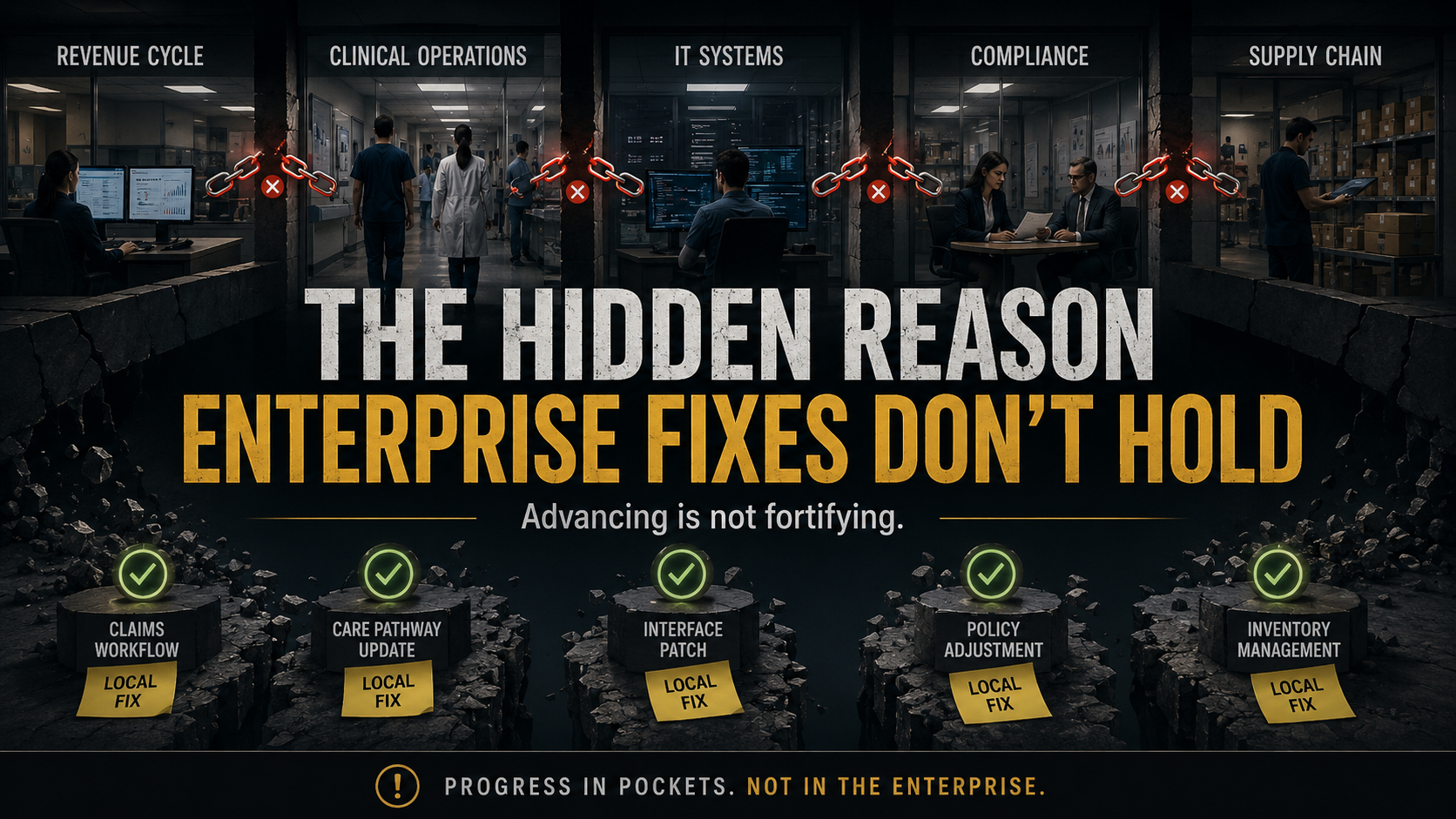
Every enterprise has denial piles. Most of them are not on the accounts receivable aging report. They are scattered across the organization: a safety protocol that works in one unit and has never been adopted in the other nineteen. A scheduling change that cut no-show rates in one clinic and never crossed the parking lot. An onboarding fix that five departments independently rediscovered over three years. A supplier exception that operations caught and fixed last quarter, while procurement was solving the same problem in a different spreadsheet.
Those are denials, too. The enterprise is just not counting them that way.
This is where the EdgeFinder lens matters most.
The Pack Is Not Your Org Chart
Imagine your VP of Clinical Operations closes an agreement with a major health plan to pilot a new care-coordination model. The pilot works. The next step is system-wide rollout, and it stalls. Three functions are coordinating. Each has its own sense of what matters. Each is waiting on a different handoff. The executive sponsor is frustrated because the thing worked last year.
That is not an execution problem. That is a Pack problem.
The Pack is the smallest set of interdependent capabilities and handoffs that must move together to keep a promise to a patient, a partner, or an internal customer. The Pack is not the team. The team operates the Pack. The Pack is also not the org chart. Two executives who report to different leaders can be in the same Pack on a given move, and two people in the same department can be in different Packs on different moves.
I use the Pack as a diagnostic object, not an organizational prescription. When a fix does not hold under pressure, the Pack boundary was drawn wrong or the handoffs inside it were not designed to stay coherent when the pace picked up. In a health system, Pack boundaries cross revenue cycle, clinical documentation, IT, compliance, and care coordination all the time, and nobody owns the Pack explicitly. That is why fixes succeed locally and fail organization-wide.
A denied claim is a Pack signal. A sepsis-bundle adherence gap is a Pack signal. A deferred-maintenance backlog is a Pack signal. They all tell you something about whether the interdependent capabilities that must move together are actually moving together.
The Real Problem Is Find and Advance Without Fortify
Think about a home inspection. You find a leaky lead pipe in the basement. You fix the leak. Do you then check whether the rest of the house has lead pipes? Because if you do not, the same problem is still waiting in the walls, and it is affecting your long-term health whether you can see it or not.
That is the shape of Find, Advance, Fortify.
- Find is the discipline of slowing down to look at what is actually happening in the organization: where things have drifted, where gaps have opened, where the next opportunity or threat lives.
- Advance is doing something about it: committing resources, choosing a direction, and acting on what was found.
- Fortify is making sure the entire organization adopts the advance so you never have to go back and do it again. It is thoroughness, speed, and closure. Fortify turns a local fix into an organizational standard so the whole system moves forward together, not as disconnected parts solving the same problem on their own time.
The primary failure mode in enterprises is not missed detection. It is not weak decision-making. It is Find and Advance without Fortify.
A pilot succeeds. The scale-up does not. A best practice is identified. It is never institutionalized. Three different teams are quietly running versions one, two, and three of the same solution for the same underlying Pack signal. The leaky pipe was fixed in the basement. The rest of the house was never checked.
This is why many enterprises feel busier than ever and less coherent. The organization is constantly finding and advancing. It is not fortifying. Every incomplete cycle spends a little more trust with the workforce, the vendor base, and the customer. That is how advantage decays quietly, long before the financials reflect it.
The Enterprise Move Is Not a Single-Payer Campaign
In the practice-scale piece, I suggested a simple action: pick the payer with the highest denial rate, run a 30-day structured appeal campaign, and watch the pattern shift. That is the right move at practice scale.
At enterprise scale, the move is different. The enterprise does not lack appeal campaigns. It lacks Fortify.
The enterprise action is this:
1. Pick one Pack that must hold under pressure.
Something promise-critical: revenue cycle, medication reconciliation, surgical scheduling, payer contracting, patient discharge. Name the recipient of the promise explicitly.
2. Walk the Pack end to end, not the departments.
Follow the handoffs across functions. Mark every place where one team has already Found and Advanced on a variance without that gain being Fortified across the rest of the system.
3. Pick one variance and Fortify it fully.
Not ten. One. Make the change the standard across every unit that touches that Pack. Design the change for adoption, not for a pilot report.
4. Measure the speed and durability of the Fortify step, not the Find step.
Most enterprises are already fast at Find. The lagging capability is Fortify. That is where the muscle needs to be built.
Do that once with intent, and the organization learns something a consulting deliverable cannot teach: what it feels like to close a cycle fully. Once a team has felt it, the pattern becomes repeatable.
The Bottom Line
Enterprises do not lose competitive advantage because they cannot Find. They lose it because they Find and Advance repeatedly, and never Fortify. The result is a hundred denial piles scattered across the operation, each one a small gain that never became an organizational standard.
Your enterprise is already doing the hard work. The question is whether the gains are being made to hold.
Want to walk your enterprise Pack with an outside lens? Get in touch, and let’s look together at where the gains are being found but not fortified.