
Strategic Meta Skills: The Capabilities Required to Execute Mission in a Changing Environment
August 12, 2026
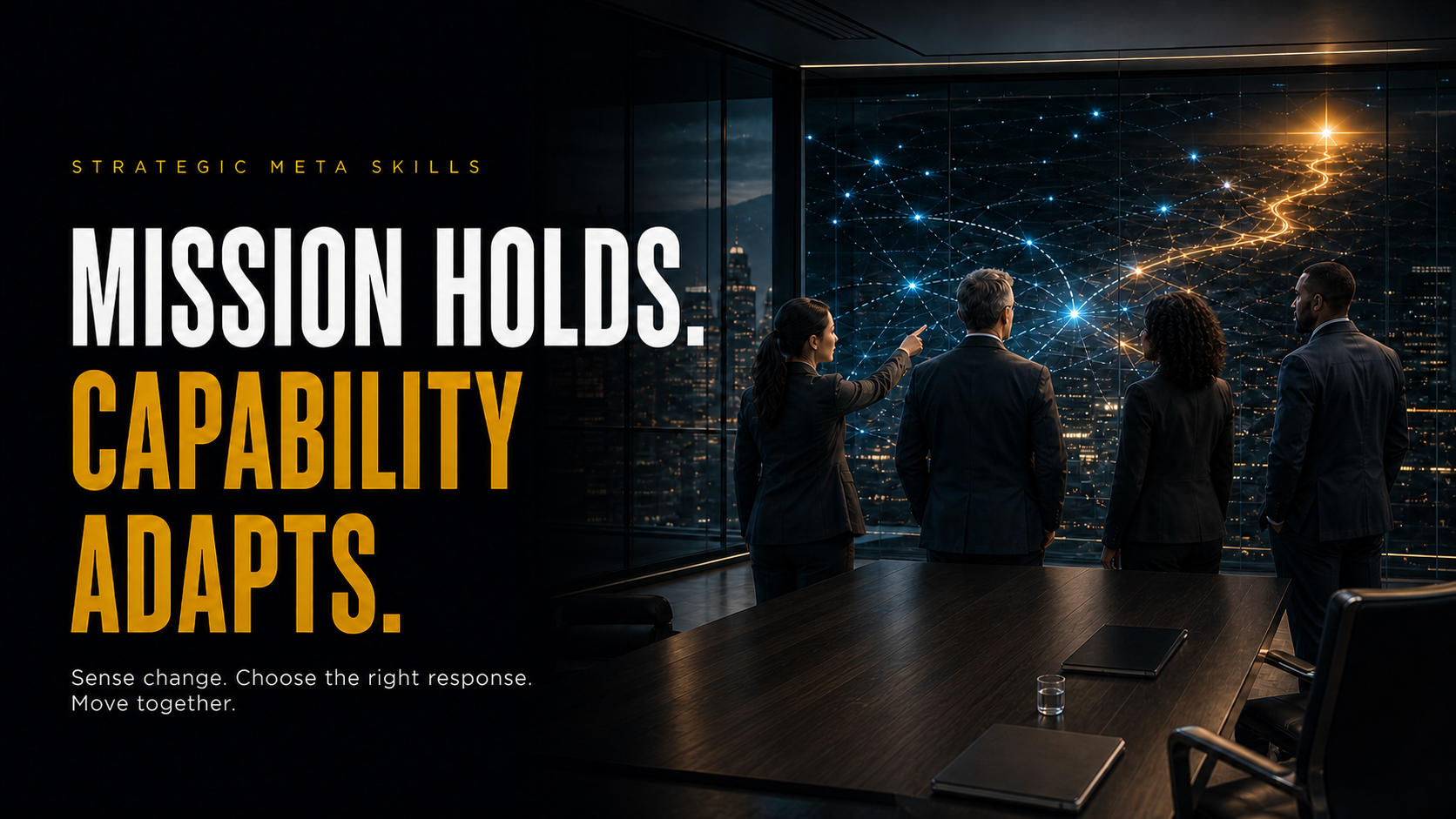
The Capability Gap Nobody Talks About
Organizations invest heavily in technical skills, leadership development, and functional expertise. They hire talented people. They send them to training programs. They build clear strategies.
And execution still fails.
Not because the people lack intelligence. Not because the strategy is wrong. The failure happens because capability is often designed for stable environments. The organization knows what problems to solve and how to solve them. The playbook works until it doesn’t.
Competitive advantage requires a different class of capability. It requires the ability to sense what is changing, interpret what matters, design responses that work, and align the organization around them. These capabilities must operate in uncertainty. They must work when the environment shifts and the old answers no longer fit.
This is the gap most organizations do not see until they are already losing.
Why Knowledge Is Not Capability
There is a critical distinction that most organizations miss. Knowing something is not the same as doing something. Doing something once is not the same as repeating it. Repeating something is not the same as adapting it when conditions change.
Organizations often mistake knowledge transfer for capability development. They document the process. They train people on it. They assume the capability now exists.
But capability is the ability to act coherently under pressure and at pace. It is muscle memory at the organizational level. It requires practice. It requires rhythm. It requires the system to work together, not just individuals understanding what to do.
When an organization tries to execute a new strategy without building the capabilities to sustain it, the strategy becomes a plan that sits on a slide. People understand it intellectually. But when real-time decisions need to be made, when priorities conflict, when resources are constrained, the organization defaults to the old patterns because the new capability does not yet exist in their muscle memory.
This is not a failure of intelligence. It is a failure of organizational development.
Why Traditional Skills Are Not Enough
Traditional skill development assumes a stable environment. It assumes:
- Problems are known
- Answers are knowable
- Processes are repeatable
But variance—signal from the environment that things are changing—creates a different condition:
- Uncertainty: The problem may not be what it appears to be
- Ambiguity: The data tells multiple stories
- Conflicting signals: Different parts of the organization are seeing different things
When variance creates these conditions, traditional skills designed for stable environments become insufficient. The organization needs capabilities that allow it to sense clearly, interpret intelligently, and respond coherently in uncertainty.
This is what separates organizations that sustain competitive advantage from organizations that win once and then drift.
The Adaptive Organization
Organizations that sustain advantage operate differently. They understand that the environment will shift. Markets change. Customer needs evolve. Competitors respond. The mission—the fundamental promise the organization makes—remains constant, but the way to deliver on it must adapt continuously.
Mission provides direction. Adaptive capability provides the ability to adjust and still reach that direction even as the landscape changes.
Without clear mission, organizations become confused about what matters. Without adaptive capability, organizations become rigid. They cannot move quickly enough. They cannot learn from variance. They become vulnerable.
The organizations that sustain advantage have both: a mission that holds and a set of capabilities that allow them to sense, interpret, and respond to change while keeping that mission intact.
Strategic Meta Skills: The Capability System
Strategic Meta Skills are the capabilities that allow individuals and organizations to operate effectively when conditions change. They are not technical skills. They are not job-specific expertise. They are not industry knowledge.
They are meta-skills: capabilities that improve how all other capabilities are applied.
When an organization develops Strategic Meta Skills, it changes the entire system. Technical skills become more valuable because the organization can apply them intelligently to emerging problems. Leadership becomes more effective because leaders can sense and interpret signals together rather than in isolation. Functional expertise becomes adaptive because the people who have it can design solutions built for organizational adoption rather than solutions that sit in documents.
Strategic Meta Skills are the human and organizational capabilities required to operate the EdgeFinder philosophy. They are not a methodology. They are the muscle that allows an organization to find, interpret, and respond to emerging variance repeatedly. When these capabilities are present, an organization can sense what is changing, decide how to respond, design solutions that work, and move together without losing coherence.
The five Strategic Meta Skills work together. Sensing detects what is changing. Tuning and Innovation are distinct capabilities: the capability to optimize within existing systems, and the capability to transform when the current system no longer works. Fusing synthesizes insights and designs solutions built for adoption. Resonance builds organizational alignment to execute. Together, they create the adaptive muscle that allows an organization to keep its mission intact even as the conditions around it shift.
The Market Gap: Why SMS Is Different
Most organizations invest in technical skills. Engineering, finance, operations, sales. They spend heavily here.
Some organizations invest in leadership skills. Strategy, decision-making, delegation, emotional intelligence. This is rarer, but it happens.
Very few organizations systematically develop adaptive capabilities. The ability to sense emerging signals. The judgment to decide between optimization and transformation. The skill to synthesize insights and design solutions for organizational adoption. The capacity to build collective alignment around change.
That gap is where Strategic Meta Skills exist. Not as a training program, but as the missing organizational capability that separates organizations that sustain advantage from organizations that lose it.
This is why SMS is different from every other training initiative. Technical skills improve specific work. Leadership skills improve the people who lead. Adaptive capabilities improve how the organization responds to change itself. And that is the capability that matters most in uncertainty.
The Five Strategic Meta Skills
Sensing: Detect and Interpret Meaningful Variance
Sensing is the capability to detect and interpret meaningful variance before it becomes visible failure.
Organizations receive thousands of signals every day. Most are noise. Sensing teaches the organization to recognize patterns that matter. It is not about gathering more data. It is about learning to read the data already available.
When Sensing operates, an organization recognizes that a small change in customer behavior might signal a larger shift in market preference. It sees that a pattern of operational variance in one function might indicate a structural problem in how work is designed. It notices that behavioral shifts in key leaders might signal misalignment in strategy that has not yet become visible as business failure.
Without Sensing, organizations become blind. They see the failure when it reaches the market, not when it first emerges as signal.
Tuning and Innovation: Choose the Right Response
Once variance is sensed, the organization must decide how to respond. This decision point determines whether the organization will deploy Tuning or Innovation.
Tuning is the capability to optimize and refine existing systems. The current approach can handle this. It just needs to be better, faster, or more aligned. The organization has the capability to respond. What is needed is discipline and execution.
Innovation is the capability to transform when the current system no longer works. Variance is telling the organization that the old model is no longer viable. A new approach is required. The organization must build new capability, not optimize the old.
The organizations that sustain advantage have both capabilities. They know how to optimize what works. They know how to transform what doesn’t. The quality of the decision—which capability to deploy—determines whether the organization will marginally improve or fundamentally shift. Organizations that tune when they need to innovate gradually make their problem worse. Organizations that innovate when they need to tune disrupt systems that just needed refinement.
Fusing: Design Solutions for Adoption
Fusing is the capability to synthesize insights, detail plans, war-game scenarios, and design solutions that can be woven into the organizational fabric.
The defining characteristic of Fusing is this: it creates solutions built for organizational adoption from the start, not recommendations that need to be retrofitted for implementation.
When Fusing operates well, the solution is already integrated into how work flows. It is not separate from the organization. It is part of the organization. This is what makes Resonance possible.
Resonance: Build Organizational Alignment
Resonance is the capability to build organizational alignment so the response is executed collectively. Strategy is not effective until it resonates. Resonance turns strategy into shared conviction and movement so teams anticipate each other and act together without constant top-down coordination.
When an organization has Fusing and Resonance, a decision made at the center does not require constant reinforcement. The organization understands why the decision matters. Teams coordinate with each other. The response moves through the system with coherence.
Why Meta Skills Create Leverage
The power of Strategic Meta Skills is this: they improve all work, not just specific work.
Technical skills improve performance in a specific domain. If you develop better engineering skills, engineering improves. If you develop better sales skills, sales improves.
Meta skills improve how all skills are applied. They multiply the value of every capability the organization already has.
An organization with excellent technical skills but weak Sensing might invest in the wrong technologies. An organization with talented people but poor Fusing might generate great ideas that never get implemented. An organization with a brilliant strategy but weak Resonance might have people working at cross-purposes.
But an organization that develops Strategic Meta Skills multiplies the return on every investment in capability it has already made. The technical skills become more valuable. The leadership talent becomes more effective. The functional expertise becomes adaptive.
This is why SMS creates organizational leverage.
The Relationship to EdgeFinder
EdgeFinder is a lens for sustained competitive advantage. It treats variance as signal and operates through a continuous loop of Find, Advance, Fortify.
Find detects variance. EdgeFinder teaches organizations to look for signal in the market and inside the organization.
Strategic Meta Skills teach the organization what to do with that signal once it is found.
EdgeFinder identifies what changed. SMS builds the capability to respond. EdgeFinder provides the lens. SMS provides the muscle. Together, they allow organizations to sense and respond to change faster than the environment changes around them.
The Relationship to Sustained Competitive Advantage
Advantage decays. Markets shift. Capabilities age. Competitors respond.
The organizations that sustain advantage are not the ones that find the best answer once. They are the ones that develop the capability to find, interpret, and respond to emerging variance repeatedly.
Advantage is not a destination. It is a rhythm. The organization that can sense and respond to change faster than the competitive environment changes around it sustains advantage. The organization that develops Strategic Meta Skills builds that rhythm into its culture and operations.
To explore the foundation behind this idea, watch What Is Competitive Advantage?. The video explains what competitive advantage actually means and why it must ultimately translate into a reason for customers to consistently choose one organization over another.
The EdgeFinder Principle
Organizations do not sustain advantage because they possess better answers.
They sustain advantage because they develop better capabilities for finding, interpreting, and responding to change.
Mission provides the direction. EdgeFinder provides the lens to recognize signal. Strategic Meta Skills provide the organizational capability to respond coherently.
Together, they create an organization capable of adapting faster than the environment changes around it. And that is what allows advantage to hold.
Get in touch to identify capability gaps and strengthen execution.