
Robotics Followed the Joints to the Surgery Center
June 9, 2026
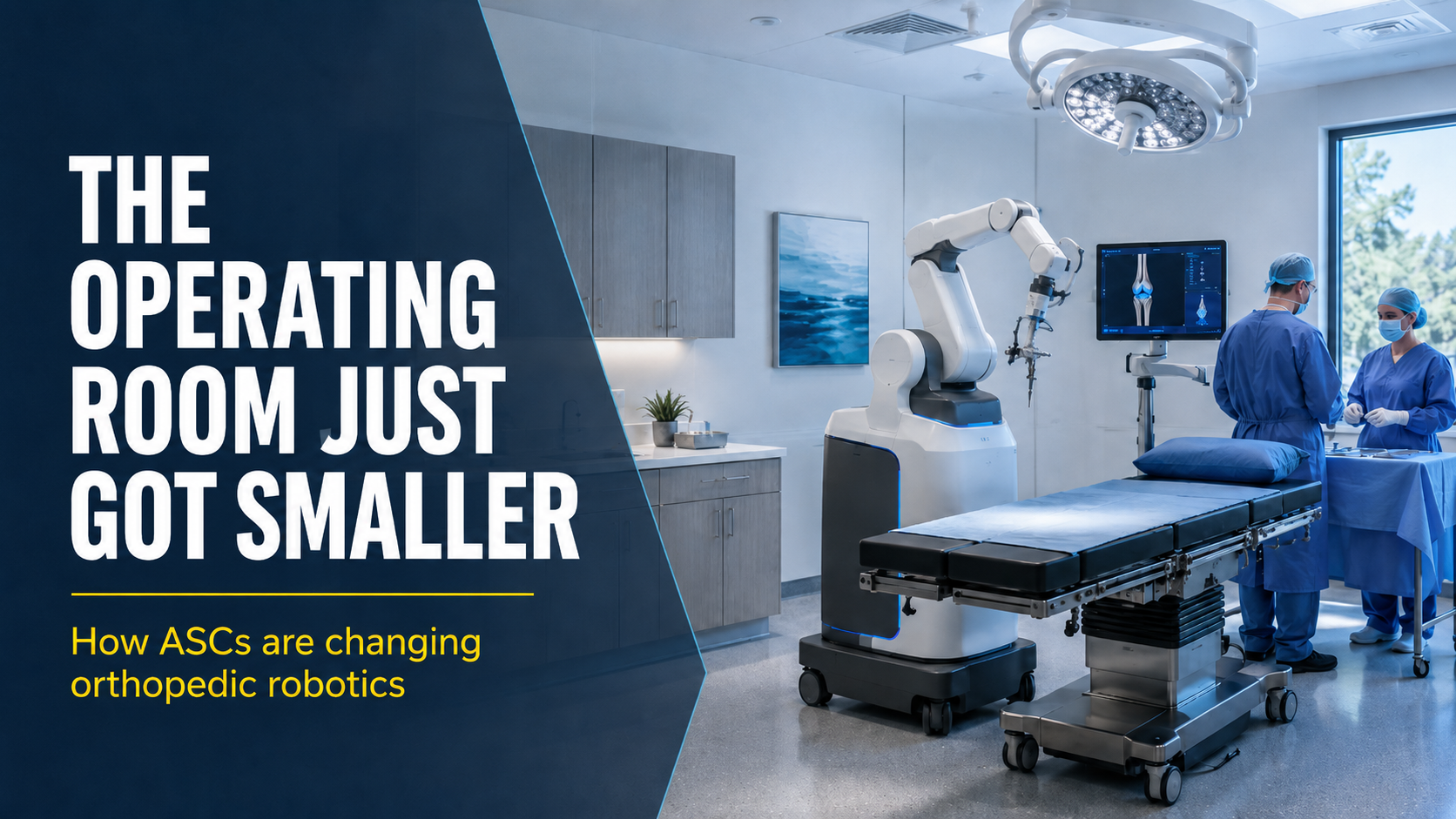
On April 1, 2026, a surgeon at a freestanding ambulatory surgery center in Florham Park, New Jersey performed a complete robotic-assisted shoulder replacement. The patient went home the same day.
Eighteen months earlier, that sentence would have been technically, regulatorily, and commercially impossible. None of those three barriers fell at random. They came down together, and they explain almost everything happening in orthopedics right now.
I have been watching the site-of-care shift in joint replacement for years. In 2026, it stopped being a shift and became a rebuild. The robots are not just following the procedures out of the hospital. They are being redesigned around the surgery center as the new center of gravity.
The Numbers Are Already Past the Tipping Point
The 2026 ASC story usually gets told as a CMS rule change. That misses the bigger picture. The volume was already moving.
Sg2 projected that 51% of total joint replacements would be outpatient by 2026. Orthopedic procedures grew from 52% of all ASC volume in 2018 to 68% in 2025. About 1.5 million total hip and knee replacements are expected in the U.S. this year. The hospital was losing share before regulators noticed.
Then on January 1, 2026, the regulators noticed. CMS removed revision total knee codes 27486, 27487, and 27488 from the inpatient-only list. Revision total hip arthroplasty followed. So did partial shoulder revisions. The list of complex orthopedic cases that can be done in an ASC now includes the cases hospital systems used to consider safest only behind their walls.
That is the demand side. Now look at the supply.
Each Major Robot Is Repositioning for a Smaller Building
For a decade, orthopedic robotics looked like a single arms race. Stryker’s Mako put a robotic arm in the operating room and ran away with the market.
By year-end 2024, Mako was in roughly 2,000 hospitals worldwide and was used for about two-thirds of U.S. robotic knees and one-third of robotic hips. Then the platforms started behaving differently.
1. Smith+Nephew CORI was built for the surgery center.
It is a compact, mobile system designed around outpatient knee arthroplasty workflow. It does not need a dedicated room or a six-figure renovation.
2. Zimmer Biomet ROSA expanded sideways.
ROSA Shoulder cleared FDA in February 2024 and was the system used in that first ASC shoulder replacement. The economics matter: hospitals already running ROSA on knees and hips can add the shoulder application for roughly $250,000, versus close to $1 million for a new robotic platform. ASCs reading that math start to pay attention.
3. DePuy Synthes Velys went after price.
Velys is roughly 56% cheaper than Mako, has been used in more than 55,000 procedures across 20 markets, and now has an FDA-cleared partial knee indication. Volume is up because the entry price came down.
4. Stryker just launched a handheld.
In February 2026, Stryker introduced the Mako RPS, a handheld robotic saw designed for surgeons who want robotic accuracy without the floor space, capital footprint, or learning curve of a full robotic arm. The leader of the robotic arm category is now selling the simpler tool. Read that sentence twice.
These are not coincidences. Every meaningful platform is moving toward a profile that fits a 6,000 square-foot outpatient facility, not a 600,000 square-foot tertiary hospital.
What This Means for the Market
A few second-order effects are worth flagging now, because they are about to drive the next twelve months of strategy decks.
- Capital architecture is the new battleground. The conversation in 2024 was arm versus image-free. The conversation in 2026 is $1 million capex versus $250,000 upgrade versus handheld versus per-case fee. ASC operators do not buy the way hospitals do, and OEMs that do not adapt their commercial model will lose volume even when they win the clinical comparison.
- The mid-tier surgeon finally gets robotic. A community orthopedist running a high-volume outpatient practice could not justify a Mako acquisition five years ago. They can justify a CORI, a Velys, a ROSA upgrade, or a Mako RPS today. That expands the addressable surgeon base by an order of magnitude.
- Hospitals just lost their robotics moat. For years, a hospital system could market itself as the only place in town with a robot. That talking point is dying in real time. By 2030, two of every three hip replacements and one of every two knee replacements are projected to be robotic, per Cleveland Clinic data. The differentiator will not be access to a robot. It will be the team and the case mix around it.
- Revision in the ASC is a wholly new risk picture. CMS opened the door, but revision arthroplasty carries a meaningfully higher infection and complexity profile than primary cases. ASCs taking these cases need diagnostic depth, vendor support, and patient selection rigor that primary-only programs never had to build. This is where the robotics conversation collides with the operations conversation, and it is where the real differentiation will happen.
The Bottom Line
The story is not robots in ASCs. The story is that ASCs are now redefining what an orthopedic robot has to be: smaller, cheaper, faster to install, and economically rational at outpatient volumes.
Every major OEM has now told you, with their product roadmap, where they think the next decade of growth lives. If you are building, selling, or investing in orthopedic technology, your strategy needs an outpatient-first lens. The hospital still matters. It just stopped being the answer to where this market goes next.
Want to talk through what the ASC migration means for your portfolio, your pipeline, or your competitive positioning? Get in touch and we will map it together.