
Infrastructure Is Not Forgiving. That Is the Point.
April 23, 2026
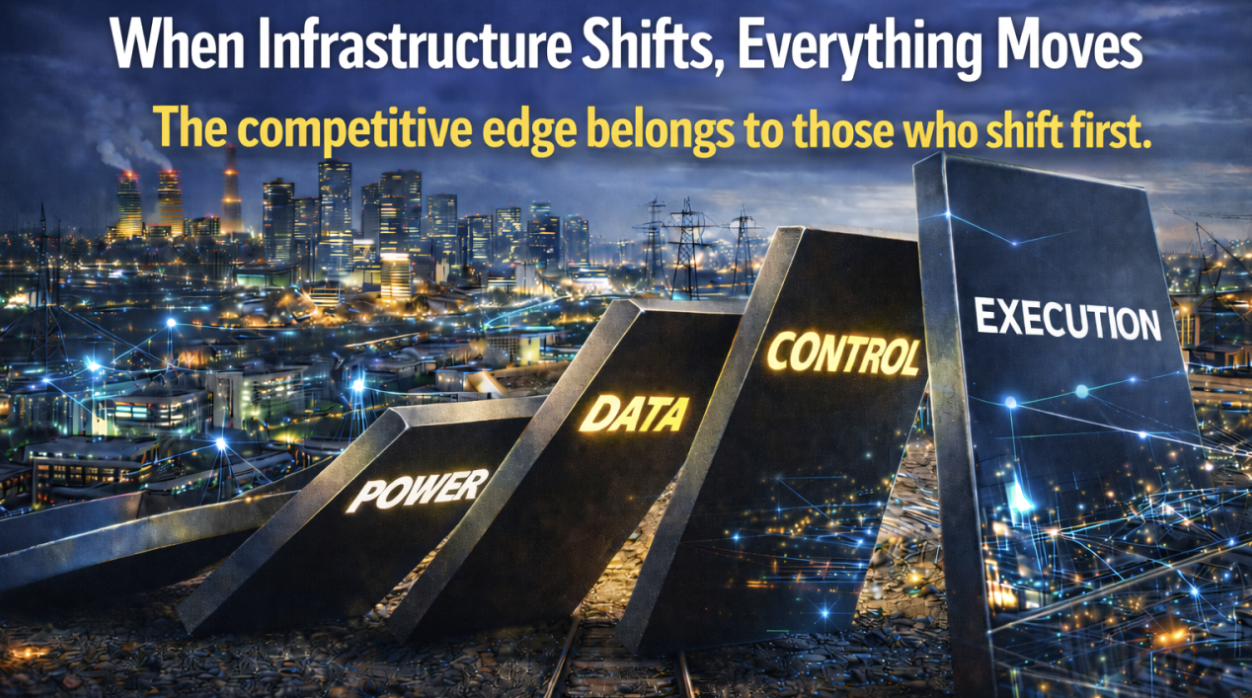
A Siemens case through the EdgeFinder lens: why the lead time problem in large infrastructure is the same reason the advantage goes to whoever gets there first and Fortified.
The Game Siemens Is Playing
Siemens Smart Infrastructure builds and operates the systems that make large physical environments run: building management, energy distribution, industrial automation, and the digital platforms that connect them. Their customers are organizations where infrastructure is not a cost line. It is the operating platform. Factories. Hospital campuses. Commercial real estate portfolios. Municipal energy grids. The asset base is large, the lifecycle is long, and the cost of changing it runs deep in both directions.
That last point is the one most strategy conversations skip. In infrastructure, you cannot afford to be wrong and you cannot afford to wait. Move too early on a signal that turns out to be noise and you carry stranded assets on a long depreciation curve with no market to justify them. Wait until the signal is unambiguous, and the lead-time to build the capability means you arrive after the window has closed. The organizations already configured to move are already serving the demand you are still preparing for.
This is the game. And the two-sided lead-time problem is not a risk to manage around. It is the central strategic condition of the industry. How you read it determines whether you build a sustained competitive advantage or spend a decade watching one consolidate in someone else’s hands.
Reading Signal from Noise
The reason most organizations misread this environment is that they are looking for a single clear signal. They want the moment when the direction is obvious. In infrastructure, that moment arrives after the opportunity has passed.
Siemens did not wait for that moment. What they read was not a single signal. It was a pattern, and the pattern had three characteristics that together told them this was structural and not cyclical.
The first was convergence of independent drivers. Carbon obligations, energy cost pressure, and operational resilience requirements were not moving in the same direction because they were related. They were moving together because each was being driven by its own independent force: regulatory, economic, and operational. When independent trend lines converge over multiple cycles, you are not looking at coincidence. You are looking at a new game state.
The second was a vocabulary shift. Executives stopped describing buildings and energy infrastructure as cost centers and started describing them as strategic assets. That is not a marginal change in language. It signals that the mental model governing investment decisions has shifted. When your customer’s category for something changes, their willingness to invest in it changes with it. The Siemens Infrastructure Transition Monitor 2025 captured this directly: energy efficiency and digitalization moved to the top of infrastructure priority stacks, not because technology got cheaper, but because the asset class was being reclassified.
The third was a recurring Back-of-Pack constraint. Organizations were reporting progress on decarbonization and digitalization goals while simultaneously reporting the same persistent constraints: lack of usable data, siloed systems, fragmented visibility across sites. Ambition moves. Execution caps at the same seam. When that pattern repeats across multiple cycles, the constraint is not operational. It is structural.
The tell was not that energy prices were high. That is cyclical. The tell was that executives were reclassifying the asset and the same execution gap kept reappearing. That combination is structural signal.
When you can name three things clearly, convergence of independent drivers, reclassification of the asset, and a recurring pattern of ambition outrunning execution at the same constraint point, you are not guessing. You are reading.
Where the Constraint Sits
To locate the constraint, you need a way to look at an organization as an operating system under pressure. The EdgeFinder lens uses the Pack for this. The Pack is the smallest complete set of interdependent capabilities and handoffs that must move together so the recipient reliably receives what was promised, especially when conditions change.
Within the Pack, Front and Back are not layers of the org chart. They are detection positions. The Front is where signals arrive first: market-facing awareness, leadership intent, the ability to read what the environment is doing. The Back is where execution lives: the operational systems, delivery infrastructure, and organizational capacity that must absorb what the Front detects and carry it through to a delivered outcome.
In the infrastructure case, the Front is functioning. Leadership understands the pressure, carbon commitments are on record, and capital conversations are happening. The signal is being received.
The constraint sits in the Back. Building management, energy procurement, and on-site operations run largely in parallel rather than in coordination. The data infrastructure required to convert leadership intent into a coordinated, measurable response is not yet in place. The handoffs that would let the Front’s signal become the Back’s action are missing or fragmented.
When the constraint lives in the Back, the gap between what leadership intends and what the organization can actually deliver widens with every cycle. Pressure from the Front accumulates. Capability in the Back does not. This is not a performance problem. It is a configuration problem. And configuration problems do not resolve themselves under pressure. They get more expensive.
First and Fortified
The EdgeFinder loop runs in three distinct moves. The distinction matters.
Find is the work of reading the environment with enough precision to separate signal from noise and confirm the signal is actionable. That is what the three-pattern test does. Convergence of independent drivers, reclassification of the asset, a recurring gap between ambition and execution. When those three are present together, you are not looking at a bad quarter. You are looking at a structural shift that will force organizational change whether or not the organization is ready. Siemens ran Find. They named what they were seeing and confirmed it was worth moving on.
Advance is turning that confirmed signal into a solution the market can buy. Not a research project. Not a pilot with no path to scale. A sellable response to a structural need. Siemens built platforms that connect physical assets to digital control, analytics that surface what those systems are doing and why, and performance contracts that deliver measurable outcomes at portfolio scale. That is the Advance. A new capability the Pack could not perform before.
Fortify is the Pack making the Advance stick. Not the insight. Not the offer. The organizational capability behind the offer that allows it to be delivered reliably, repeatedly, and at scale. For Siemens that meant standardized platforms, repeatable service models, and performance contracts that encoded how outcomes are measured and shared across every engagement. Pilots did not stay pilots. The pattern became the operational baseline because Fortify was designed in from the beginning, not bolted on after the first deal closed.
Insight has a shelf life. The moment the signal becomes obvious to everyone, the insight evaporates as a differentiator. An organization can move in the same year as Siemens and still be structurally late because they moved without configuring the Pack to hold the position under load. What remains when the window closes is the capability you built while you had the runway. Build it and you hold. Do not, and someone who did is already there.
Sustained advantage is a property of the system, not the idea.
What This Means for Your Organization
The Siemens case is not a story about a company with better technology or more capital. Most of their competitors have access to both. It is a story about what happens when Find, Advance, and Fortify run as a complete sequence, with Fortify designed into the move from day one rather than added after the pilots succeed.
Most organizations facing the infrastructure transition are still treating it as a procurement problem. Find the right technology. Run a pilot. Evaluate. That sequence works for decisions where lead times are short and change costs are low. It does not work when the asset lifecycle runs ten to twenty years and the cost of arriving configured after the window closes is a decade of catch-up.
The organizations that will carry a durable edge through the infrastructure transition are treating it as a Pack reconfiguration problem. That means asking different questions. Not what technology should we evaluate, but where is the constraint in our Back that keeps ambition from becoming delivered capability. Not how do we run a good pilot, but how do we design the pilot so Fortify is already built into the next step.
That distinction is the signal worth acting on. Everything else is noise with good slide decks.
Is This Pattern Showing Up in Your Organization?
If you are seeing ambition advancing and execution capping at the same constraint point, that is a Back-of-Pack configuration problem. The EdgeFinder lens is built to locate that constraint precisely and name the sequence that resolves it.
The question is not whether the infrastructure transition is coming. The question is whether your Pack will be configured to move through it before the window narrows.
Jim Jordan jjordan@stratactic.com