
Did Apple Mess Up on AI, or Find Its Way Back to Its Why?
June 15, 2026
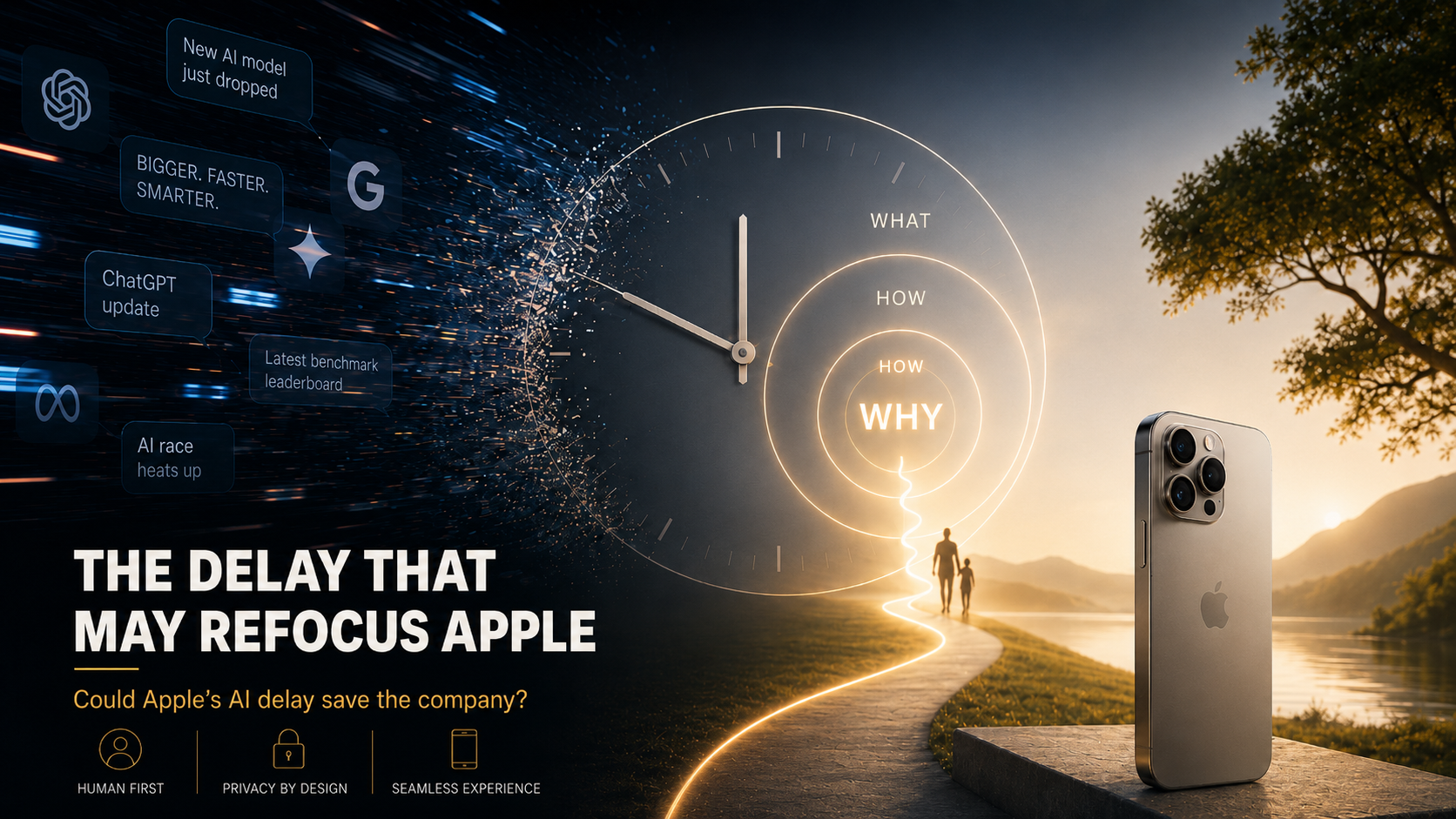
Everyone already agrees on the easy part. Apple was late to AI, and for two years the market treated that as a failure. While rivals shipped chatbots and rebuilt their products around large language models, Apple shipped a delay. The verdict was in before the product was: they messed up.
But the easy verdict is the boring one. The more interesting question is the one that takes a little nerve to ask.
Did Apple actually mess up? And if they stumbled, did the delay buy them something more valuable than a head start: time to remember why they exist in the first place?
Start With Why
Simon Sinek built a whole framework on a simple observation: great companies do not lead with what they make. They lead with why they make it. He calls it the Golden Circle, and it runs from the inside out. Why, then how, then what.
Most companies talk from the outside in. Here is our product, here are the specs, please buy it. Apple, in Sinek’s telling, talks the other way. We believe in challenging the status quo and thinking differently. The way we do that is by making beautifully designed, simple-to-use products. We happen to make great computers. Want one?
People do not buy what you do. They buy why you do it.
Apple’s why has never been the technology underneath. It has been the human on the other side of the glass. The why is human-centered design. The chip, the model, the radio: those are just the how and the what.
The Race That Was Never Apple’s Race
Here is what the last two years really were: a contest over the what. Whose model is biggest, whose benchmark is highest, who shipped first. That is an outside-in race, and Apple is structurally bad at outside-in races. It always has been.
So when critics said Apple was losing, what they really meant was that Apple was losing a race built around someone else’s why. Apple did not invent the MP3 player, the smartphone, or the tablet. It arrived late to all three and won anyway, because it competed on the experience, not the spec sheet.
Look at what Apple finally shipped at WWDC 2026 and you can see the why reasserting itself:
- It rebuilt Siri around conversation and context, so the assistant fits the human instead of forcing the human to learn the prompt.
- It made privacy the architecture, processing much of the work on the device, sending only complex requests to a cloud walled off even from Apple itself.
- It licensed the model rather than worshipping it, using Google’s Gemini to power Siri so Apple could spend its energy on the experience layer it actually cares about.
Craig Federighi all but said it out loud, describing Apple’s approach as deliberately different from rivals racing ahead without much regard for the people the technology is supposed to serve. That is a why talking. Whether you buy it or not, it is consistent with the one Apple has always had.
When a Stumble Becomes a Course Correction
I do not think the delay was a master plan. Early Apple Intelligence underwhelmed, the personalized Siri slipped, and that was a real miss. But here is the thing about being forced to wait: it gives you time to stop chasing someone else’s what and return to your own why.
An Apple that rushed a me-too chatbot in 2024 would have been competing on the limbic question every rival was already losing on: is ours a little smarter than theirs? An Apple that waited got to come back and ask its real question instead: what should this feel like for the person holding the phone?
That is the difference between a company that knows what it does and a company that remembers why it does it.
The Honest Caveat
A why does not guarantee a win. Renting your core intelligence from Google, a rival in phones and search, is a genuine vulnerability, and Sinek’s framework cannot wave it away. If the model layer stays the battleground and one model stays meaningfully smarter than the rest, design becomes the consolation prize, not the point. And a more conversational Siri that fumbles real tasks would betray the very why Apple is leaning on. Belief inspires people. It still has to ship something that works.
The Bottom Line
Apple probably did stumble, and the delay probably did pull it back to its why. The market scored the last two years as a loss because it scored a what race. Apple has never won those. It wins when it stops asking whose technology is best and starts asking what the human experience should be. The forced pause may have done Apple a strange favor: it interrupted a race it was never built to win and handed the company time to start with why again.
The lesson travels well beyond Cupertino. In healthcare, digital health, and every field where AI is now the shiny what, the organizations that win will not be the ones with the biggest model. They will be the ones who remember why they exist and design the experience around it.
Not sure whether your team is chasing a what or building from a why? Get in touch and let’s pressure-test where your real advantage lives as AI commoditizes.