
Co-Location Is Not Integration: What Primary Care Clinics Get Wrong in 2026
May 26, 2026
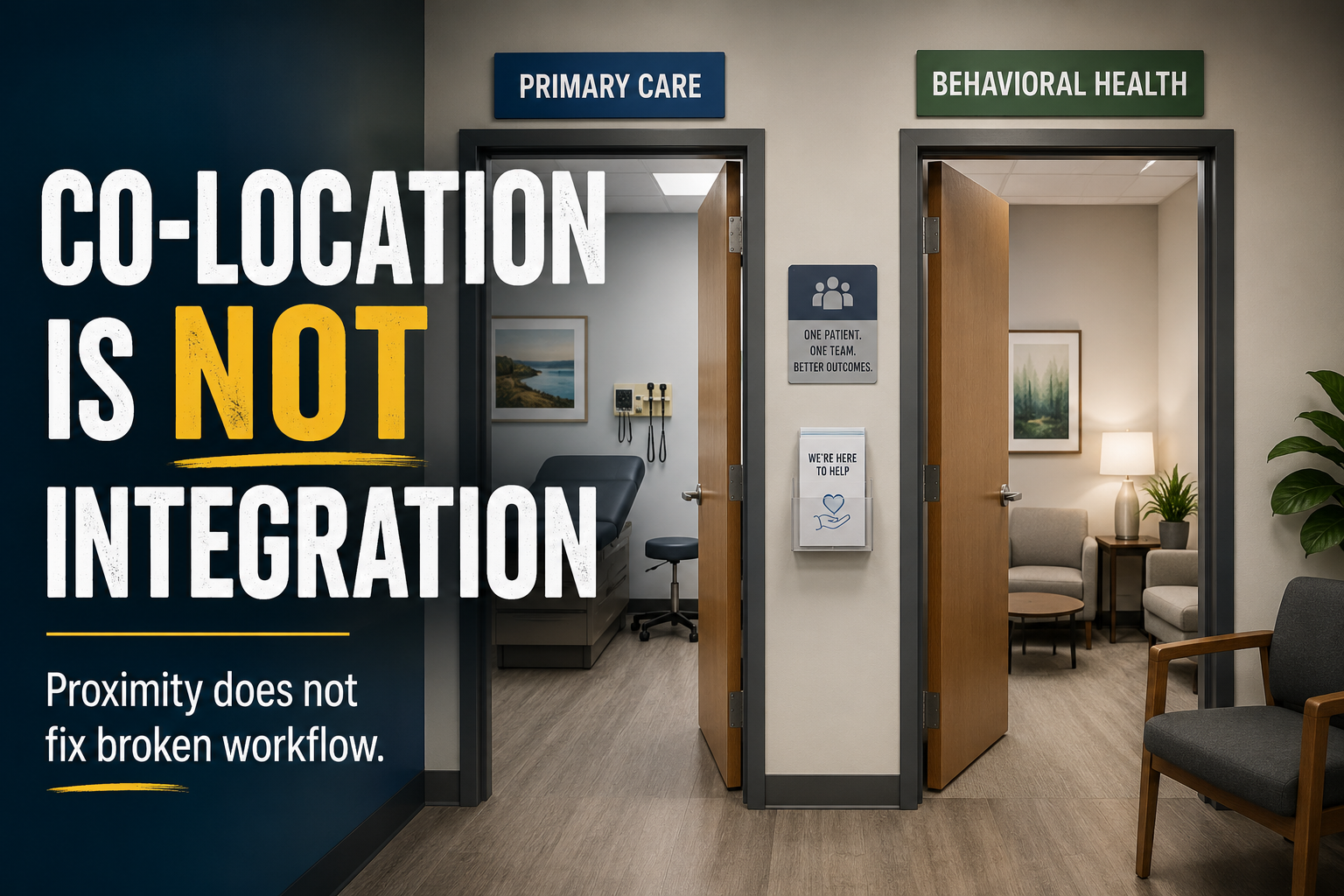
Walk into a primary care clinic in 2026 and ask the leadership team a simple question: are you integrated?
You will hear yes almost every time. The behavioral health clinician sits two doors down from the family medicine team. There is a shared waiting room. The therapist takes warm handoffs on Tuesdays.
Here is the problem. None of that is integration.
The most expensive mistake in primary care right now is treating physical proximity as a substitute for clinical workflow. Patients still fall through cracks. Follow-up still breaks down. The clinic still bears the downstream cost in emergency utilization, no-shows, and unmanaged chronic disease. Leadership keeps pointing to the floor plan and wondering why the outcomes have not moved.
CMS pays for actual integration in 2026. They do not pay for floor plans.
What Real Integration Looks Like
The Agency for Healthcare Research and Quality and SAMHSA have spent more than a decade defining integrated primary care, and the definition is operational, not architectural. A clinic earns the label when it can reliably identify needs, intervene early, monitor response, and step care up or down without losing the patient.
That is six verbs. None of them are about location.
Real integration shows up in workflow:
- Standardized screening for depression, anxiety, substance use, and adherence barriers, run at every relevant visit
- Shared documentation so the primary care clinician sees what the behavioral health clinician saw, and vice versa
- A registry that tracks symptom trajectories over time and flags patients whose PHQ-9 scores are not improving
- A psychiatric consultation pathway for diagnostic clarification and medication review
- Closed-loop referral tracking for specialty psychiatry, substance use treatment, and social services
If your clinic has a behavioral health clinician on-site but no registry, no measurement-based care, and no shared accountability metrics, you are co-located. That is a real thing. It is not integration.
Why 2026 Forces the Issue
Three forces are converging on this distinction right now, and they are making the gap between co-location and integration financially visible.
1. CMS payment policy
The Calendar Year 2026 Medicare Physician Fee Schedule reinforced Behavioral Health Integration (BHI) and the Psychiatric Collaborative Care Model (CoCM) as durable Medicare pathways, and added the Advanced Primary Care Management (APCM) add-on for clinics with deeper management infrastructure. Each of these codes requires specific workflow elements: a behavioral health care manager, a billing practitioner, measurement-based follow-up, and in CoCM’s case, a psychiatric consultant. You cannot bill these codes from a co-located clinic with no registry. The reimbursement design rewards operational integration directly.
2. Value-based contracts
Commercial payers continue expanding per-member-per-month support, quality bonuses, and shared savings for whole-person care. These contracts evaluate panel-level outcomes. A clinic that screens broadly but cannot document closed-loop follow-up generates risk, not value.
3. Workforce economics
Primary care practices are absorbing more risk and complexity per encounter, and the visit-volume model is no longer enough. Clinics that redesign team workflows, reserving physicians and APCs for diagnosis and complex management while empowering behavioral health, care management, and pharmacy roles for follow-up, get more done per FTE. Clinics that simply hire a therapist and add screening forms to unchanged workflows do not.
The Five Ways Co-Located Clinics Stall
Across implementation guidance from AHRQ, SAMHSA, and CMS, the same failure modes appear in clinic after clinic:
1. Screening without response capacity
A positive PHQ-9 with no follow-up plan is a patient-safety and compliance issue, not a quality metric.
2. Co-location without shared documentation
If the behavioral health clinician’s notes live in a separate system, the primary care team cannot adjust treatment in real time.
3. Insufficient therapist capacity for positive-screen volume
Screening generates demand. The math has to work.
4. No psychiatric consultation pathway
Without it, complex medication questions stall and patients wait for external referrals that may never close.
5. Layering integration work onto unchanged workflows
The team gets exhausted, screening rates fall, and the program quietly dies.
Notice the pattern. Every failure is operational, not conceptual. Most clinics agree integration is a good idea. The breakdown happens at execution.
What Mature Integration Pays For
Clinics that have actually built integrated workflows, especially the Collaborative Care Model with measurement-based follow-up, see better symptom control on common mental health conditions, reduced avoidable emergency use when care management is active, and lower-friction access for patients who would otherwise face stigma or specialty wait times. The evidence base for CoCM is the strongest among behavioral health integration approaches, and it is not close.
The financial picture is also clearer than it used to be. A durable model combines fee-for-service integration payments (BHI, CoCM, APCM) with value-based or PMPM support tied to longitudinal outcomes. That mixed revenue structure is what carries integration past the pilot phase. Single-source funding, whether grant or one payer, almost always collapses on contact with reality.
The Bottom Line
Co-location is the easy part. Integration is the hard part. In 2026, the payment system, the patient population, and the workforce equation all reward clinics that have done the hard part.
If you lead a primary care clinic and you keep telling your team you are integrated, run a quick test: pull your registry. Pull your follow-up rates after positive screens. Pull your psychiatric consult turnaround. If those numbers do not exist, or they are flat, you are not integrated yet. You are co-located. There is a meaningful operational gap between the two, and 2026 will make that gap visible whether you measure it or not.
Want to talk through what this looks like in your clinic or system? Get in touch and we can map your current state against the integration maturity continuum and identify the highest-leverage next moves.