
Claude Is Watermarking Text. Your Clear Writing Was Already Evidence Against You.
August 13, 2026
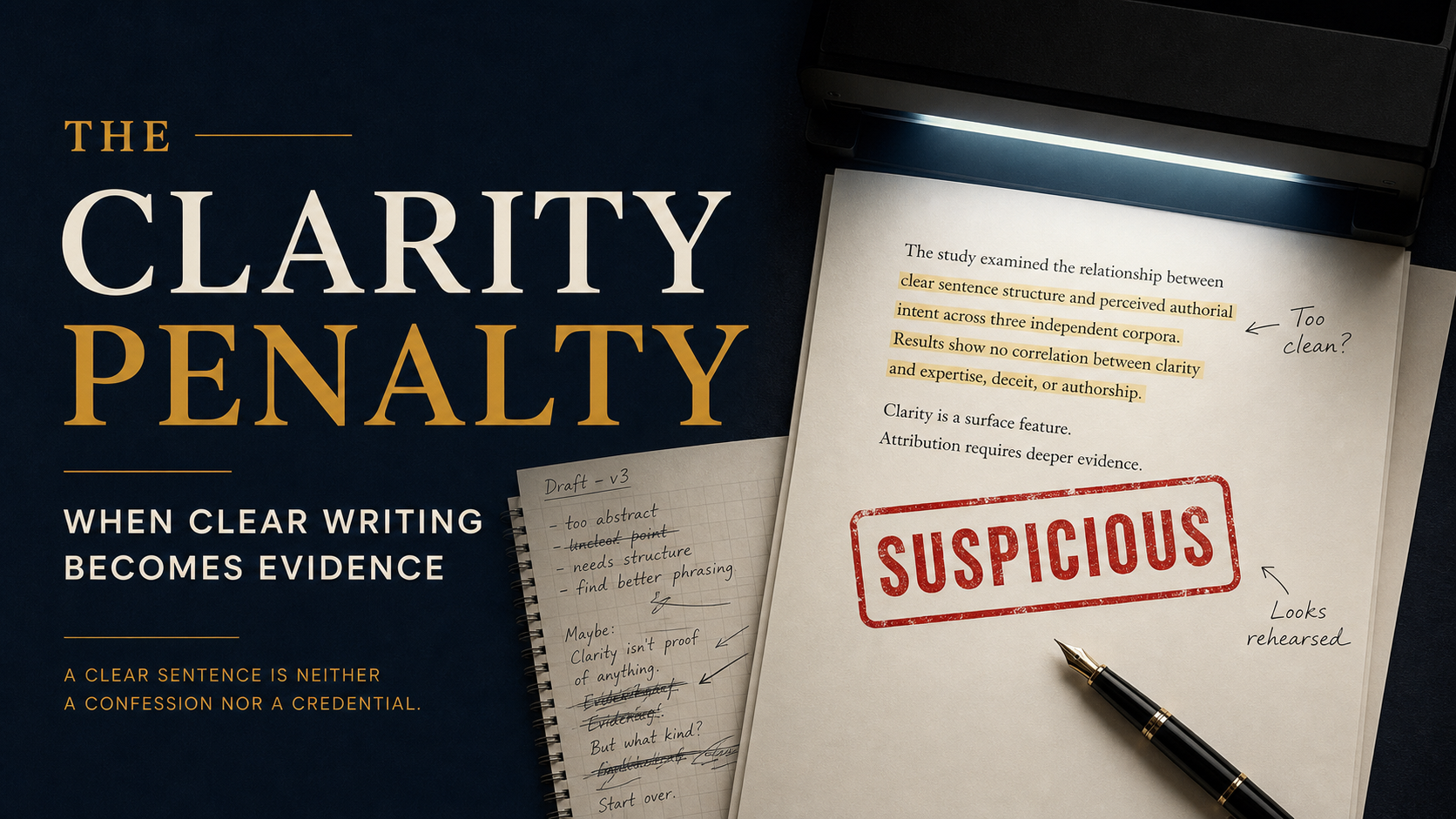
This week it is Claude. Microsoft and OpenAI are moving the same way. They share one flaw, and it makes clarity a liability.
Your clear writing is now evidence against you. Read that again, because it is the strange new rule of the moment, and almost no one has said it out loud. Write something clean, structured, easy to understand, and an AI detector is more likely to flag it, not less. We have built a world where the better you communicate, the guiltier you look.
And the timing is not subtle. This week Claude began watermarking the text it helps people write. It is not the first. Google has marked Gemini’s text since 2024, Microsoft now marks AI audio, video, and images, and OpenAI marks AI images. A mark on your words is about to be normal. Watermarking and detection are different machines. They share one flaw, the one this whole piece is about. Both read the surface of your writing as evidence about you.
That is backwards. And to see why, you have to give up a comfortable idea that both sides of this argument are still holding onto.
For a long time, clear writing meant something. It was hard to produce. You did not write clearly about a difficult subject unless you had done the work to understand it, so clarity was a decent proxy for effort, for mastery, for having earned the right to an opinion. We learned to trust it. A clean page felt like a credential.
That proxy is dead. A capable tool can now produce clarity on demand, over a subject the writer barely understands, or over nothing at all. Which means a clear sentence, by itself, no longer tells you what sits beneath it. And here is where it cuts against what almost everyone wants to believe.
If you think clarity still proves competence
If you believe a person who writes well must know their subject, you are reading a gauge that stopped working. Clarity can now be borrowed by the hour. It certifies nothing about the mind behind it. The clean page you have been trusting as a credential is no longer one.
If you think admitting this lets the fakers win
And if you are on the other side, if you think we should keep flagging clarity to catch the people faking expertise, you are reading the same dead gauge from the other end. Punishing clarity does not catch fakers. It catches the honest expert who happens to write well, while the faker runs a light paraphrase and sails through untouched. You are not protecting standards. You are convicting the people you meant to protect and clearing the ones you meant to stop.
Both readings make the same mistake. They treat a surface as evidence. Clarity was never proof of fraud, and it was never proof of merit. It is a surface, and the tool reads the surface and is blind to what is under it, so a score built on it convicts and absolves almost at random.
Which leaves an uncomfortable question, and I am going to leave it with you rather than pretend it is easy. If clear writing no longer tells us who did the work, what does? Not a detector. Not a percentage. Something older and slower and harder to automate. The evidence. Whether the argument holds when you push on it. The record of how the work was made, and a person willing to stand behind it. We outsourced that judgment to a proxy because the proxy was cheap and usually right. The proxy is gone. The judgment is back in our hands, and most institutions have not admitted it yet, because admitting it means doing the harder work of reading closely.
Bottom line. A clear sentence is not a confession, and it is not a credential. It is just a clear sentence. Your clear writing is not evidence against you. But it is not evidence for you either. That is the part nobody wants to say, and it is the whole thing.
The full argument, with the studies behind every claim here, is in the white paper: The Clarity Penalty. Tell me where you think I have this wrong.