
AI Does Not Fix Your Organization. It Reveals It.
June 8, 2026
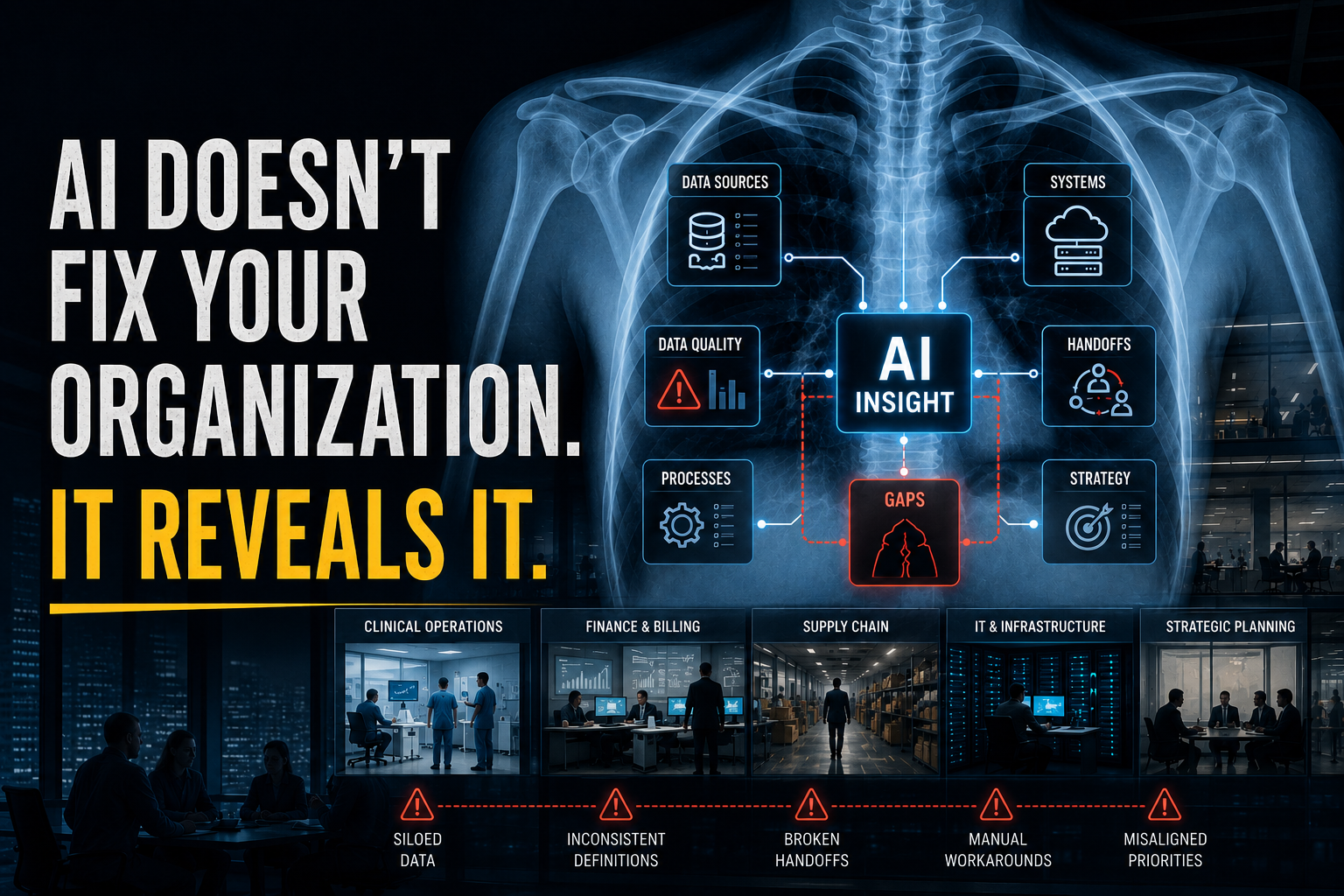
In 2025, global enterprises invested an estimated $684 billion in AI initiatives. By year’s end, more than $547 billion of that had failed to deliver intended business value. The instinct is to blame the technology: immature models, overpromised vendors, unrealistic timelines. But the pattern is far more consistent than any single technology explanation can account for.
AI does not fail because it does not work. It fails because it works too well. It processes exactly what it is given, encodes exactly the patterns it finds, and delivers exactly the outputs those patterns produce. When the organization underneath is misaligned, AI does not correct the misalignment. It amplifies it, automates it, and serves it back to leadership at scale.
The real value of AI may not be in the answers it gives. It may be in what it reveals about the organization that deployed it.
Three Variances AI Exposes
When an AI deployment underperforms, the failure is typically attributed to the model or the implementation. But in the EdgeFinder lens, every failure is a signal. Variance is not error; it is the most valuable intelligence available. The question is not “why did the AI fail?” The question is “what is the AI revealing about this organization?”
AI adoption tends to expose three distinct forms of variance simultaneously:
1. Market Variance: the pressure to adopt before the foundation is ready.
AI adoption is not optional in most industries. The competitive pressure is real. When 78% of organizations reported using AI in some capacity in 2024, the remaining 22% faced a strategic imperative to close the gap. This external pressure creates Market Variance: a shift in competitive dynamics that forces organizations to respond, often faster than their internal capabilities can support. The danger is not that organizations adopt AI. It is that the speed of adoption outpaces the organization’s ability to prepare the systems AI depends on.
2. Operational Variance: the gap between how data flows and how it was designed to flow.
AI exposes Operational Variance with unusual precision because it processes data literally. Every inconsistency, every gap in data lineage, every field that was designed for billing but is now being queried for clinical insight shows up in the model’s outputs. Research from Kythera Health demonstrated this directly: LLMs pointed at raw claims data returned zero correct answers to basic business questions. The data’s operational design (billing) and its analytical use (strategic questions) had diverged. The AI did not bridge that gap. It measured it, exactly.
3. Strategic Variance: the misalignment between declared strategy and observed priorities.
An organization that declares AI transformation as a strategic priority but allocates data architecture resources through IT operations has a Strategic Variance. The stated priority and the resource allocation do not match. AI adoption reveals this misalignment because it requires genuine cross-functional integration to succeed. When only 14% of senior executives report successfully aligning workforce, technology, and business goals for AI, the other 86% are living with a Strategic Variance they may not have named.
The Pack Under Pressure
These three variances do not operate independently. They interact inside the Pack: the smallest complete set of interdependent capabilities and handoffs that must move together to reliably keep a customer promise. The Pack is not the team. The team operates the Pack.
AI adoption puts the Pack under a specific kind of stress. It connects capabilities that previously operated with some degree of independence. A billing system, a clinical decision support tool, an operational dashboard, and a strategic planning process may have coexisted for years with inconsistent data definitions, informal handoffs, and undocumented assumptions. Each worked well enough in isolation.
AI collapses that isolation. It draws from all of these sources simultaneously. It treats them as a single system. And when their inconsistencies are processed through a model that does not distinguish between “designed this way” and “drifted this way,” the output reveals every quiet misalignment the organization had learned to live with.
This is why the Back of Pack concept matters so much in AI deployment. The Back of Pack is the capability that cannot yet deliver at the required level and sets the sustainable pace for the entire Pack. In most AI initiatives, the Back of Pack is not the model, the engineering team, or the vendor. It is the data infrastructure. And until that constraint is addressed, no amount of investment in the Front of Pack (the model, the platform, the talent) will produce the intended result.
The Fortify Failure at Scale
Think of it like a home inspection. You find a leaky lead pipe in the basement. You fix the leak. But do you also check whether the rest of the house has lead pipes? Because if you do not, the fix you just made is temporary. The same problem is waiting in the walls, and it is affecting your long-term health whether you see it or not.
In the EdgeFinder lens, this maps to a continuous loop of Find, Advance, Fortify. Find is the discipline of slowing down to examine what is actually happening: where has the organization drifted, where have gaps opened, where is the next opportunity or threat? Advance is doing something about it: committing resources, choosing a direction, launching the initiative. Fortify is making sure the entire organization adopts the advance so you never have to go back and do it again. It is thoroughness, speed, and closure. Fortify turns a local fix into an organizational standard so the whole Pack moves forward together rather than disparate groups solving the same problem independently.
The most common failure is Find and Advance without Fortify. The organization spots the leaky pipe and fixes it, but never checks the rest of the house. And AI adoption has become the largest-scale example of this failure mode in enterprise history. The numbers are striking:
- 42% of companies abandoned at least one AI initiative in 2025, up from 17% in 2024
- 90% of generative AI experiments never scale beyond pilot (MIT/McKinsey)
- 85% of AI models fail due to poor data quality (Gartner)
- Only 16% of healthcare organizations have system-wide AI governance frameworks
Each of these statistics describes the same structural failure. Organizations found the opportunity. They advanced into investment. They did not fortify the infrastructure, governance, and cross-functional alignment that would make the investment hold.
The 2024 Boston Consulting Group study that found 70% of AI challenges are people and process related, not technical, confirms this. Fortify is not a technology problem. It is an organizational capability problem. It requires making new patterns the default: how data is governed, how cross-functional handoffs work, how strategic priorities are translated into operational resource allocation.
What AI Actually Offers: An Organizational X-Ray
There is an alternative way to think about AI deployment that most organizations have not considered. Instead of treating AI failure as a problem to be solved, treat it as a diagnostic.
AI, deployed into an organization, functions as an X-ray of the Pack. It reveals:
- Where data was designed for one purpose but is being used for another
- Where terminology has drifted between functions without anyone noticing
- Where handoffs between capabilities are informal, undocumented, or broken
- Where strategic priorities and operational resource allocation have diverged
These are not AI problems. They are organizational problems that AI makes visible. The organizations that extract the most value from their AI investments will be the ones that use this diagnostic capability deliberately: deploying AI not just to generate answers, but to reveal where the Pack’s capabilities and handoffs need attention.
This reframes the ROI conversation entirely. The question is not just “did the AI produce the right output?” The question is “what did the AI’s performance reveal about how this organization actually operates versus how it thinks it operates?”
What This Means for Leaders
For leaders navigating AI investment decisions, the implication is direct: stop evaluating AI initiatives solely on model performance. Start evaluating them on what they reveal about organizational readiness.
Specifically:
1. Before any new AI investment, map the Pack it will depend on.
Identify every capability and handoff the AI system will touch. Where are the data sources? Who maintains them? What were they designed for? Where do they cross functional boundaries? The AI will process all of this as a single system. If you have not mapped it as one, you will be surprised by the results.
2. Use early AI outputs as a diagnostic, not a deliverable.
When a pilot produces unexpected or poor results, resist the instinct to blame the model. Instead, trace the output back to the data and the handoffs. What variance did the AI detect that the organization had been living with? That variance is the insight.
3. Build Fortify into the budget from the start.
If the AI budget covers model licensing, engineering, and deployment but not data architecture remediation, cross-functional governance, and ongoing quality testing, the initiative is designed to Find and Advance without Fortify. Budget accordingly.
The Bottom Line
AI does not fix organizations. It reveals them. Every AI failure is a signal about the organization underneath: where data and decisions have drifted apart, where handoffs have quietly broken, where stated strategy and observed priorities no longer match. The organizations that treat AI as a diagnostic tool, not just an output engine, will be the ones that convert AI investment into sustained competitive advantage. The rest will keep investing in the Front of Pack while the Back of Pack sets the pace.
If your AI investments are revealing more about your organization than they are producing in results, that is not a failure. That is the beginning of the real work. Get in touch and let’s talk about what the signal is telling you.