

THE SYSTEM
The Four Layers
| Layer | Element | What It Does | |
|---|---|---|---|
| 01. | Philosophy | EdgeFinder | The lens. Governs all perception and judgment. Treats variance as signal, not noise. Sits above everything. No other element redefines it. |
| 02. | Diagnostic Intelligence | Five Diagnostic Variances | Categorizes what the lens sees: Operational, Behavioral, Strategic, Market, Pattern. Compresses time to alignment by giving leaders shared language. Does not prescribe action. |
| 03. | Capability System | Strategic Meta Skills | Installs EdgeFinder as organizational muscle. Trains the Pack to run Find → Advance → Fortify without the principal in the room. Five skills: Sensing, Tuning, Innovating, Fusing, Resonance. |
| 04. | Application Context | EdgeShift (Enterprise) | Where the system is used, not defined. Aligns strategy, operations, and people when a new pattern must become the standard at enterprise scale. Does not redefine EdgeFinder. |
THE PHILOSOPHY
EdgeFinder
Competitive advantage is a moment. A temporary lead. Sustained competitive advantage is continuous organizational capability that compounds into brand trust. EdgeFinder is the lens that builds the second one.
What It Is
EdgeFinder is a philosophy for sustained competitive advantage. It treats variance as signal, not noise.
Variance is not failure. It is early information about where performance is breaking, or where hidden strength is emerging.
Results are lagging indicators. By the time performance metrics show a problem, the constraint has been building in the Pack for weeks or months. Variance is what shows it early, while there is still room to act.
What It Enables
Acting while there is still room to maneuver.
Small deviations in execution, behavior, and outcomes reveal where alignment is breaking before results collapse. When leaders learn to sense and act on that signal, advantage stops resetting. It compounds.
It all starts with your Pack
THE PROMISE
The Pack
Every organization makes a promise to the recipient of its work. That promise is what customers experience. Not your strategy, not your org chart, not your intentions. The Pack is what must move together for that promise to hold.
The Pack is the smallest complete set of interdependent capabilities and handoffs that must move together so the recipient reliably receives what you promised, especially under pressure.
The Pack is not the team. The team operates the Pack.
When the Pack moves together under pressure, progress holds and compounds. When it fragments, advantage erodes before the metrics say so.
THE PACK TEST
If it fails and the recipient loses trust, it is in the Pack.
Front
AND
Back
The Front of Pack is the capability best able to deliver the promise at the required level today. The Front could handle increased demand if the Back can remove the constraint.
The Back of Pack is the capability that cannot yet deliver at the required level. It is the constraint. The Back sets the sustainable pace for the entire Pack. You can only move as fast as the constraint allows.
WHAT THE PACK SENSES
Reading Signal From Inside and Outside
The Pack senses what’s changing. From outside: customer behavior, competitive moves, market conditions. From inside: handoff delays, priority drift, decision bottlenecks.
If sensing fails, the promise breaks. You can’t keep a promise in a market you’ve stopped reading or an operation running blind.
EdgeFinder reads both as the same intelligence: early signal that demands response.
How You Categorize
What You’re Seeing
When variance appears, the first question is: What kind of variance is this?
The Five Diagnostic Variances compress time to alignment by giving leaders shared language:
01.
Operational
Deviation in how work actually flows through processes, handoffs, or systems compared to how it is designed or assumed to work.
02.
Behavioral
Unexpected patterns in how people act, decide, or interact that differ from stated norms, roles, or incentives.
03.
Strategic
Misalignment between declared strategy and observed priorities, investments, or decisions.
04.
Market
Shifts in customer behavior, demand, competition, regulation, or economics that change the external playing field.
05.
Pattern
Changes in rhythm, timing, or recurrence across the system that signal deeper structural stress or emerging evolution.
These don’t prescribe action.
They stabilize perception so teams stop arguing about what’s real.
THE DECISION RHYTHM
Find. Advance. Fortify.
The decision rhythm that converts variance into changes that hold.
 Find
Find
Detects variance across the Pack. Categorizes it using the Five Diagnostic Variances. Locates the constraint preventing the promise from holding.
 Advance
Commits to the next edge move that creates new capability or shifts competitive position. Advance happens where the constraint is: Front or Back. Specific. Bounded. Stakes named.
 Fortify
Makes the gain hold and spreads it. Vertical Fortify: makes it repeatable in the Pack that built it. Horizontal Fortify: spreads it across other Packs where it applies.
Skipping Fortify is an ROI problem. The variance returns, requires retreatment, and the full cost of the cycle is never recovered. Most organizations are competent at Find and Advance. They identify the issue and push a fix. The failure mode is stopping there.
THE DECISION RULE
Find always runs first. It determines which type of constraint you are facing. If the constraint is lack of capability, Advance leads. If the constraint is fragility (you have the capability but it’s not holding reliably), Fortify leads.
YOUR PACK
What It Aligns
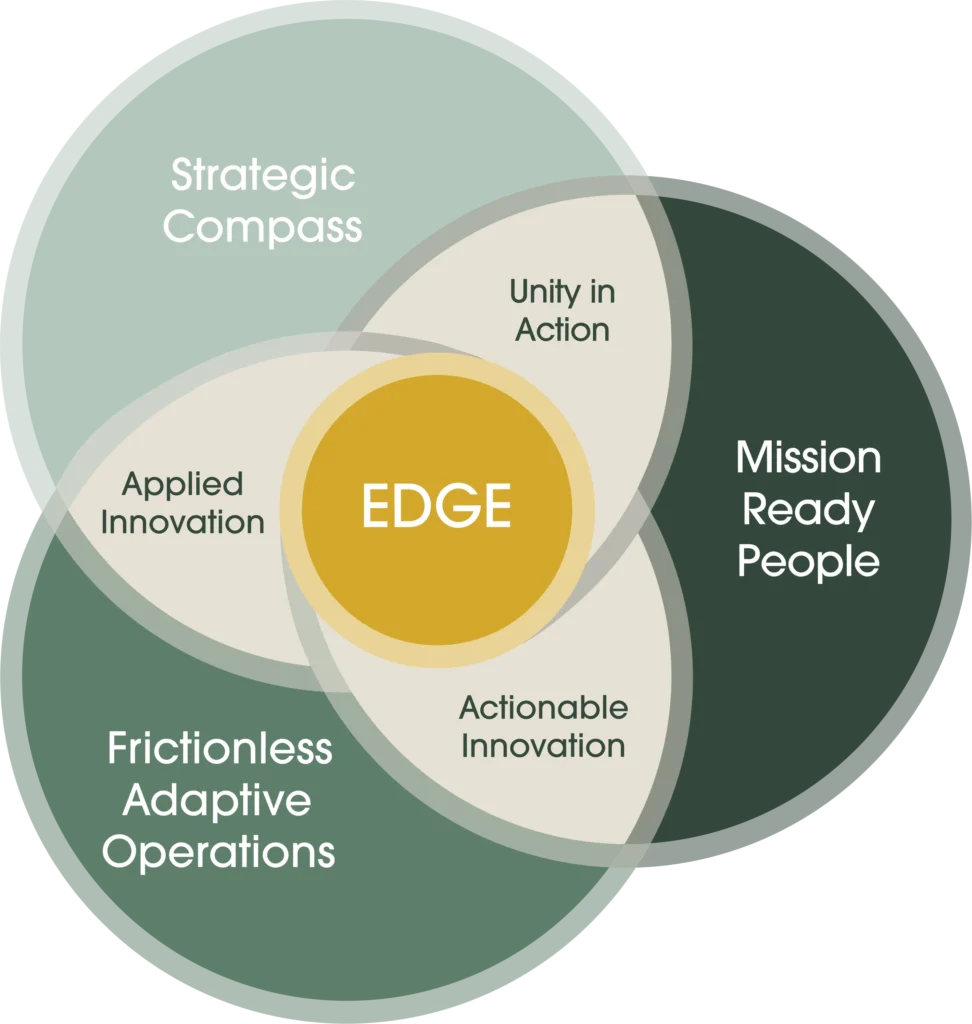
EdgeShift
FOR ENTERPRISES
When advantage erodes because execution fragments under pressure, EdgeShift aligns strategy, operations, and people so performance holds as conditions change, and advantage compounds instead of decaying.
Strategy + People
Unity in Action
THE EFFECT:
Strategy and teams move together. People make local decisions that advance the strategy without constant top-down control.
RISK IF MISSING:
Leadership knows which products are maturing and heading toward sunset but that intelligence never reaches the people making daily improvement decisions. Operations optimizes what is visible, not what is strategic.
People + Operations
Actionable Innovation: implement immediately
Where innovation improvement effort is aimed.
THE EFFECT:
Capable, informed teams working inside adaptive systems turn ideas into real, repeatable improvements that scale beyond pilot.
RISK IF MISSING:
Mature, stable products are the perfect improvement artifact. Predictable, measurable, Six Sigma ready. So that is where operational attention goes. New products in introduction generate no signal yet. Operations leaves them alone. By the time the signal arrives, it arrives as a crisis.
Operations + Strategy
Applied Innovation: solve real world problems
Ideation through research through development through pilot.
THE EFFECT:
Strategic direction is built into the way operations run. Innovation becomes systematic and scalable, not a one-off hero effort.
RISK IF MISSING:
R&D and marketing hand off a validated concept to an operational system designed to run what already exists, not to receive what is new. The pilot succeeds. The scale never comes.
When all three zones are missing, organizations keep making declining products more efficient while the next generation waits in pilot. Innovation at Scale never happens because the system is oriented toward what already exists.
STRATEGIC META SKILLS
How the Pack Learns
to Run the System
EdgeFinder is how you see. Find → Advance → Fortify is what you do. Strategic Meta Skills is how the organization learns to operate the system independently.
SMS trains the Pack in five capabilities: Sensing, Tuning, Innovating, Fusing, and Resonance. The goal is operational coherence. Pack members make the same trade-off decisions under pressure without constant coordination.
Without SMS, the system depends on heroics. With SMS, it becomes operational muscle.

Need Immediate Clarity
If you are leading under pressure and need performance to hold as conditions change, the next step is a short advisory call.