
Duet, Dots, Grok Bot: Same Approach, Different Starting Points
October 23, 2026
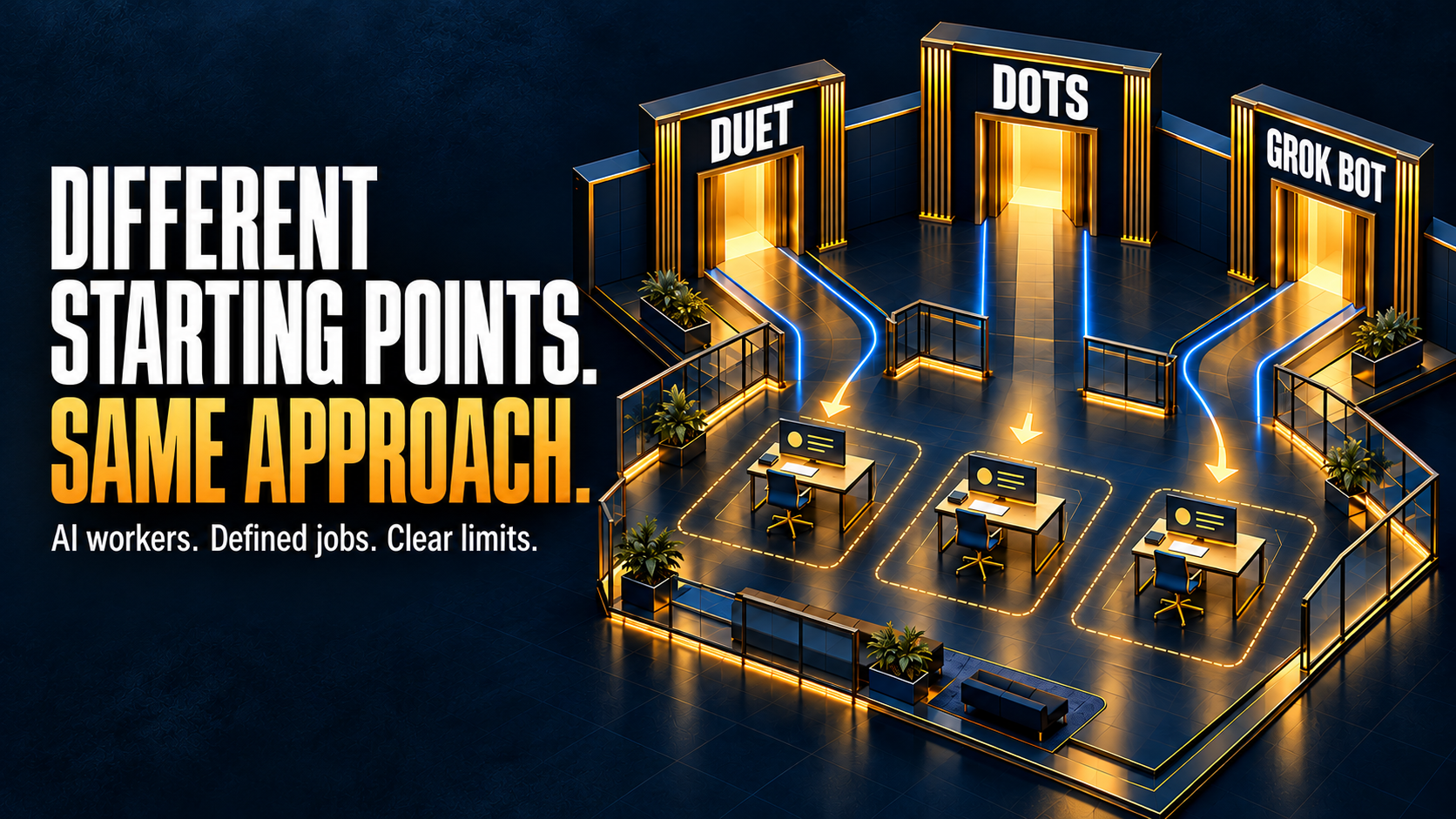
Three launches, three sets of names
Duet, Dots, and Grok Bot look different, but they are building the same thing: a virtual organization made of jobs. Their starting points differ.
Grok Bot entered early beta on August 11, 2026. OpenAI announced Dots on September 29. Anthropic opened a research preview of Claude Duet on October 21. That is three launches in about ten weeks, each with its own names and its own pitch. If you run a company, you may be asking which one to pick, or whether you are already behind.
The shared approach
All three give an AI worker an objective, some limits, its own computer, and a way to report back to you. The products differ in how they package those four things.
| Product | Objective | Limits | Own computer | Reports back |
| Grok Bot | A named bot with a job | Comes back when something needs approval | Persistent cloud computer | Desktop app and iPhone companion |
| Dots | An ongoing goal | You set rules for what it does alone and what it asks about | Cloud computer with a browser | ChatGPT, Slack, Teams |
| Claude Duet | A task in one ongoing thread | Asks before it sends, pays, signs, or deletes | Virtual machine with its own browser | Messages and notifications in its app |
A worker with a goal, a fence, a desk, and a way to call you. That is the pattern in all three rows.
A job description is an objective with more detail
A job description is an objective with scope, rules, and limits written into it. Start with the objective “chase unpaid invoices.” Add the scope (invoices more than 30 days old), the rules (draft the reminder, never send it), and the limit (skip any client on the do-not-contact list). Now you have a job description.
Anthropic’s own Duet announcement uses a close example: checking QuickBooks or Stripe for unpaid invoices and drafting reminders.
Make it run every week, and let it remember what it learned last time. Now you have a bot. So the test I use has three parts:
- Detail: are the scope and limits written down?
- Duration: does it stay open or repeat, or does it end after one run?
- Memory: does it keep what it learned between runs?
A task with all three is a bot, whatever the product calls it.
Three rollout strategies
The companies differ on one thing: who builds the organization.
- Grok Bot builds from the bottom up. You create named bots, and each gets a title and a description. Bots can hand work to each other. You build the team, then put a chief on top. In my own organization, a bot called Chief sits on top.
- Dots starts with one agent. You give a dot a standing job. OpenAI is only beginning to pilot specialist dots, so a team of dots is not here yet. I read that as top-down: one agent first, specialists later.
- Claude Duet starts with one agent too. You message it in one ongoing thread, and it has a Tasks tab for tracking work. Anthropic has not said whether you can create named agents or give a task its own limits. So, far it looks top-down, like Dots. That is my reading, and Anthropic could change it.
My view: where this ends up
I expect all three to look alike within three years. This is my prediction, not a finding.
Each starting point has a gap. Grok Bot gives you the team, but you have to build it. Dots and Duet give you a ready worker, but the team stays out of sight. I think buyers will ask for both: ready on day one and visible and adjustable later. The names will differ. I expect the structure underneath to be the same: a chief on top, jobs underneath, and limits on each job.
What would prove me wrong? A company that keeps its agents hidden for good, and customers who are happy with that.
What to do now
Design the jobs, not the product. Write one page for each job you want done:
- The objective, in one sentence.
- What the worker may do alone.
- What it must ask you about first.
- How often it runs.
- What it must remember between runs.
That page works in any of the three products. To test a product, ask one question: can it hold a standing job with its own limits? If yes, it can be a bot in your organization.
Start with one job that has a clear end result, such as chasing unpaid invoices. Duet is a waitlist preview for Pro and Max subscribers in the US, so you may need to wait for access.
Which jobs could AI take on in your business? Schedule a call to explore where to start and what boundaries to put in place.