
AI Is Revaluing the Middle
October 12, 2026
In the first week of June 2025, Windsurf told its customers that Anthropic had removed nearly all of its direct access to Claude models, with less than a week of notice.
Windsurf sold an AI coding tool. Customers paid Windsurf. But the tool ran on someone else’s capacity, and the supplier changed the terms in days.
Windsurf is a middle. A middle earns money by connecting market participants or supplying a shared capability they would struggle to provide themselves. A coding tool sits between developers and AI models. A data linker sits between hospitals and drug makers. A chip-architecture licensor supplies competing chipmakers.
If you run one, or buy from one, you may be asking whether AI will replace it. The better question is what it is paid for, and who else could be paid for it instead.
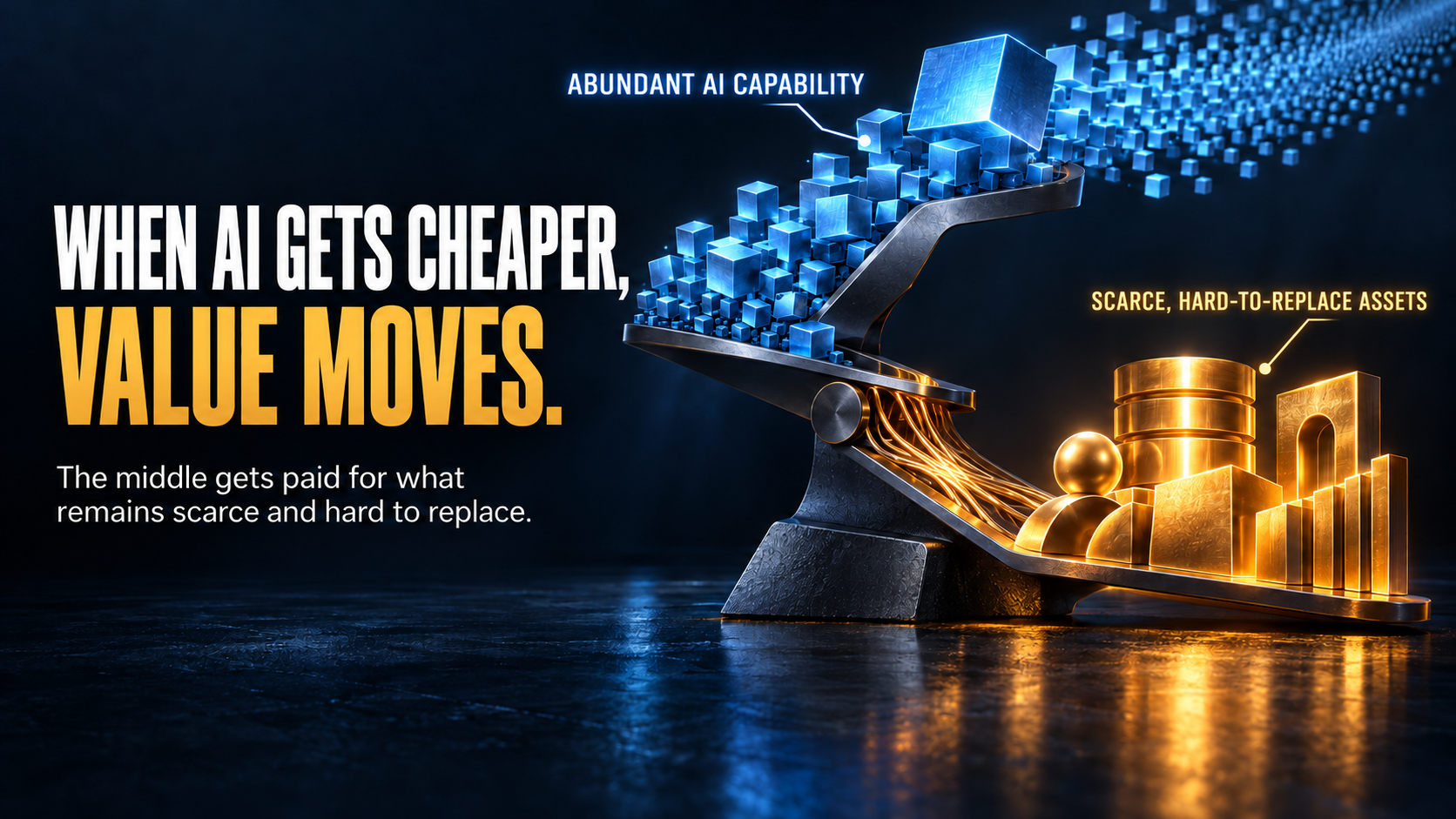
A middle gets paid for what its neighbors cannot easily replace. When one input gets cheap, the money can move to what stays scarce, sometimes before it shows in revenue.
Cheaper AI does not give everyone the same data, access, or relationships
Start with what is getting cheaper. Guido Appenzeller, an investor at Andreessen Horowitz, tracked the lowest price for a model that reaches a fixed score on one benchmark (MMLU, 42 or higher). GPT-3 cost $60 per million tokens when it became public in November 2021. By November 2024, Llama 3.2 3B, run by Together.ai, met the same score at $0.06.2
Keep the limits in view. That is one author, one benchmark score, and prices, not the cost of building the models. He puts the longer trend at about ten times cheaper per year for a given level of performance, and says it may slow.2 It does not show that every AI function is getting cheaper.
What follows is my reading. If a product’s value was access to a fixed level of capability, that value gets harder to charge for as the price falls. The job the middle does can survive even when the middle’s business does not. What stays scarce is whatever the model cannot get on its own.
Reddit shows one version. On May 16, 2024, Reddit announced that OpenAI would get access to Reddit’s real-time, structured Data API. In return, Reddit would use OpenAI’s platform to build AI features. Reddit also stated that commercial use of its API requires its approval.3
Read that from the supplier’s side. OpenAI supplies intelligence. Here it also bought access to a source of content it does not control. The same company is both supplier and customer. Who holds the stronger hand depends on what each side brings and what the other could use instead.
Try a thought experiment. Suppose AI cost nothing tomorrow. What would still cost money? In this case, continuing access to a community that keeps posting, plus permission to use what it posts. In my view, useful data and permission to use it work together, and neither wins automatically.
Technology shifts change who captures the value in the middle
A falling price is one way a middle loses its pay. A platform giving the function away is another. Start in the 1990s.
Netscape Navigator let people reach the new internet from whatever computer they owned. That made the browser valuable. It also made it a threat.
The 1999 court findings in United States v. Microsoft describe Netscape Navigator and Java as middleware that could weaken the Windows barrier to entry. The findings also document that Microsoft gave away Internet Explorer and worked to win preferred browser distribution.4 The court found some of that conduct exclusionary, so this is not a story of ordinary technical progress.
Here is the pattern I take from it. A platform does not have to buy the middle if it can make the middle’s paid function part of the platform. I am not claiming every middle follows that path. The browser is one documented case where the platform owner gave the function away. An AI product that sits on someone else’s platform should ask whether that could happen to it.
Strategy is a sequence of positions and moves
Strategy must account for both position and movement. A position is a snapshot: where a company competes, what it controls, and what it depends on. Then the company acts, competitors respond, and customer needs change, and each of those creates a new starting point.
Starting conditions → strategic moves and market responses → changed position → reassessment
A move that fits one set of conditions can stop fitting when the conditions change. The task is to know why a move works now and what would make it stop working.
The table lists five moves that change a market and five ways to respond to one. They can overlap or come in sequence. They are not company types, and they are not the only strategies.5, 6
| Creating a market change | Responding to a market change |
| Create a new category | Enter or improve the emerging offering |
| Split an existing category | Reposition or refocus within the market |
| Collapse part of the value chain | Reconfigure how you reach and serve customers |
| Change the terms of exchange | Adapt pricing and the revenue model |
| Build a new connecting layer | Strengthen the relationships and access your position depends on |
Two entries matter most for this series. Netscape’s browser was a new connecting layer. Windsurf’s problem, below, was access to its supplier’s capacity. For a model-dependent coding tool, strengthening access could mean securing capacity commitments or making models easier to substitute. Building a stronger connecting layer could mean adding workflow capabilities customers cannot get from the model alone. These are possible moves, not claims about what Windsurf did.
The split between moves that change a market and moves that respond to one comes from Jaworski, Kohli and Sahay.5 The five-by-two layout is my own synthesis. It has not been tested as a classification, and not every case here fits one cell.
The question is not simply, “Which box do we belong in?” It is, “Given where we stand and what is changing, which move should we make, what position could it create, and what would we need to reconsider afterward?”
The AI middle is exposed when its supplier is harder to replace than it is
Back to Windsurf. The company reported that replacement providers could not cover its immediate demand, and that customer access changed as a result. On July 16, 2025, it reported that first-party Sonnet 4 access had been restored for paid users.1
That restoration matters, and so does whose account this is. It is Windsurf’s. It does not tell us why Anthropic acted, and it does not show a permanent cutoff or that Windsurf lacked features of its own. It shows something narrower and still useful: a supplier’s capacity decision reached the downstream product within a week.
Price is only one way a supplier holds power. Capacity counts. So do notice periods, permitted uses, and the time it takes to switch to another model.
Here is the test I would run on any AI product. If your supplier changed access tomorrow, what happens to your service next week? How long does it take to switch? Who is allowed to say no?
A second test: does the product mostly repackage a supplier’s output, or does it add something the supplier lacks? The first is easier to replace. The Windsurf record does not tell us which one Windsurf was. You have to judge that for your own product.
Owning the customer does not settle the matter. You can own the customer relationship and still depend on someone else to keep the service running.
Strategic options can narrow while the business is still growing
Research In Motion, the maker of BlackBerry, reported fiscal 2011 revenue of $19.9 billion, up 33%. It shipped 52.3 million smartphones, up 43%. Its shares still fell more than 10% after the results.7
By March 2012, Wired reported quarterly revenue down 25% from a year earlier, with pressure on the company’s enterprise position.8
BlackBerry made devices and ran an enterprise platform, so it was not a pure middle. The numbers do not identify the best date to sell, show that a buyer existed at some price, or prove one cause of the decline.
What the sequence does show is that growth in the current year can sit next to a falling view of the future. The record year can be a late warning, not proof that the position is safe.
In my view, a board should watch four things before operating weakness shows: whether customers can substitute, whether the platform still matters to them, whether developers still build for it, and what alternatives buyers have. These are my indicators, not findings from the BlackBerry record.
The Bottom Line
A middle gets paid for what its neighbors cannot easily replace. When one input gets cheap, the money can move to what stays scarce, sometimes before it shows in revenue.
Before your next board meeting, ask one question. If our supplier or our platform changed its terms next quarter, what would we still own that they could not replace?
If you cannot name it in a sentence, you have found your next project.
If your business sits between customers and someone else’s technology, I would like to hear how you would answer the supplier test. Schedule a call or reach out through jim@jfjordan.com to discuss how to strengthen your position.
Sources and notes
1. Statement on Anthropic Model Availability, Windsurf, June 3, 2025, updated July 16, 2025. Note: Windsurf’s own account; it does not establish Anthropic’s reasons.
2. Appenzeller, G. Welcome to LLMflation: LLM inference cost is going down fast, Andreessen Horowitz, November 12, 2024. Note: one author’s analysis of price for a fixed benchmark score.
3. Reddit and OpenAI Partner, Reddit, May 16, 2024. Note: company announcement; it does not show exclusivity, price, or that Reddit owns its users’ copyrights.
4. United States v. Microsoft: Court’s Findings of Fact, U.S. Department of Justice archive, 1999. Note: it does not show that the same cycle fits every market or that browsers lost all value.
5. Jaworski, B., Kohli, A. K., and Sahay, A. (2000). Market-driven versus driving markets. Journal of the Academy of Marketing Science, 28, 45-54. Note: supports the two orientations, not this exact table.
6. Research behind individual rows, none of which validates the table: Navis and Glynn (2010), how new categories emerge; Shankar, Carpenter and Krishnamurthi (1998), late entrants; Rosa and others (1999), product market formation; Smith (1956), segmentation; Balasubramanian (1998), direct channels; Lambrecht and Skiera (2006), tariff choice; Nenonen and others (2019), market shaping; Palmatier and others (2006), relationship marketing.
7. RIM stock tanks after disappointing results, RCR Wireless, March 25, 2011. Note: a share price reaction is not a full measure of strategic value.
8. RIM earnings coverage, Wired, March 2012.