
The Execution Advantage: Why Organizations That Learn Faster Execute Better
September 22, 2026
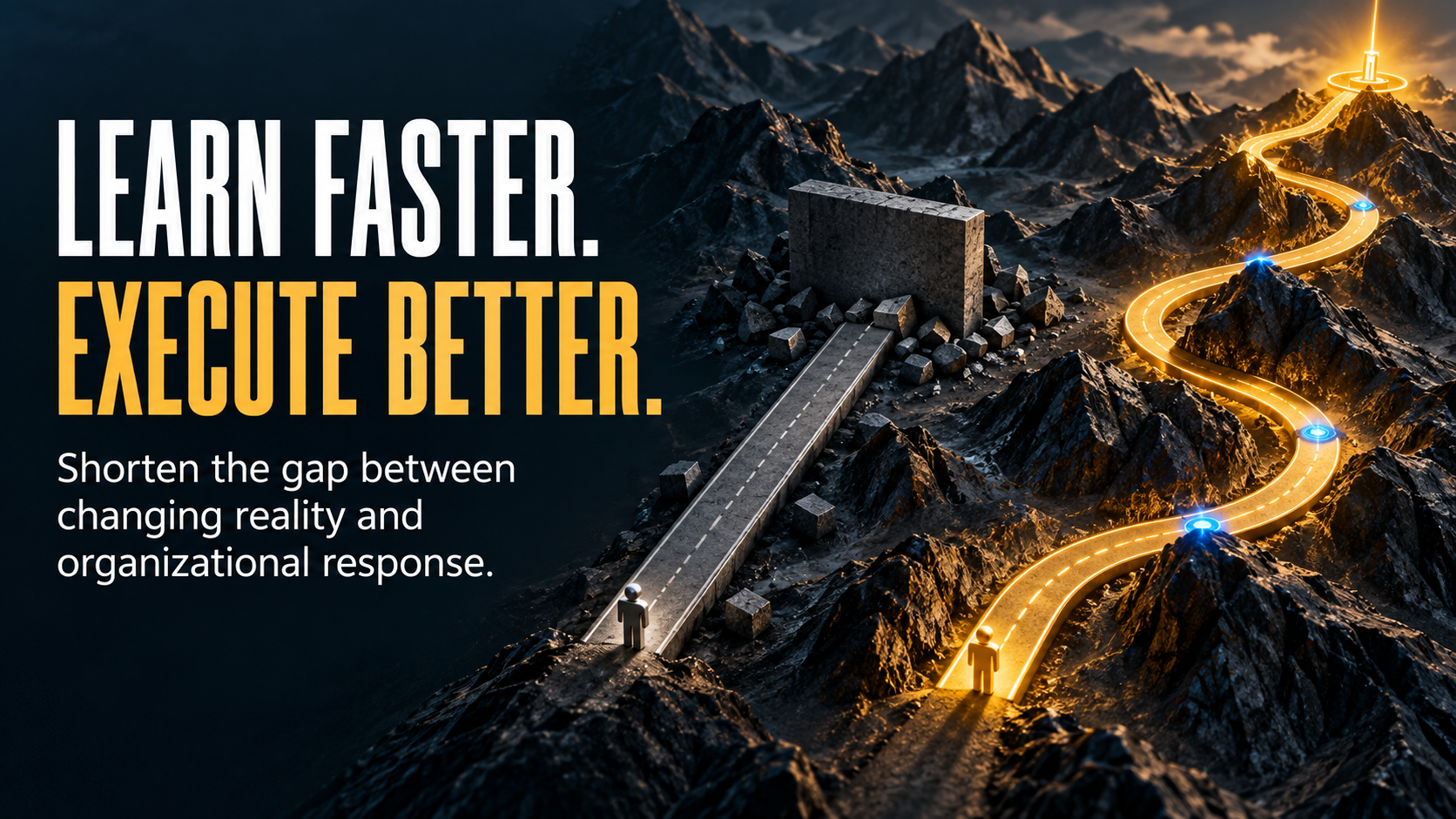
The Myth of Perfect Execution
Most executives, when facing execution problems, reach for the same playbook:
We need more accountability. We need stronger discipline. We need better execution.
Sometimes they are right. Often they are treating symptoms rather than causes.
Organizations frequently fail not because people refuse to execute. They fail because people are executing an outdated understanding of reality.
A plan made in January assumes January’s market. By March, the market has moved. By June, it has changed fundamentally. But the organization keeps executing against the January assumptions.
This is not a discipline problem. This is a learning problem.
Why Good Plans Still Fail
A mission can be clear. A strategic storyboard can be complete. Resources can be allocated. Capabilities can exist.
Execution can still fail.
Why?
Because assumptions changed. Reality moved. The organization did not.
The plan was sound. The execution was disciplined. But the plan was built on a version of reality that no longer exists.
This happens thousands of times in organizations every year. A department executes flawlessly against a plan that stopped being relevant six months ago. A team moves with precision down a path that no longer leads where the organization needs to go.
The failure is not in the execution. The failure is in the gap between what the plan assumes and what reality actually is.
Execution Is An Outcome
Here is the fundamental principle:
Execution is the visible result of invisible systems.
Most organizations treat execution as a cause. We execute well, and good things happen. We execute poorly, and bad things happen.
But execution is actually an outcome. It is produced by systems that run in the background:
Clarity about what matters. Capability to adapt. Alignment around reality. Learning from variance. Investment in the right capabilities.
Poor execution is often evidence of failures elsewhere in the system.
A team executing beautifully against an obsolete plan is not executing well. They are executing perfectly toward the wrong destination.
A team moving slowly because they are constantly re-learning something they should have learned once is not disciplined. They are caught in recurring effort.
A team that cannot decide between competing priorities is not indecisive. They are executing without alignment.
Execution is a symptom. The real work is fixing the systems underneath.
The Learning Loop
The strongest organizations operate in a continuous cycle:
Mission clarifies what matters. Strategic Storyboard clarifies what must be true. EdgeFinder detects where reality deviates from the storyboard. The Pack reports variance. Find identifies which capabilities are constrained. Advance develops those capabilities. Fortify removes structural obstacles. Fortify Review surfaces capability gaps and persistent variance. Strategic Meta Skills develops the capabilities the review identifies. Better execution follows. Then the cycle repeats.
This is not a once-per-year planning process. This is a continuous learning system. Mission provides direction. Everything else detects variance and adapts.
The organization is not trying to execute a fixed plan in a changing world. The organization is continuously learning what the world actually is and adjusting accordingly.
Why Speed Matters
The advantage is not learning itself. Many organizations learn.
The advantage is learning faster.
Consider two organizations in the same market:
Organization A discovers in month six that a key assumption changed. By month nine, the assumption has been acknowledged. By month twelve, a response has been planned. By month fifteen, execution begins.
Organization B discovers in month two that the same assumption changed. By month three, it is acknowledged. By month four, a response is planned. By month five, execution begins.
Same learning. Vastly different timing.
Organization B gains three months of execution against reality. Organization A has spent nine months executing against an assumption that no longer holds.
Over time, this timing advantage compounds. Organizations that shorten the cycle between reality changing and the organization responding gain separation from competitors that cannot move as fast.
This is the execution advantage. Not perfect plans. Not flawless discipline. But the ability to sense reality, adapt to it, and execute against it faster than competitors can.
The Hidden Cost of Slow Learning
When organizations do not learn quickly, costs begin to compound:
Recurring effort multiplies. The same problem is solved repeatedly because organizational learning never happens. Energy spent solving the same obstacle in three different places could have solved the obstacle once at the system level.
Investment drifts. Resources continue flowing toward initiatives built on assumptions that no longer hold. Capital is deployed toward yesterday’s strategy.
Adaptation slows. By the time the organization responds to market change, the change has already shifted again. The organization is always executing against the previous version of reality.
People burn out. They are not burning out from hard work. They are burning out from the futility of executing plans that stopped being relevant. They work hard and see no progress. That is demoralizing.
Culture degrades. People stop speaking up. Why report a variance if leadership will not act on it? Why share an observation if the learning will not stick? Why invest in improvement if tomorrow will require solving the same problem again?
These costs compound. Organizations become increasingly busy while becoming increasingly ineffective.
The activity increases. The progress decreases.
The Leadership Role
Leadership cannot execute everything. Leadership creates the conditions for execution.
Leaders establish mission. They provide direction about what matters most.
Leaders establish priorities. They create focus about where to invest first.
Leaders establish capability investments. They sponsor the development of skills and systems the organization needs.
Leaders establish review mechanisms. They create structures for learning to become systematic rather than accidental.
The Fortify Review is one such mechanism. It creates a rhythm where leadership intentionally surfaces variance, acknowledges obstacles, and invests in capability renewal.
Organizations become what leadership reviews.
If leadership reviews sales every month, the organization learns that sales matter. If leadership reviews capability every month, the organization learns that capability matters. If leadership reviews variance every month, the organization learns that understanding reality matters more than defending assumptions.
Leadership does not execute. Leadership creates systems where the organization learns faster, adapts more coherently, and executes more effectively.
Why Culture Matters
Culture determines whether execution systems actually work.
Culture determines whether people speak up. In some organizations, bad news travels upward. In others, it disappears. The difference is culture.
Culture determines whether assumptions are challenged. In some organizations, people are rewarded for questioning whether a plan still makes sense. In others, people are punished for raising concerns.
Culture determines whether learning is preserved. In some organizations, lessons learned stick. In others, the organization forgets and re-learns the same lesson repeatedly.
Culture determines whether variance is seen as signal or as failure. In some organizations, persistent variance triggers learning. In others, variance triggers blame.
Execution is cultural before it becomes operational.
Organizations do not execute strategies. People do. And people execute based on whether they trust leadership, whether they believe their observations matter, whether they know they will be heard if reality deviates from plan, and whether change is welcome or threatening.
An organization with perfect systems but a culture of fear will execute poorly. An organization with simpler systems but a culture of learning will execute better.
Activity Is Not Progress
Many organizations are busy. Meetings, initiatives, projects, decisions.
Many organizations are disciplined. People work hard. Resources are allocated. Plans are executed.
Many organizations are hardworking. Long hours. Dedication. Commitment.
None of those guarantee progress.
Progress requires movement toward mission under changing conditions.
An organization can be busy, disciplined, and hardworking while moving away from its mission. The busier it is, the less it notices the direction has changed.
Activity creates motion. Learning creates progress.
Organizations that are active but not learning execute faster in the wrong direction. Organizations that learn but are not active understand the right direction but cannot reach it.
The strongest organizations combine both. They learn what reality actually requires. And they execute with discipline and speed toward that reality.
The EdgeFinder System
This entire series has been building one coherent system.
Mission clarifies what matters. Not what is urgent. Not what is loud. What actually matters to the organization’s reason for existing.
Strategic Storyboard clarifies what must be true. What inputs are required. What activities must happen. What outputs should result. What outcomes should emerge. The storyboard establishes expected reality against which variance can be detected.
EdgeFinder detects change. It treats variance as signal rather than noise. When reality deviates from the storyboard, something is worth understanding.
The Pack sees reality first. While leadership operates at the system level, the Pack experiences reality daily. Variance hits the Pack before it reaches leadership.
Find, Advance, Fortify creates adaptation. Find identifies what is constrained. Advance builds capability. Fortify removes obstacles. Together they enable the organization to respond to what variance reveals.
Fortify Review creates leadership visibility. It surfaces variance from the Pack to leadership systematically. It connects capability gaps revealed by variance to capability investments needed.
Strategic Meta Skills develops the specific capabilities that variance reveals as required. Not training. Not skills development for its own sake. But capability development targeted at the obstacles the learning system has identified.
Organizational Capability creates sustained competitive advantage. Not from executing today’s plan, but from the system’s ability to sense, learn, and adapt continuously.
Together, they create the Execution Advantage. Not through perfect plans or flawless execution. But through a system that detects reality faster, learns from it more completely, and adapts more coherently than competitors can.
Related Video: What Role Does A Mentor Play In Leadership Development?
The EdgeFinder Principle
Most organizations pursue better plans.
The strongest organizations build better learning systems.
Plans become obsolete. Markets change. Customers change. Competitors adapt. Reality moves.
The organization that learns faster than reality changes gains an advantage that competitors struggle to match.
It is not that the plan was better. It is that the system for detecting when the plan stopped working was better. And the system for adapting was faster. And the capability to execute the new direction was stronger.
Mission provides direction. The Strategic Storyboard provides clarity. EdgeFinder provides awareness. Strategic Meta Skills provide capability. The Fortify Review provides leadership visibility into variance.
Together they create an organization capable not merely of executing today’s strategy, but of continuously adapting and executing tomorrow’s.
The organization that learns faster executes better.
That is the execution advantage.
Get in touch to explore how your organization can learn faster, adapt sooner, and execute better.