
MISSION BEFORE CAPABILITY
September 2, 2026
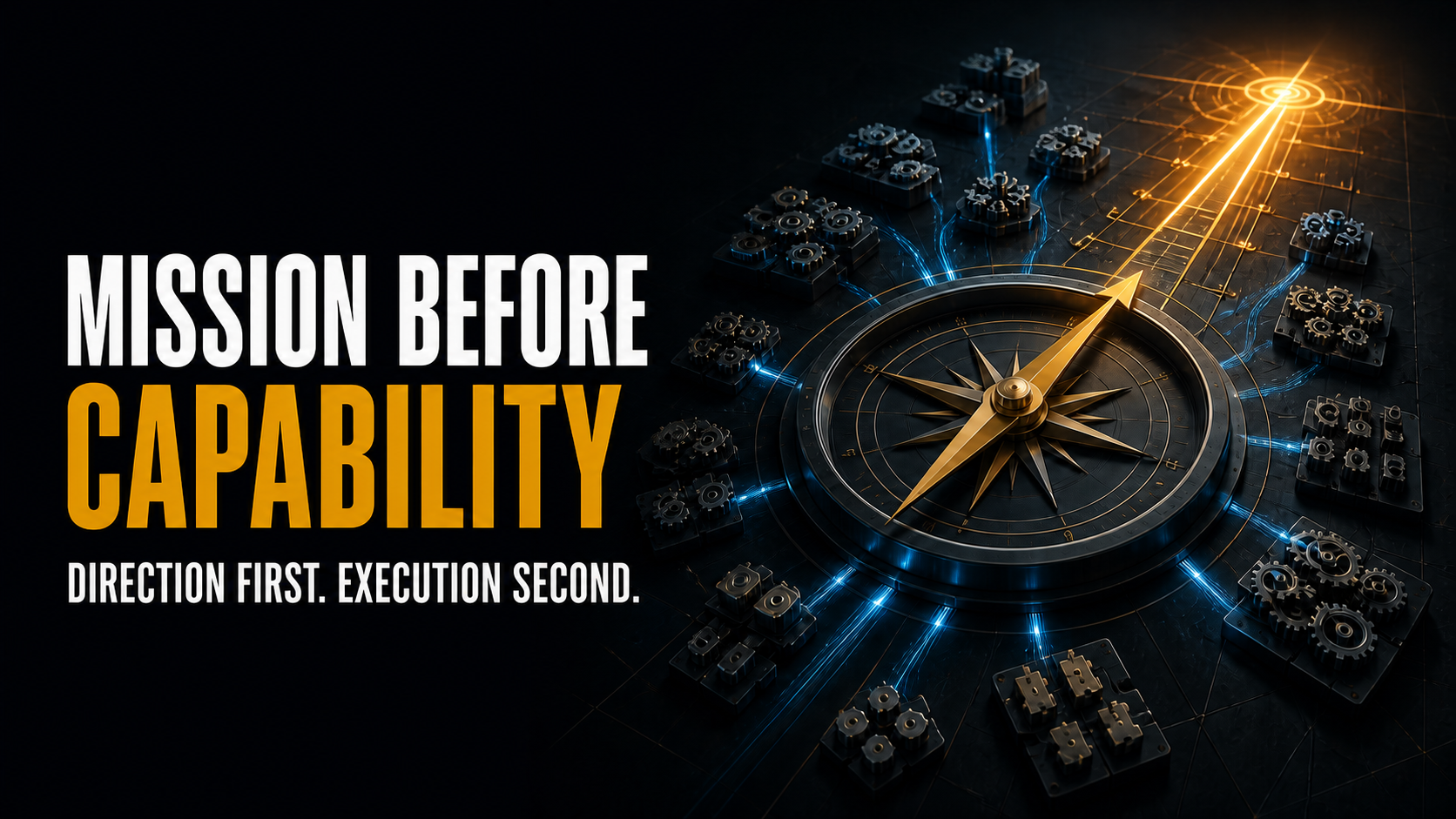
Why Organizations Must Agree on What Matters Before They Improve How They Work
Most leadership teams spend their energy asking the wrong question.
How do we become more innovative? How do we become more agile? How do we improve execution? How do we develop leaders?
These sound intelligent. Every one of them will attract investment, consulting engagement, and board-level nods of approval.
But every one of them skips a more fundamental question.
Toward what end?
THE WRONG QUESTION
Organizations are trapped in a capability-first mindset. The implicit logic goes like this: if we build better capabilities, better outcomes will follow. Train the leaders. Improve the systems. Certify the methodologies. Then watch the advantage compound.
This is backward.
The insight is not new. Military strategy has understood this for decades. A soldier in the field cannot receive real-time instructions for every decision. Conditions change too fast. Communications break down. Reality intervenes. What the soldier needs instead is clarity about intent. Why are we here? What outcome matters most? What are we protecting or preserving?
That clarity becomes the decision architecture. The soldier makes better choices because he understands the mission, not because he was given perfect instructions.
The same principle applies to organizations. Yet most organizations attempt to improve capability before establishing clarity about mission.
They train. They certify. They launch leadership programs. They implement methodologies. They improve execution.
But they never fully answer: What are we trying to accomplish?
CAPABILITY WITHOUT DIRECTION
A highly capable organization can still fail. Consider three scenarios that play out repeatedly:
1. Efficient Execution of Declining Strategy
The execution is flawless. The strategy is obsolete.
2. Optimization in Shrinking Markets
The process improvements are real. The market opportunity is gone.
3. Capabilities Nobody Needs
The training is world-class. The skills are misaligned with actual demand.
This is the trap of capability without direction. The organization amplifies its effort and gets only louder failure.
Capability amplifies direction. It does not provide direction.
Capability is purchasable. Alignment is not.
Yet in most organizations, leadership focuses on capability development without first answering what that capability should serve.
WHY MISSION COMES FIRST
Mission is not what most organizations think it is.
It is not a wall poster. It is not a slogan. It is not an aspirational statement about “making a difference.”
Mission is the shared understanding of what matters.
Mission answers three essential questions:
1. Why do we exist?
2. What promises are we trying to keep?
3. What outcomes matter most?
Without a clear answer to these questions, the organization cannot align. Different departments operate under different assumptions about what success looks like. Resources get distributed based on politics rather than priority. Variance goes uninterpreted because the organization has no frame for understanding what variance signals about the work that matters.
With mission clarity, something shifts. The Pack knows what to protect. The team knows where variance appears first. Leadership can interpret what they are seeing.
In the EdgeFinder system, mission is the frame through which variance becomes signal. Without it, variance is just noise. The organization detects change but cannot determine whether the change matters.
THE MILITARY LESSON: INTENT OVER INSTRUCTION
The military learned this lesson through necessity, not theory. A commander cannot control an operation through a chain of command that depends on perfect communication and unchanging conditions. War is fluid. Plans fail. Communication networks get damaged. Subordinates face situations their leaders did not anticipate.
What works instead is intent-based orders. The commander explains the mission: what the operation aims to achieve, why it matters, what constraints exist. Then subordinates adapt their execution to changing conditions while staying aligned to the mission.
This is not giving people freedom to do whatever they want. It is giving people a decision frame so that when they face an unanticipated choice, they can decide in a way that serves the larger purpose.
Organizations should work the same way. Once the team understands the mission, they can adapt their execution to changing conditions while staying aligned. They do not need permission. They do not need a memo. They do what the mission requires.
This ties directly to how variance operates in the EdgeFinder system. The Pack detects variance because the team is watching for variance that matters to the mission. The team interprets that variance against what they know matters most. The team acts because they understand the intent behind the work.
Without mission clarity, the team cannot do this. They report variance through channels. They wait for instructions. They cannot adapt.
THE HIERARCHY: VISION, MISSION, PRINCIPLES, AND CREDO
Most organizations conflate these concepts. Leadership uses the terms interchangeably, creating confusion about what actually guides decision-making.
They are not interchangeable. They form a hierarchy.
Vision is the future destination. Where the organization aspires to be. What the market experience could look like if the organization executes perfectly. Vision points to what is possible.
Mission is the purpose and promise. Why the organization exists right now. What commitment the organization is making to customers, employees, and partners. Mission is present tense. It is what we are doing today to move toward the vision.
Principles are the decision rules that ensure mission-aligned choices. When faced with a choice, principles answer: what matters most in this decision? What trade-offs are acceptable? What trade-offs are not?
Credo is the behavioral commitment. How the organization will conduct itself in pursuit of mission. Credo answers: how will we act? What are the non-negotiable standards for our conduct?
Together, they create alignment. A team that understands vision, mission, principles, and credo can navigate complexity. They can make decisions without checking in with leadership every time. They can interpret variance through a shared frame.
Most organizations have slogans and wall posters. Few have clarity on the hierarchy that connects vision, mission, principles, and credo. And fewer still use that clarity to actually guide decision-making.
THE STRATEGIC STORYBOARD: WHERE MISSION MEETS CAPABILITY
Most organizations discuss outcomes, goals, and aspirations without discussing requirements. They approve ambitious targets and then cut resources. They celebrate strategy and then shrink staffing. They promise customers and then reduce investment.
The gap between promise and resources is never reconciled. It simply lives as organizational stress.
The Program Logic Model forces this visibility. Here is the logic:
Resources create activities. Activities create outputs. Outputs create outcomes.
Remove one component and something else must change. If you reduce resources, you must reduce activities. If you reduce activities, you will reduce outputs. If you reduce outputs, outcomes will decline.
Yet in most organizations, leadership approves outcomes and then reduces resources, pretending the logic does not apply.
WHY BUDGET SEASON REVEALS REALITY
Leadership approves ambitious outcomes. “We will grow market share by 15 percent.” “We will launch three new products.” “We will improve customer retention by 20 percent.”
Then budget season happens. Resources are cut. Staffing is reduced. Investments are deferred.
But the outcomes? Those targets remain unchanged. The organization simply absorbs the contradiction. People work harder. Corners are cut. Quality erodes. Stress increases.
The Program Logic Model exposes this contradiction. It forces visibility: if you want these outcomes, you need these resources and these activities and these outputs. If you reduce resources, you must reduce outcomes or increase pressure on the team.
When mission is clear, the Program Logic Model becomes a planning discipline. The organization discusses what outcomes matter most (mission). Then it plans the activities and resources required (capability). Then it reconciles the two.
The Pack knows what matters. Capability is designed to serve mission, not vice versa.
REQUIREMENT TRUTH: MISSION MAKES IT VISIBLE
This connects back to the first article in this sequence. Requirement Truth asked: what must be true for this commitment to hold?
Mission defines the commitments. The Program Logic Model exposes the requirements. Requirement Truth becomes visible through the connection between them.
An organization that understands mission and applies the Program Logic Model can answer the essential question: what must be true about our capability, our resources, our processes, and our people for our mission to hold under pressure?
Without mission clarity, Requirement Truth remains abstract. The organization cannot determine what is actually required because it has not agreed on what matters most.
With mission clarity, Requirement Truth becomes operational. The organization can see what must be in place. When variance appears, the organization can interpret whether the variance is a threat to Requirement Truth or merely a friction point that does not matter to mission.
WHY CAPABILITY DEVELOPMENT OFTEN FAILS
Organizations frequently train capabilities without strategic context. They develop leaders in communication, decision-making, and innovation. They implement methodologies. They certify processes.
But they never connect the training to the mission.
The training is disconnected from purpose. People learn problem-solving skills but not which problems matter. They learn innovation techniques but not which innovations serve the mission. They learn to be “agile” but not what direction they are being agile toward.
This is why capability development often fails. The capability is real. The effort is genuine. But it is orphaned from the mission it should serve.
In the EdgeFinder system, Strategic Meta Skills builds the organizational muscle to execute a shared mission in a changing environment. But SMS only makes sense after mission clarity exists.
THE COST OF MISALIGNMENT
When mission is unclear, misalignment spreads silently.
Different departments optimize for different outcomes. One team chases growth; another chases margin. One team values speed; another values quality. One team builds for today; another builds for tomorrow.
Each team has coherent logic from its own perspective. But the organization as a whole has no coherence.
Misalignment creates wasted effort. Resources go to contradictory priorities. Work gets redone because teams did not coordinate. Decisions get reversed because different leaders have different assumptions about what matters.
Misalignment slows decisions. Every choice requires lengthy negotiation because teams cannot align on outcome. Escalation becomes the default when cross-functional decisions need to be made.
Misalignment creates recurring friction. The same conflicts appear again and again. The organization resolves them on an ad-hoc basis rather than addressing the underlying misalignment.
Most damaging: misalignment creates variance that never resolves. The Pack detects something is wrong, but the variance cannot be interpreted because the organization has no frame for understanding what should be normal. Is this variance about strategy, execution, market conditions, or internal conflict? The organization cannot tell.
Without mission clarity, variance becomes noise.
MISSION CREATES COHERENCE
The payoff of mission clarity is coherence.
When the organization agrees on what matters, something shifts internally.
The Pack knows what to protect. Variance becomes easier to interpret because the team has a frame for understanding what variance signals about mission-critical work. The team can ask: Is this variance about something that matters to our mission? If yes, it is signal. If no, it is friction that we can absorb.
The Five Diagnostic Variances become easier to apply. The team understands whether the variance is operational, behavioral, strategic, market-based, or pattern-based. And more importantly, the team understands which category of variance matters most given the mission.
Find, Advance, Fortify becomes easier to execute. The team finds variance. They understand which variance matters to mission. They advance to the move that serves the mission. They fortify the gain and ask whether the fix should scale to the whole organization.
This is how EdgeFinder actually works in practice. The philosophy operates through a shared understanding of what matters. Without mission, the philosophy is a set of smart concepts that do not connect to actual execution.
Mission is not separate from EdgeFinder. Mission enables EdgeFinder.
WHY CAPABILITY COMES SECOND
This is the insight that leads naturally into capability development.
Once mission is understood, now capability matters.
Now the organization can ask the right question: what skills, behaviors, and systems are required to fulfill this mission in a changing environment?
That question leads naturally into capability development. Not capability for its own sake. Capability designed to execute the mission.
Strategic Meta Skills becomes the training program that installs EdgeFinder as organizational muscle. But here is the critical point: SMS is built in response to a mission, not in advance of one.
The organization is not building generic capability. It is building the specific capability required to execute a specific mission under pressure and at pace.
Related Video: What Is The Theory of Constraints?
THE EDGEFINDER PRINCIPLE
Here is the fundamental insight:
Organizations do not gain advantage because they possess more capability.
They gain advantage because their capability is aligned toward a shared purpose.
Mission determines direction. Capability determines execution. Without mission, capability creates motion. With mission, capability creates advantage.
The organization that is less capable but unified around a clear mission will outperform the organization that is more capable but misaligned. The unified organization converts capability into results. The misaligned organization converts capability into noise.
Most leadership development focuses on building capability. EdgeFinder focuses on aligning it.
The question for leadership is not: how do we build more capability?
The question is: what are we trying to accomplish?
Answer that first. Everything else follows. If your organization is facing this challenge, let’s talk.