
Organizational Capability: The Ultimate Competitive Advantage
August 28, 2026
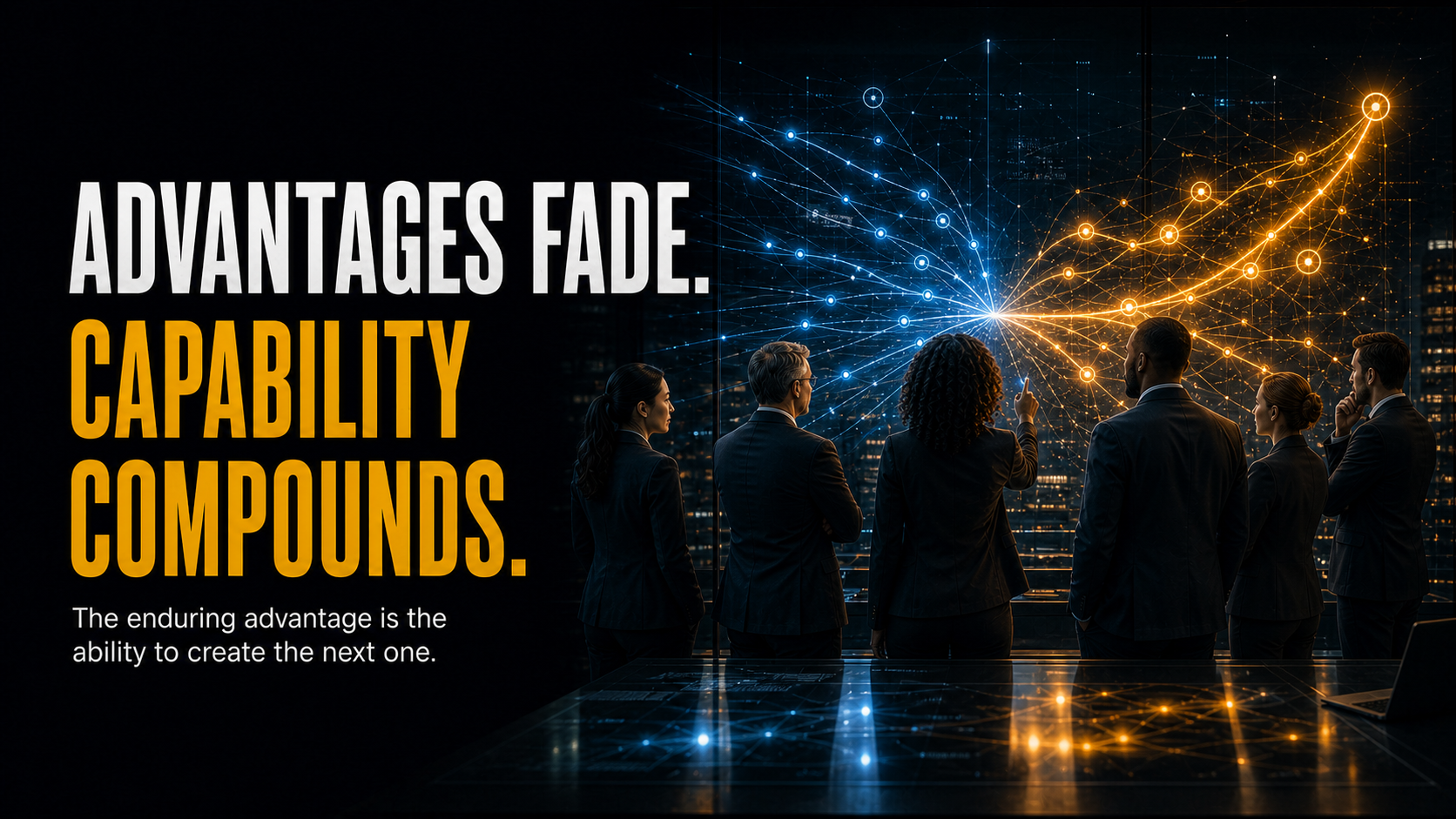
Why Capability Outlasts Strategy, Products, and Technology
The Competitive Advantage Trap
Organizations spend enormous energy asking: What is our competitive advantage? How do we protect it? How do we grow it?
Those are important questions.
But they miss a more important one: What allows us to create the next advantage when this one inevitably fades?
The assumption embedded in most competitive strategy is that advantages endure. Organizations build moats. They create defensibility. They assume that if they can achieve a position of advantage, they can hold it.
But this assumption is wrong.
Advantages do not endure. They decay.
The Problem with Advantages
Technology leadership gives way to new innovations. Cost advantages erode as competitors learn. Product differentiation fades as the market catches up. Distribution advantages dissolve as channels shift. Brand positions fade as customer needs evolve.
History is a graveyard of once-dominant organizations that lost their advantage and never recovered. Not because they lacked intelligence. Not because they lacked resources. But because they confused their current position with their underlying capability.
When the position changed, they had no system for creating a new one.
What Actually Sustains Advantage
The organizations that sustain competitive advantage are not the ones with the best current position. They are the organizations with the strongest capability to adapt.
Consider two organizations that possess the same advantage. One loses it and enters decline. The other loses it and creates another. The difference is not luck or timing. The difference is capability.
Capability is the organizational muscle that allows a company to detect what changed, interpret what it means, respond coherently, and institutionalize the learning so the adaptation becomes part of how the organization works.
Without capability, advantage is temporary. With capability, advantage can be renewed repeatedly.
Capability Is a Renewal System
The previous articles in this series have outlined the components of this renewal system.
EdgeFinder provides the lens to recognize meaningful variance in the market and inside the organization. The Pack operates as the sensing network closest to customer reality, where variance becomes visible first. Find, Advance, Fortify creates the adaptation cycle that moves from detecting variance to institutionalizing the response. Strategic Meta Skills provide the human and organizational capabilities required to operate that cycle effectively. Fortify preserves the learning so capability compounds rather than resets with each new challenge.
Together, these elements create a renewal system. An organization with this system can sense, adapt, and learn faster than the environment changes around it. And that is what allows advantage to be created repeatedly rather than held statically.
The Difference Between Assets and Capabilities
This distinction matters greatly.
Assets are things the organization possesses: patents, products, facilities, capital, distribution networks. Assets can create competitive advantage. A superior technology can dominate a market. A unique product can command a premium. Efficient manufacturing can create a cost advantage.
But assets age. Technology is surpassed. Products become commodities. Facilities become obsolete. Capital gets deployed. Competitors learn and respond.
Capabilities are how the organization thinks and operates: sensing, adaptation, alignment, learning, decision-making coherence. Capabilities are embedded in people, systems, and culture. Capabilities allow organizations to renew assets. When a product becomes obsolete, capability determines whether the organization can create the next one. When a market advantage erodes, capability determines whether the organization can find another.
Assets create advantage. Capabilities renew advantage.
Why Organizations Confuse Success with Capability
Many organizations assume: We succeeded, therefore we are capable.
Not necessarily.
Sometimes success comes from market timing rather than competitive superiority. Sometimes it comes from regulatory protection rather than operational excellence. Sometimes it comes from temporary scarcity rather than lasting differentiation. Sometimes it is simply luck.
True organizational capability reveals itself through repeated adaptation. The organization that can sense changing markets, make coherent decisions under uncertainty, align people around new direction, and institutionalize learning—that organization demonstrates capability.
An organization that succeeded once may have been fortunate. An organization that succeeds repeatedly has capability.
Capability Compounds
Capability creates leverage because each improvement reinforces the next.
Better sensing leads to earlier detection of meaningful variance, which reduces surprises and wasted resources. Faster learning reduces waste across the organization. Stronger alignment reduces friction in execution. Improved decision-making coherence shortens the cycle from insight to action. Lower recurring effort—the energy spent maintaining yesterday rather than creating tomorrow—releases resources for adaptation and growth.
These effects are not independent. They compound.
Organizations trapped in recurring effort spend their energy maintaining yesterday. Their attention is consumed by keeping yesterday’s systems running. They have no capacity for tomorrow. Organizations with strong capability invest their attention in creating tomorrow, because the systems that manage yesterday run with efficiency rather than crisis.
Over time, this compounds into a widening gap. The capable organization dedicates increasing resources to adaptation and growth. The less capable organization spends increasing resources trying to keep up. One is building the future. The other is defending the past.
This is not merely an organizational observation. It has economic consequences. Faster learning reduces waste. Better sensing reduces surprises and unplanned expenses. Stronger alignment reduces friction and rework. Lower recurring effort releases capital for investment in capability and innovation. Over time these effects compound, creating a widening gap in profitability, growth rate, and competitive resilience between organizations that adapt and organizations that react.
The Capability Stack
The organizational capability that sustains competitive advantage is not a single skill or program. It is a system of elements working together.
Mission defines what matters and provides the direction the organization renews its advantage toward. EdgeFinder provides the lens to detect meaningful change. The Pack acts as the sensing network closest to reality, where variance becomes visible first. Find, Advance, Fortify creates the adaptation cycle that moves from detecting variance to institutionalizing the response. Strategic Meta Skills provide the capabilities required to operate that cycle effectively. Fortify preserves the learning so capability compounds rather than resets.
These elements are not independent initiatives. They operate as a system. Mission defines what matters. EdgeFinder provides the lens to detect change. The Pack acts as the sensing network closest to reality. Find, Advance, Fortify creates the adaptation cycle. Strategic Meta Skills provide the capabilities required to operate that cycle effectively. Fortify preserves the learning so capability compounds rather than resets. Together, they create organizational capability.
The Strategic Consequence
There is a critical distinction between two types of organizations.
A company with one advantage may win temporarily. When that advantage erodes, the company declines. A company with superior capability can win repeatedly. When one advantage erodes, the capability system detects what changed, adapts the response, and creates the next advantage.
This is the difference between Advantage and Advantage Creation.
Most organizations pursue competitive advantage. The strongest organizations pursue the capability to create and renew competitive advantage repeatedly. This is not semantic. It is a fundamental strategic choice about what the organization optimizes for.
Optimize for advantage, and you will win until the advantage fades. Optimize for the capability to create advantage, and you create sustained competitive advantage.
Why Capability Is Hard to Copy
Competitors can copy many things. Products can be reverse-engineered. Services can be replicated. Features can be matched. Pricing can be undercut. Business models can be imitated.
Much harder to copy is organizational capability.
Capability is embedded. It lives in how people think, how decisions are made, how information flows, how learning is preserved, how the organization aligns around change. It is embedded in culture, systems, and the rhythm of how work happens.
A competitor can hire talented people away. But they cannot hire away the capability to sense, decide, and adapt together as a system. A competitor can purchase technology. But they cannot purchase the organizational muscle to deploy it effectively. A competitor can study your strategy. But they cannot copy the capability that allows you to shift strategy when conditions demand it.
This is what makes capability a durable competitive moat. Not because it is secret. But because it is systematic and embedded. Related Video: Organizational Constraints in Decision Making
The EdgeFinder Principle
Most organizations pursue competitive advantage.
They ask: What should we win at? How can we dominate this market? How do we protect our position?
The strongest organizations pursue the capability to create and renew competitive advantage repeatedly.
They ask: What allows us to detect change before it becomes crisis? What allows us to make coherent decisions under uncertainty? What allows us to align our people around new direction? What allows us to learn from each cycle so the next adaptation is faster?
Advantages come and go. Technology becomes obsolete. Products become commodities. Markets shift. Competitors respond. Advantage decays.
Capability endures.
Mission provides direction. EdgeFinder provides the lens. Strategic Meta Skills provide the adaptive capability. Fortify preserves the learning.
Together they create an organization capable not merely of winning, but of winning again.
And again.
And again.
That is sustained competitive advantage.
Ready to strengthen your organization? Let’s talk.