
AI Made Your Company Fast at the Two Steps That Were Never the Problem
August 24, 2026
A director sends you a twelve-page market analysis on Tuesday morning. She wrote it in forty minutes. By Thursday, two colleagues have spent an afternoon checking her numbers, and one of them has rewritten the middle section. The report still ships on time. Nobody in the building would bet money on page seven.
Tiago Forte wrote about this pattern recently, and the diagnosis is his. He describes four symptoms of what AI is doing to us at work. Cognitive debt: you approve output you never thought through, so you do not really believe in it. Trust debt: you read every line and still cannot tell whether a better model, or a better prompt, would have sent you somewhere else. Knowledge decay: the skills you stop using start to fade. Temporal confusion: the tool has no memory of last quarter, so keeping the history falls back on you. He traces all four to one root cause, the loss of the line between your own thinking and the tool’s.
He is right about what happens to the person. I want to add what happens to the company.
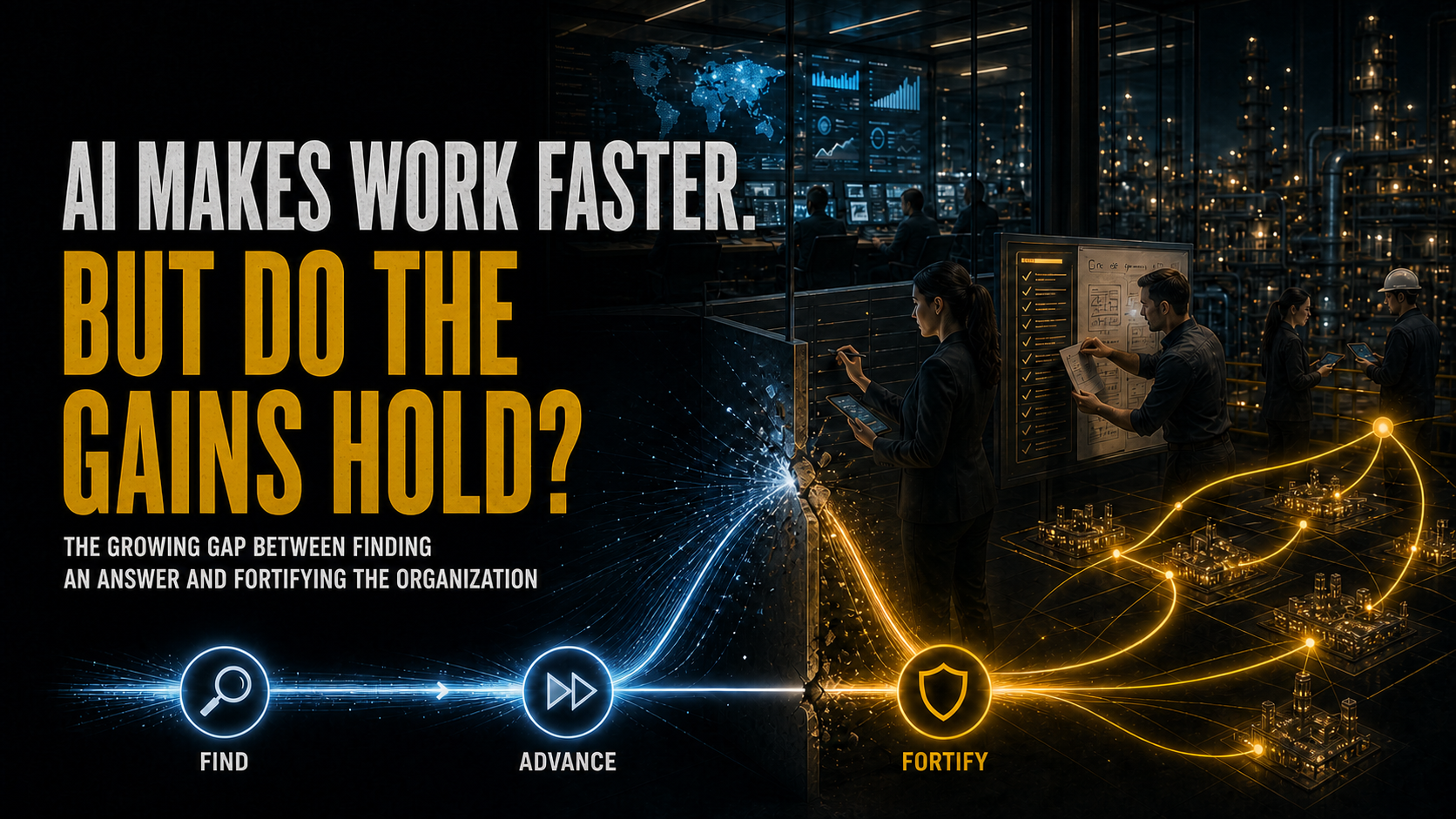
There are three steps, and AI only got fast at two
Start with a house. You find a leaking lead pipe in the basement. You replace it. Do you then check whether the rest of the house has lead pipes?
Most people stop at the replacement. The leak is gone. The lead is still in the walls, and it is affecting the family’s health whether anyone can see it or not.
Companies run the same way, and the loop has three parts.
- Find is slowing down to look at what is actually happening. Where the work has drifted from the process, where a gap has opened, where the next threat lives.
- Advance is doing something about it. Committing the money, the people, and a direction.
- Fortify is making sure the whole company adopts the advance, so nobody has to solve that problem a second time. It is thoroughness, speed, and closure.
All three are required. The most common failure in business is Find and Advance without Fortify. One plant cuts its changeover time in half. The other three plants still lose the same four hours a week. Eighteen months later, a new vice president launches the same project under a different name, and the people in plant one watch it happen.
Here is what AI changed. A market scan that took a team three weeks now takes one analyst an afternoon. A business case that took a month takes a day. Find got fast. Advance got fast, because the paperwork that used to slow a decision down is no longer the bottleneck.
AI did nothing for Fortify. Fortify is a shift supervisor changing what she does on Monday. It is a spec getting rewritten, a template getting replaced, a purchasing rule getting retired. No model does that for you.
So the gap between the first two steps and the third one just got much wider. That gap is where the slop collects.
Workslop is what a skipped third step looks like on a Tuesday
Researchers at BetterUp Labs and Stanford’s Social Media Lab named this in the Harvard Business Review in September 2025. Workslop is work content that looks finished but does not move the task forward. In their survey, 40% of workers said they had received it, and each instance cost the receiver close to two hours to sort out.
Those two hours are not a tool problem. They are the cost of sending a deliverable that was built to be handed off rather than built to be used.
In the EdgeFinder lens, building for use is Fusing. Fusing takes what was learned or decided and shapes it so the rest of the organization can pick it up and run it. The output of Fusing is not a recommendation on slide fourteen. It is the changed template, the revised spec, the one-page checklist the night shift can follow without calling anyone.
AI is a strong accelerator inside Fusing. It will war-game five scenarios before lunch and find patterns across data nobody had time to compare. But Fusing is the capability and AI is the amplifier. Send the raw output and you have moved the work downstream, not finished it.
Trust debt has a company-level version, and it costs more
Forte’s trust debt is private. You doubt your own work. The company version is public, and it shows up in what people do next.
In that same research, 42% of people who received workslop trusted the sender less afterward. About a third said they would rather not work with that person again.
Each of those is a small broken promise, and trust decays at the rate promises get broken. Run it for three quarters and finance stops reading your deck and rebuilds the model themselves. Now two teams do the same work, and the second team does it while annoyed.
That is a cultural scar: the damage left when people commit to something that later gets cut or quietly ignored. Scars are expensive because they change what the company can see next. People who have been burned twice stop raising a signal early. They wait until the number moves, and by then the cheap fix is gone.
Related Video: What Is Organic Growth in a Business?
The Bottom Line
Forte’s closing point is that AI multiplies execution and is a poor substitute for vision. The company version is narrower and more useful: AI multiplies Find and Advance, and Fortify is still yours to do.
So change what you count. Stop counting drafts produced and hours saved. Count gains that held. How many fixes were adopted by every team that had the same problem, and how many were still in place two quarters later? That number tells you whether your AI spending is compounding or evaporating.
If your teams are producing more and holding less, that is a Fortify problem, not a tooling problem. Get in touch and let’s look at where your gains are leaking.