
A Detector Called Your Writing Fake. Now Claude Marks It Too.
August 14, 2026
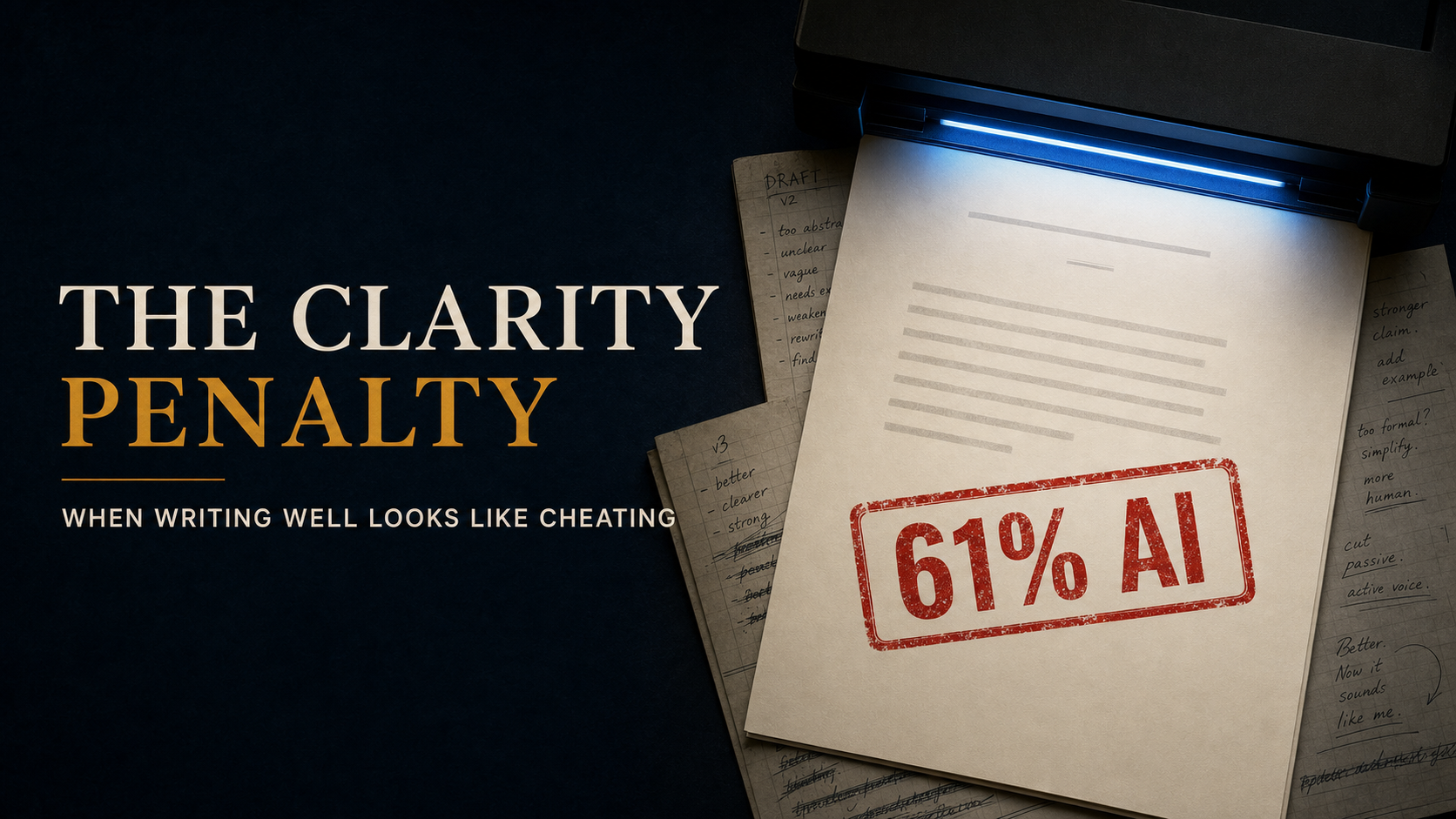
The watermarking that arrived this week is not just Claude. It is where the whole industry is going. And the tools still cannot see who wrote a word.
The email arrives and your stomach drops before your mind catches up. Your paper came back flagged. Sixty-one percent likely AI. You wrote every word of it. You remember the nights, the rewrites, the one sentence you fixed four times. And now you are being asked to do the one thing no honest person can do on command. Prove a negative. Prove that the writing you did is writing you did.
If you are reading this with that particular sickness in your chest, I want to tell you what is happening, because it is not what the number implies.
You have picked a strange week to be flagged. This is the week Claude began watermarking the text it helps people write, so anything it touches can be marked as created by AI. And this is not just Claude. Google has quietly watermarked Gemini’s text since 2024, Microsoft now marks AI-generated audio, video, and images, and OpenAI marks AI images while it works toward text. That is the new fear, and it is industry-wide, not one company. But the tool that convicted you today is the older one, the detector, and it has been getting this wrong for years. Start there, because it is what just happened to you.
What the machine measured
The detector did not read your mind, and it did not check a record of who typed the words. It cannot. What it did was run your text through a model and measure how closely your sentences match the smooth, predictable patterns it associates with AI. Clean, disciplined, well-structured writing matches those patterns, because that is what clean writing is. So the clearer you write, the more you look like a machine to it. This is not a story about your honesty. It is a story about a gauge pointed at the wrong thing.
It falls hardest on the people who worked most to write well. A Stanford study ran seven detectors against essays by non-native English speakers and falsely flagged the majority of them, because writers trained to lean on correct, textbook grammar produce exactly the clean, regular prose these tools most often mistake for a machine. Their reward for mastering the language was to be told a machine must have done it.
The relief, and it is not what you think
Here is the part I need you to hear, because the obvious comfort is a trap. The comfort is not your writing is clearly yours, so you will be fine. That was never solid ground, because a clear sentence cannot prove who wrote it any more than it can prove who did not. The real relief is colder and stronger. The gauge that convicted you cannot see whether you wrote it. It never could. Not for you, and not for anyone. It reads the surface of the words and is blind to where they came from. The verdict was empty before it ever reached your name.
Which means the thing to defend was never your prose. It is the simple fact that no score was ever entitled to stand in for a judgment about you.
What to do, and what not to do
So do not do the thing the number is quietly pushing you toward. Do not rough up your own writing to score lower. Do not add clumsy sentences and broken rhythm to look more human to a machine. That trades the one thing that matters, being understood, for a lower number on a meaningless test. You would be making your work worse to satisfy a gauge that was wrong to begin with.
Do this instead. Keep writing as clearly as you can. And keep your receipts. Dated drafts, notes, version history, the trail of how the work was really made. If anyone ever treats a score as evidence, that trail is the answer, because it speaks to the one thing a detector cannot: your process, your substance, your hand on the work over time. A number describes a surface. Your drafts describe a person doing the work.
Bottom line. You were not flagged because you cheated. You were flagged because you wrote clearly, and a tool that cannot tell clarity from anything else called that suspicious. The score is not a verdict. It was never able to be one. Keep writing well, keep your receipts, and do not let a broken gauge talk you into writing worse.
The full evidence, the studies, the mechanism, and why even the newest tools, including this week’s watermarking, do not fix this, is in the white paper: The Clarity Penalty.