
Why Organizations Fail at Fortify: The Hidden Tax of Heroics
August 3, 2026
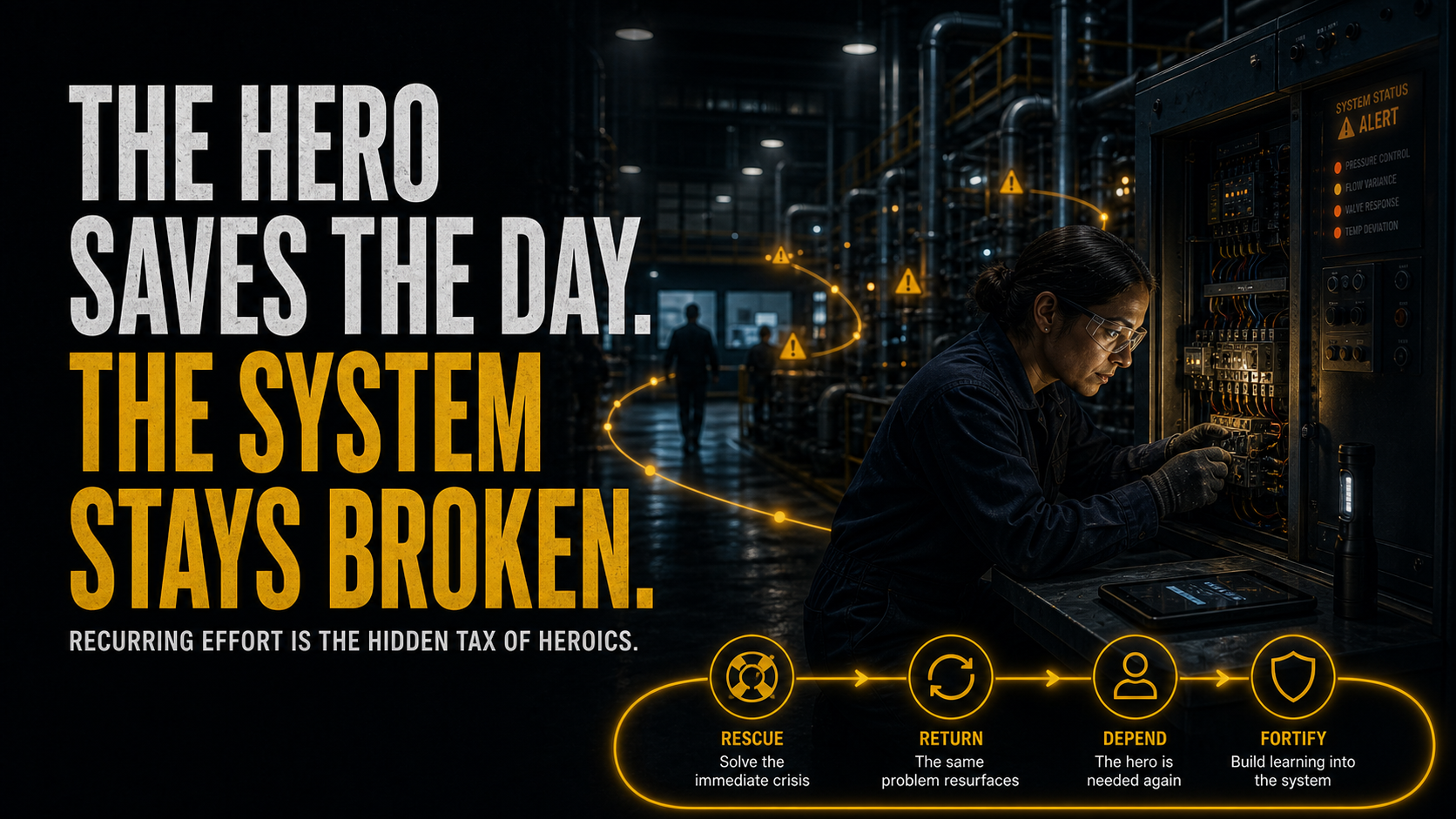
The Employee Everyone Loves
Every organization has one.
The person who is always available. Who solves every crisis. Who knows all the workarounds. Who saves projects at the last moment. Who fixes customer issues that nobody else seems able to untangle. The one who stays all weekend when the rest of the company has gone home. The person who gets recognized in all-hands meetings, praised in performance reviews, and counted on by everyone.
Leadership loves them. Customers love them. Coworkers depend on them.
But here is what actually happens in that organization: the system never improves.
The crisis gets solved. The immediate problem goes away. Life returns to normal. And then, three months later, a similar problem appears. Or the same problem surfaces in a different part of the organization. Or a variant of the original crisis emerges just complicated enough to demand another heroic intervention. The hero responds. The problem disappears again. The cycle repeats.
The organization has begun to train its people to become heroes instead of builders.
Heroics Feel Like Success
Why does this happen? The answer lies in the fundamental nature of how organizations see success.
A heroic intervention creates a visible win. The hero stays late. The customer is saved. The crisis is averted. The narrative is clear and compelling. It shows up in status reports, conversations, and organizational memory as a moment of triumph.
By contrast, a system improvement creates an invisible win. The crisis never occurs at all. The customer problem is designed out of the system. The issue is prevented before it reaches critical mass. And because the crisis never happens, it leaves no story. The prevention engineer, the person who redesigned the system so the problem could not recur, leaves no trace in organizational consciousness. There is no drama. There is no moment of salvation. There is simply: nothing went wrong.
Organizations naturally reward the visible. Leaders unconsciously cascade resources toward the dramatic. And so the incentive landscape quietly reshapes itself. Over time, the message becomes clear: solve the problem once heroically, and you gain recognition. Prevent the problem systematically, and you gain silence.
The firefighter gets celebrated. The fire prevention engineer does not.
The Hidden Cost of Heroics
But here is what organizations frequently miss: heroics have an invisible cost beyond the moment of the intervention itself.
Every heroic intervention carries a price tag. Not in the moment. In the moment, it looks like a win. The cost appears later, when the same problem surfaces again. And again. And again.
Consider the organization that has a recurring customer complaint. The first time the complaint surfaces, the team solves it heroically: custom work, special handling, manual workaround. The customer is delighted. The crisis is resolved. Everyone feels the satisfaction of a problem well-managed. But the underlying system that created the complaint—the workflow that generates the complaint, the handoff that drops the ball, the assumption that was wrong—never gets addressed.
Six weeks later, a different customer complains about the same thing. The team solves it again, using similar heroics. Special handling. Manual intervention. Another workaround created and deployed.
Now consider what the organization has actually done. It has not solved one problem. It has solved the same problem twice, explained the same solution twice, worked around the same broken system twice, and created organizational debt: the memory that “this is how we handle this,” which becomes the shadow system that operates alongside the official one.
Multiply this pattern across an entire organization. The same operational issue solved five times. The same customer confusion addressed eight times. The same quality failure prevented twelve times through manual safeguards instead of system design. The same process bottleneck circumvented with workarounds every single month.
Each of these is not one problem. It is organizational debt. The organization is paying repeatedly for the same solution.
EdgeFinder calls this recurring effort.
Recurring effort is the tax that organizations pay when they choose heroics over Fortify. It is invisible because it is distributed across the organization and across time. It is not tracked as a single line item. It appears instead as normal work. It becomes the background radiation of organizational life: the things everybody knows they have to do to make the system work, even though the system was not designed to require them.
The tragedy is not failure. The tragedy is that the same person, the same team, the same capability has to be deployed over and over again on the same underlying problem.
Can Your Growth Strategy Hold as You Scale? Watch the related video: What Is Growth Strategy?
Why Organizations Choose Heroics Over Fortify
If the cost of recurring effort is so high, why do organizations not simply prevent it? Why do they not choose to Fortify—to install learning into the system so that the crisis never returns?
The reasons are structural, not moral.
Fortify is hard to measure. The crisis that never occurs leaves no data point. The problem that is prevented never shows up in your exception reporting. Leadership sees the calendar and asks: “What have we fixed this quarter?” The organization that points to yesterday’s crises solved has a narrative. The organization that points to crises that did not occur at all because we designed them out of the system has a hypothesis. One is visible. One is theoretical. Even though the theoretical one is true.
Fortify requires cross-functional action. The person who works around the system daily may see the solution clearly. But the solution often spans multiple organizational Packs—different departments, different workflows, different leadership structures. No single leader owns the fix. The person who could design the better system lacks the authority to implement it. The person with the authority does not see the daily friction clearly enough to prioritize the redesign. The problem gets visible only when the heroic response is required. By then, everyone is too exhausted to redesign.
Fortify competes with today’s emergencies. This is perhaps the deepest structural reason. Today’s fire is visible. Next quarter’s fire is hypothetical. Organizations naturally prioritize the visible. A crisis demands attention now. A system redesign demands attention now but solves a problem that may not surface for weeks or months. The rational human mind, facing a burning building, does not prioritize the building code. It prioritizes getting out of the burning building. The rationality is not wrong in the moment. But moments, repeated, become the career and the culture.
Fortify requires leadership engagement. Many of the system redesigns that prevent recurring effort exceed the authority of the frontline Pack. They require capital. They require policy changes. They require staffing decisions. They require executive sponsorship. Without that engagement, Fortify stalls. It becomes the thing everyone agrees needs to happen but nobody sponsors, because the crisis response is already consuming the leadership attention needed to launch an improvement initiative.
The Organizational Consequences
What happens to an organization that consistently chooses heroics over Fortify?
Cultural Scars. Over time, people stop believing in improvement efforts. They have watched the same problems resurface. They have seen initiatives launched and abandoned. They have learned that survival depends not on the system, but on knowing the workarounds, building relationships with the heroes, and hoping that you happen to be available when the crisis hits your area. That becomes organizational memory. That becomes culture.
Trust Decay. Promises keep breaking because the system that makes promises was never redesigned. The customer service commitment fails repeatedly because the fulfillment system has not been improved. The product delivery timeline keeps slipping because the engineering workflow was not updated. Employees eventually realize: the system never gets fixed. Promises continue breaking. Leadership continues celebrating the people who save the day while the day keeps needing saving. That reduces trust. Not distrust, exactly. But the quiet understanding that while this organization is good at responding to crises, it is not reliable at preventing them.
Burnout. The hero eventually burns out. Not because they are weak. But because the same burden keeps coming back. The best people in the organization carry the hardest work because they are the only ones who can do it and still keep the customer promise. The workaround that was meant to be temporary becomes permanent because nobody invested in the better system. The person who was supposed to be an engineer becomes a firefighter. And one day they leave, taking with them the only system knowledge that kept the organization functioning.
Slower Adaptation. Resources stay trapped solving old problems. The best minds in the organization are locked in firefighting mode responding to yesterday’s crises instead of seeing tomorrow’s changes. Strategic response becomes reactive response. Competitive advantage erodes while effort remains tied to maintaining yesterday’s solutions.
Advantage Erosion. This is the ultimate cost. The organization that systematically chooses heroics over Fortify gradually loses the ability to move forward. Competitors, meanwhile, design their systems for Fortify. They solve a problem once and then move on to the next competitive frontier. They free capacity instead of consuming it. Over time, the organization caught in the heroics cycle finds itself further and further behind, not because the competitors are smarter, but because the competitors are not paying the hidden tax. They are not paying for the same solution 20 times.
The Difference Between Heroics and Capability
This is the heart of the insight: heroics and capability are fundamentally different paths.
Heroics are person-dependent. They require the right person, at the right moment, with the right knowledge and instinct. When that person is unavailable, the system fails. When that person leaves the organization, the capability walks out the door.
Capability is system-dependent. It is built into how work flows. It is baked into the process, the training, the handoff, the design of the work itself. When anyone in the organization performs that work, the same standard of quality and reliability emerges. The system does not depend on heroism. It depends on coherence.
Heroics are temporary. They solve the immediate problem but do not prevent its return. Tomorrow, the same class of problem will require a similar intervention. The crisis is prevented, but the next crisis of the same type will come.
Capability is repeatable. The system that is designed to prevent the problem prevents it, over and over, under different conditions, with different people, at different times. The problem does not return because the system was built so that it cannot.
Heroics consume energy. They demand intense focus, rapid decision-making, often working at a pace that cannot be sustained. The person performing the heroic act is operating at elevated stress and attention. Once the crisis passes, they are exhausted. If crises keep coming, the exhaustion never ends.
Capability creates leverage. The system works the same way whether the person is fresh or tired, focused or distracted, present or absent. The system carries the burden. The person simply operates the system. This is what creates the freedom to think about tomorrow while the system reliably handles today.
The Ultimate Goal of Fortify
Fortify is often misunderstood as being about fixing problems. It is not. Fortify is about freeing future capacity.
Every problem that never returns releases attention. Every crisis that is prevented releases resources. Every recurring issue that is designed out of the system releases energy that was previously consumed managing the workaround.
Those released resources can now be invested elsewhere. In innovation. In strategy. In responding to the market changes that actually matter. In building the next capability the organization needs. In becoming what the organization was meant to become instead of what it was forced to become by yesterday’s crises.
This is why Fortify creates sustained competitive advantage. It is not because Fortify organizations never face problems. They do. It is because when Fortify organizations face a problem, they do not remain trapped by it. They solve it and move on. They do not pay the recurring effort tax. They do not build cultural scars. They do not watch their best people burn out managing workarounds. They free capacity to respond to the future instead of remaining consumed by the past.
Why Fortify Creates Sustained Competitive Advantage
Organizations that systematically choose Fortify over heroics gain a cumulative advantage that is difficult for competitors to replicate.
They make fewer repeated mistakes. Each solution is learned once and then integrated into the system. The same issue does not resurface because the system was designed to prevent it.
They move faster. Resources are not consumed managing workarounds and firefighting recurring problems. Attention can be directed toward emerging opportunities and competitive threats instead of yesterday’s solutions.
They require less heroic effort. The standard operating system is reliable enough that when crises do occur, they are genuine anomalies rather than the predictable recurring problems that heroism was trained to solve.
They trust their systems. Employees believe that the customer promise will be kept not because someone will work all weekend, but because the system was designed to keep it. That trust extends to vendors, to partners, to customers. The organization becomes known as one that is reliable, not just responsive.
They preserve organizational energy. The best people in the organization are not chronically exhausted. The burden is not concentrated in the few who have instinct and knowledge. The entire Pack can operate at a sustainable pace because the system is carrying the load.
This compounds. Year after year, the organization that chooses Fortify gains ground against the organization that chooses heroics. Not in any single decision, but in the accumulated effect of a thousand decisions where one organization frees capacity and the other consumes it.
The EdgeFinder Principle
Organizations often celebrate the people who save the day.
The stronger organization celebrates the people who make saving the day unnecessary.
Heroics keep organizations alive. Find identifies the problem. Advance commits to the move that matters. But without Fortify, the move does not hold. The same problem surfaces again. The same heroic intervention is required again. The cycle repeats, and the organization never escapes the recurring effort tax.
Fortify is where advantage compounds. It is where the organization stops paying for the same solution repeatedly and starts building capability that works reliably, repeatedly, even when conditions change. It is where the wisdom gained from one crisis becomes the system that prevents the next.
The organization that systematically converts recurring effort into capability gains an advantage that competitors cannot easily copy. Not because the competitor does not understand the principle. But because the advantage is no longer in the people. It is in the system. The system is reliable. The system is repeatable. The system is resilient.
And that is the quiet power of Fortify: it makes heroics unnecessary. In doing so, it frees the organization to become something more than a collection of crises waiting to be solved. It becomes an organization that can think about the future.
• • •
Over the course of my career, I have watched organizations repeatedly invest in the response to the crisis while overlooking the design of the system that creates the recurring crisis in the first place. I have watched good people burn out managing workarounds instead of solving the underlying problem. I have watched organizations pay the same cost five times, ten times, twenty times, never realizing that the hidden tax was not the crisis itself. It was the decision to celebrate the hero instead of asking why the crisis kept coming back.
The question organizations need to ask is not: “Who can save us?” It is: “What system could be designed so that saving is not required?”
Questions about what this means for your organization’s approach to competitive advantage? Get in touch.