
Find, Advance, Fortify: Why Organizations Keep Solving the Same Problems
July 27, 2026
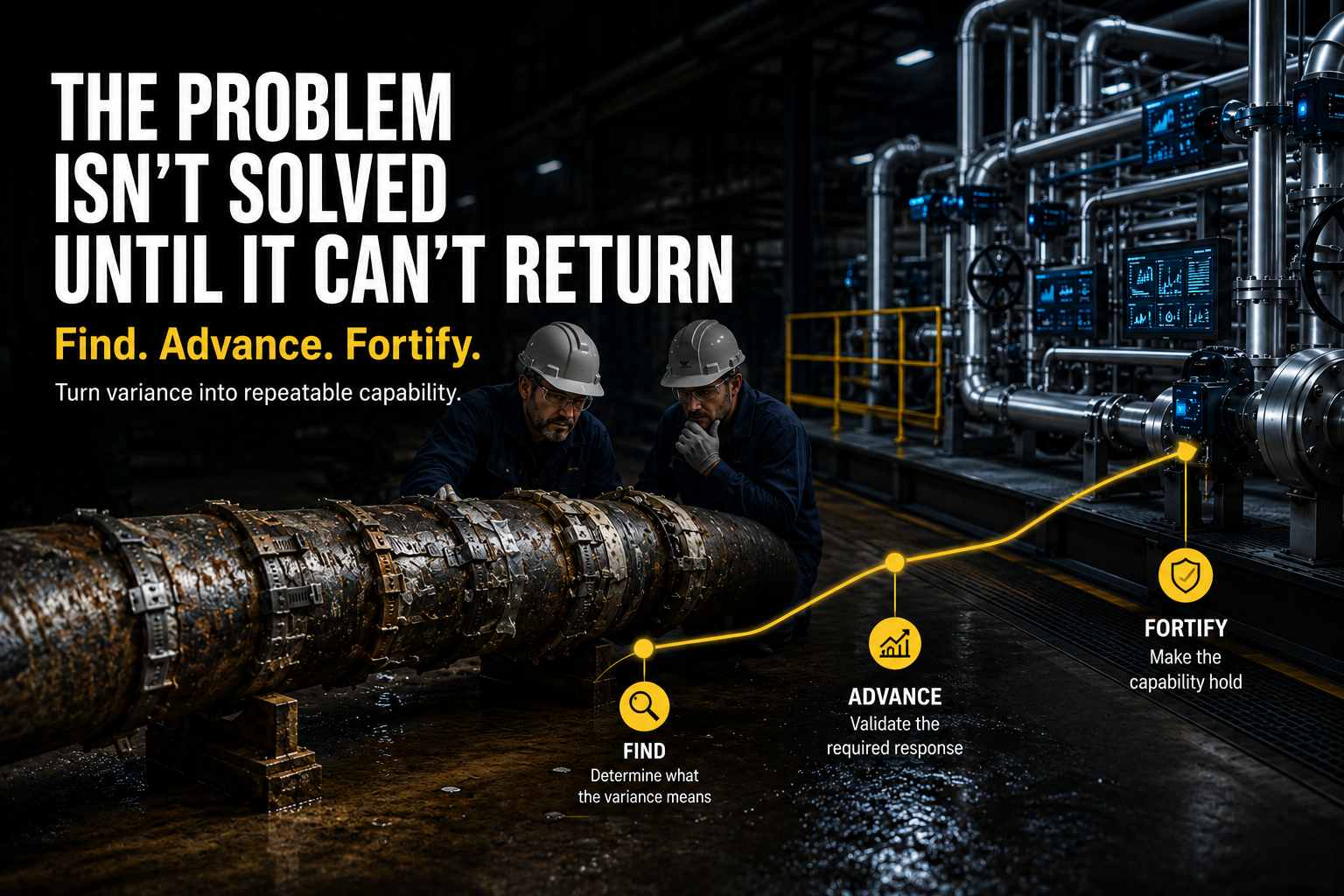
The same customer complaint returns. The same quality issue reappears. The same project delay happens again. The same communication breakdown resurfaces. Leadership believes: We already fixed that. Yet it does.
This is not a memory problem. It is not a competence problem. It is a completion problem. Most organizations do not lack the ability to solve problems. They lack the discipline to ensure the solution holds.
Why Organizations Keep Solving the Same Problems
Every leader has experienced this frustration. An issue is identified. A team is assembled. Resources are committed. The problem is resolved. Stakeholders move on. Months later, the same breakdown occurs.
The organization solved the problem. It did not learn from it.
The Difference Between Solving and Learning
Solving means: The immediate issue is removed. The pipe is fixed. The customer complaint is addressed. The process is adjusted. The tension is relieved.
Learning means: The issue is prevented from returning. The fix is installed into the system so thoroughly that the problem cannot recur under normal conditions.
Most organizations solve. Few learn.
This distinction matters because every problem your organization encounters is a signal. It carries information about how your system actually operates versus how you believe it should operate. That signal has value only if the organization captures it and converts it into capability.
Every Signal Creates a Choice
When variance appears in your organization—an unexpected cost, a missed timeline, a customer complaint, a quality failure—it always originates in the operational unit responsible for that promise. The team detects it first. The team diagnoses it first. In EdgeFinder terms, the Pack (the smallest complete set of interdependent capabilities keeping a specific customer promise) recognizes the signal before anyone else does.
At that moment, the organization faces a choice.
Ignore the signal and continue. React to the signal in isolation and move on. Or learn from the signal and ensure it cannot return.
The third option is where sustained competitive advantage accumulates. But it requires completion.
Find: The Disciplined Practice of Recognizing What Matters
Find is not data collection. Every organization collects data. What most organizations fail to do is recognize which data contains meaningful signal.
Find is the practice of identifying variance that carries strategic weight: an emerging customer need, a competitive threat, an operational friction, an erosion of your capability, or an emerging advantage nobody has yet named. It is pattern recognition under pressure.
Why Find Fails
Organizations miss signals because they are blinded by what has worked. Success creates confidence, then certainty, then blindness. A methodology that performed well in one context gets applied universally. Hierarchy filters what news reaches the top. Metrics designed to track one outcome obscure emerging shifts that metrics were never designed to capture. Cultural scars from previous failures cause organizations to dismiss signals that resemble old pain, even when they signal something new.
The Pack sees the variance first. But the signal often does not travel beyond the operational unit. It gets absorbed as “just one more thing” rather than recognized as strategic intelligence.
Advance: The Deliberate Effort to Resolve or Exploit
Advance is not a synonym for action. It is deliberate action aimed at the signal the Pack detected.
Sometimes Advance means tuning: optimizing and refining what already works. Sometimes it means innovating: designing something that does not yet exist. Sometimes it means fixing: removing a specific friction. The common thread is intentionality. The Pack has recognized something that matters. Now the organization responds. Watch: What Is Growth Strategy In Business? for a deeper discussion.
Why Advance Fails
Organizations understand signals but fail to act on them. The response never materializes because debate extends beyond decision, because no one holds authority to move, because resources are unavailable, or because the urgency dissipates as soon as the immediate crisis passes.
Advance fails most often when the organization confuses “we understand the problem” with “we will resolve the problem.” Understanding is necessary. It is not sufficient. If the response does not materialize before the next pressing issue claims attention, the signal goes unaddressed.
Fortify: Where Competitive Advantage Accumulates
This is where most organizations fail, and where competitive advantage actually compounds.
Fortify is the installation of learning into the system. A problem is not truly solved until the organization no longer depends on memory, vigilance, or heroics to prevent its return. It is not the moment the fix is implemented. It is the moment the fix is made irreversible by the system itself. The solution becomes “how we operate” rather than “what we did that one time.”
The Difference Between Repair and Fortify
A pipe bursts in your warehouse. Water floods the inventory. The team rushes to repair the pipe. The inventory is salvaged or replaced. The crisis passes. The team moves on.
That is repair.
But the burst revealed a problem: the corrosion is system-wide. Other pipes are under the same stress. The design of the water system creates vulnerability under high flow. The maintenance schedule misses early warning signs. None of this is addressed.
Months later, another pipe bursts. Same location, same consequence, same scramble.
Fortify would have asked: What kind of problem does a burst pipe signal? Not just “this pipe failed,” but “what about our water system makes pipes fail?” Then the organization redesigns the system, upgrades the materials, changes the maintenance rhythm, and installs monitoring that catches corrosion before rupture. The problem does not return because the system no longer allows it.
Why Organizations Fail at Fortify
Organizations fail at Fortify for several reasons, each rooted in how organizational attention works:
1. Heroics mask the need for system change.
People compensate. Your best operational leaders work longer hours or develop workarounds that keep the system functioning despite its design flaws. The problem appears solved. Urgency disappears.
2. Ownership is unclear.
The operational unit knows the specific pain. But who owns the systemic response? If the answer is “someone else will handle it,” the systemic fix never happens.
3. Leadership attention drifts.
The crisis is resolved. The next crisis emerges. Fortifying yesterday’s problem is not as urgent as fighting today’s fire.
4. Success kills momentum.
Once the immediate fix is in place, the problem seems gone. The pain that drove action fades. Why invest more effort if the problem appears to be solved?
The result is predictable: the same issue returns, the same workarounds resume, and the same people compensate at higher cost until something breaks catastrophically.
Fortify Is Where Competitive Advantage Becomes Irreversible
Your competitors can replicate your product. They can copy your processes. They can hire your people and build what you built.
What is difficult to replicate is accumulated learning. It is the institutional memory embedded in how you operate. It is the adaptive capability that lets you sense and respond as a unit. It is the fact that your system does not allow the same failures to return.
Fortify creates these advantages. When you systematically convert experience into capability, when you install learning into the system rather than into a person, when you make it impossible for a solved problem to return, you build something that compounds over time and cannot be easily copied.
Organizations that fortify less often make the same mistakes. They operate with lower friction. They respond faster because their people trust that systems will hold rather than needing constant heroic compensation. Customers commit because your reliability is structural, not personality-dependent.
This is the origin of sustained competitive advantage.
Thoughtfulness, Speed, and Closure
Find, Advance, and Fortify produce three critical outcomes:
Thoughtfulness: Did the organization understand the signal, or did it react on instinct? Thinking shapes response quality. A thoughtful response to a signal is more likely to address root cause than a reactive response that addresses only the visible symptom.
Speed: Did the organization act before reality forced the move? Organizations that fortify compete differently. They are not racing to catch up to problems; they are anticipating them. This is the paradox of Fortify: it requires more time to get right in the moment, but it saves vastly more time across the organization’s lifetime.
Closure: Did the organization ensure the problem cannot return? Closure is not complacency. It is confidence. When Fortify works, the organization can close the file on a problem and invest its energy elsewhere, trusting that the system will not allow the same failure to recur.
Find, Advance, and Fortify together produce organizations that are thoughtful about what matters, move quickly when it matters, and achieve the closure that lets them move forward.
Why Find, Advance, Fortify Is a Philosophy, Not a Process
Organizations often mistake FAF for a process. It is not.
FAF is a way of thinking about what it means to build an organization that learns.
It is the belief that variance contains information. It is the conviction that action must follow understanding. It is the discipline that learning must be installed into the system, not left to individuals.
The EdgeFinder Principle
Organizations do not sustain competitive advantage because they find more signals than their competitors.
They do not sustain advantage because they react faster.
They sustain advantage because they systematically convert experience into capability. They find signals. They advance against signals. And critically, they fortify so that the same signal does not return.
Find identifies reality. Advance responds to reality. Fortify ensures the organization remembers what reality taught.
That conversion—from signal into capability, from experience into system—is what separates organizations that solve problems once from organizations that solve them permanently.
It is also what separates organizations that compete from organizations that compound advantage.
Curious how this plays out in your organization’s specific context? Get in touch and let’s discuss how Find, Advance, Fortify maps to your competitive strategy and operational reality.