
The Five Diagnostic Variances: How Adaptive Organizations Distinguish Actionable Signals from Noise
July 13, 2026
The Most Expensive Meeting in Business
A leadership team gathers around a problem. On the surface, they all see the same issue. But look closer, and something essential is broken.
Sales says the problem is the market. “Customers are pulling back. Our sales cycle has stretched by six weeks. This is a demand issue.”
Operations disagrees. “Our fulfillment delays are creating that perception. We could be shipping in weeks, not months. The problem is execution, not market.”
Finance chimes in. “You both miss the point. We cut staffing six months ago to manage the downturn. We don’t have capacity for this volume. The real problem is resources.”
Human Resources adds another layer. “The staffing issue points to something deeper. We’ve had two rounds of unexpected departures. Our culture has shifted. People aren’t confident in the organization’s direction.”
Product finally speaks up. “Everything here is a symptom. We shifted our product roadmap three months ago without getting input from the largest customer segment. We lost market fit.”
Nobody is wrong.
And that is the problem.
Each leader sees a different kind of signal. Each one is real. Each one matters. But the team is not solving the same problem. They are solving five different problems, in five different languages, using five different time horizons.
The result: weeks of activity with no progress. Resources deployed in competing directions. Urgency without clarity. The organization moves, but it does not move together.
This meeting is the most expensive meeting in business because it is universal. Every organization above a certain scale has had it. Most have it regularly.
Why Variance Alone Is Not Enough
The EdgeFinder lens starts with a fundamental assertion: variance is signal, not error. Most organizations see deviation as something to eliminate. EdgeFinder sees it as intelligence to investigate.
This is powerful. It elevates early warning signals that most organizations miss until failure becomes visible. It shifts the organization’s attention upstream, where response is still possible.
But knowing that variance exists is only half the battle.
Variance tells you that something changed. It does not tell you what kind of change it is. The sales leader, the operations leader, and the product leader all see variance. They are reading different signals through different lenses. Without a shared language for interpreting what they are seeing, they cannot align on what matters next.
The Hidden Cost of Diagnostic Confusion
When leadership teams cannot agree on what kind of variance they are looking at, the consequences cascade.
1. Resources get deployed to solve the wrong problem. The organization invests in hiring because Finance says it is a capacity issue, while the real issue is market shift or strategic misalignment. Money is spent. The problem persists.
2. Symptoms get treated instead of causes being addressed. The team focuses on reducing fulfillment delays (a symptom), while the root signal is that the product no longer meets customer needs (the cause). Effort is expended. Progress is illusory.
3. Trust erodes. When the organization invests heavily in a solution that does not work, employees lose confidence in leadership’s ability to read reality. They see activity without progress. They question judgment.
4. The same variance reappears. Because the underlying signal was never properly diagnosed, the conditions that created it persist. The problem returns, often in disguised form.
This cycle is expensive. It costs time, resources, and credibility. It leaves the organization reactive instead of adaptive.
A Shared Language for Reality
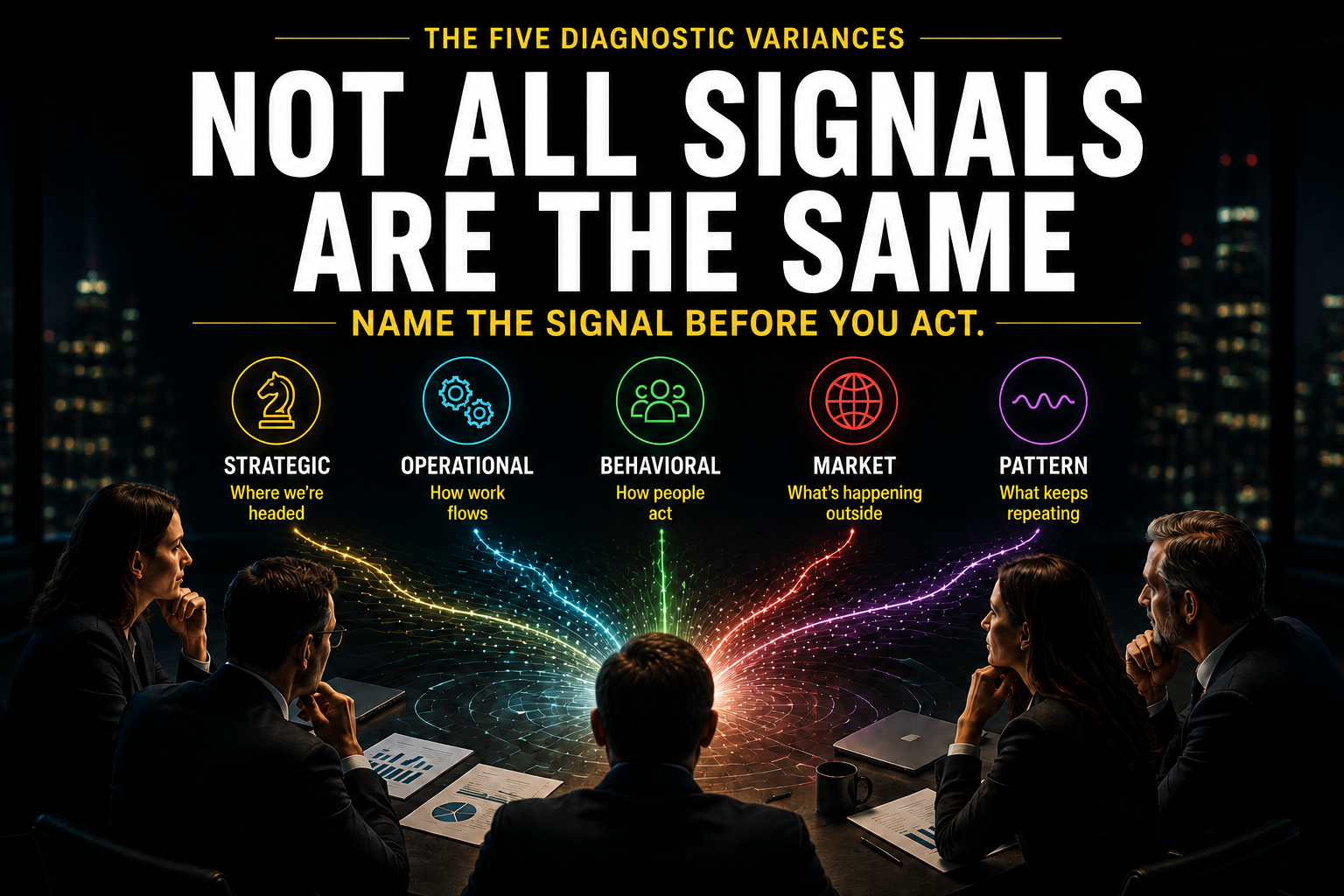
This is where the Five Diagnostic Variances become essential.
The Five Diagnostic Variances are not a scoring model. They are not a maturity assessment. They are not a prioritization tool or a framework for root cause analysis.
They are a shared language for understanding what kind of signal is present.
Their purpose is to answer two urgent questions: Is this variance actionable? And if so, what kind of action does it require?
Strategic Variance
The organization is moving away from its intended direction.
This shows up in misalignment between declared strategy and observed priorities. Activities no longer support the stated objectives. Resources flow away from what leadership said mattered most. Market conditions shift, making assumptions invalid. A product pivot was made without reconnecting it to the original market opportunity.
Strategic variance is often the most consequential diagnostic because it questions the assumptions behind the plan rather than the execution of the plan itself.
The leadership question: Are we still pursuing the right objective?
Operational Variance
The strategy is sound. Execution is not.
This is deviation in how work actually flows compared to how it is designed to flow. Bottlenecks appear. Delays compound. Quality issues emerge. Friction accumulates at handoffs. The system was built to deliver, but the actual experience of moving through it has degraded. The promise on paper no longer matches the experience in practice.
Operational variance is the easiest to see and the most commonly misdiagnosed because leaders often assume all variance is operational variance.
The leadership question: Can the system reliably deliver?
Behavioral Variance
People are behaving differently than expected.
Unexpected resistance emerges to a change that leadership expected would be welcomed. Adoption accelerates faster than anticipated. An outlier performer is delivering results differently than the rest of the organization. Cultural norms are shifting in ways that were not explicitly stated. People are voting with their presence, their effort, or their voice. What they are communicating is often the most important signal available.
Behavioral variance is often the earliest indicator of deeper strategic or cultural issues because people frequently sense change before leadership systems measure it.
The leadership question: What are people telling us through their actions?
Market Variance
The external world has changed.
Competitor actions shift the playing field. Customer behavior shifts, revealing new needs or diminishing demand for something you offered. Regulatory changes create new constraints. Technology changes create new possibilities or obsolete existing advantages. The organization’s assumptions about the market were valid yesterday. They may not be today.
Market variance is dangerous because it originates outside the organization’s control yet eventually affects every internal system.
The leadership question: What changed outside our walls?
Pattern Variance
Something recurring is happening.
The same issue shows up repeatedly, even after it was “fixed.” The same handoff fails again under stress. The same customer complaint keeps surfacing. The same strategic miss repeats. The pattern is the signal. Pattern variance signals a structural issue that point fixes cannot address. The organization is treating symptoms while the underlying system remains unchanged.
Pattern variance is the diagnostic most closely associated with Fortify failures because recurring problems often indicate the organization fixed an event rather than the underlying system.
The leadership question: What pattern are we failing to see?
Why This Framework Differs from Root Cause Analysis
Root cause analysis asks: What caused this?
The Five Diagnostic Variances ask: What kind of problem are we looking at?
One seeks explanation. The other seeks orientation.
That is a powerful distinction.
The Diagnostic Is Not the Decision
This is a critical distinction.
Naming the variance does not tell you what to do.
If the team diagnoses strategic variance, that does not mean “change the strategy.” Strategic variance says: “The organization’s observed direction has drifted from its stated direction. Alignment is lost. This is a decision point. What should we do about it?” The options remain open: clarify and reinforce the original strategy, adjust it, or change it entirely. The diagnosis opens the question. The decision comes next.
The diagnostics accelerate this process. They compress the time spent debating what the problem is. Once alignment on the diagnosis is achieved, the organization can move to decision and action with a shared understanding of what it is responding to.
The EdgeFinder Principle
Organizations rarely fail because they lack data. Data is everywhere. What differentiates adaptive organizations from reactive ones is not the amount of information available. It is the ability to interpret it.
The Five Diagnostic Variances do not eliminate uncertainty. No shared language can. What they create is a common way of discussing it, rapidly.
Organizations that can interpret reality faster than their competitors gain the most valuable advantage of all: the ability to act before everyone else understands what is happening.
In markets where conditions change at pace, this speed is everything. The organization that can sense variance, name it, and align on response in hours instead of weeks is the organization that maintains competitive advantage across uncertainty.
This is not about complexity reduction. It is about coherence. Shared language creates coherence. Coherence creates trust. Trust creates sustained competitive advantage.