
When Everyone Uses the Same Words and Means Different Things
June 22, 2026
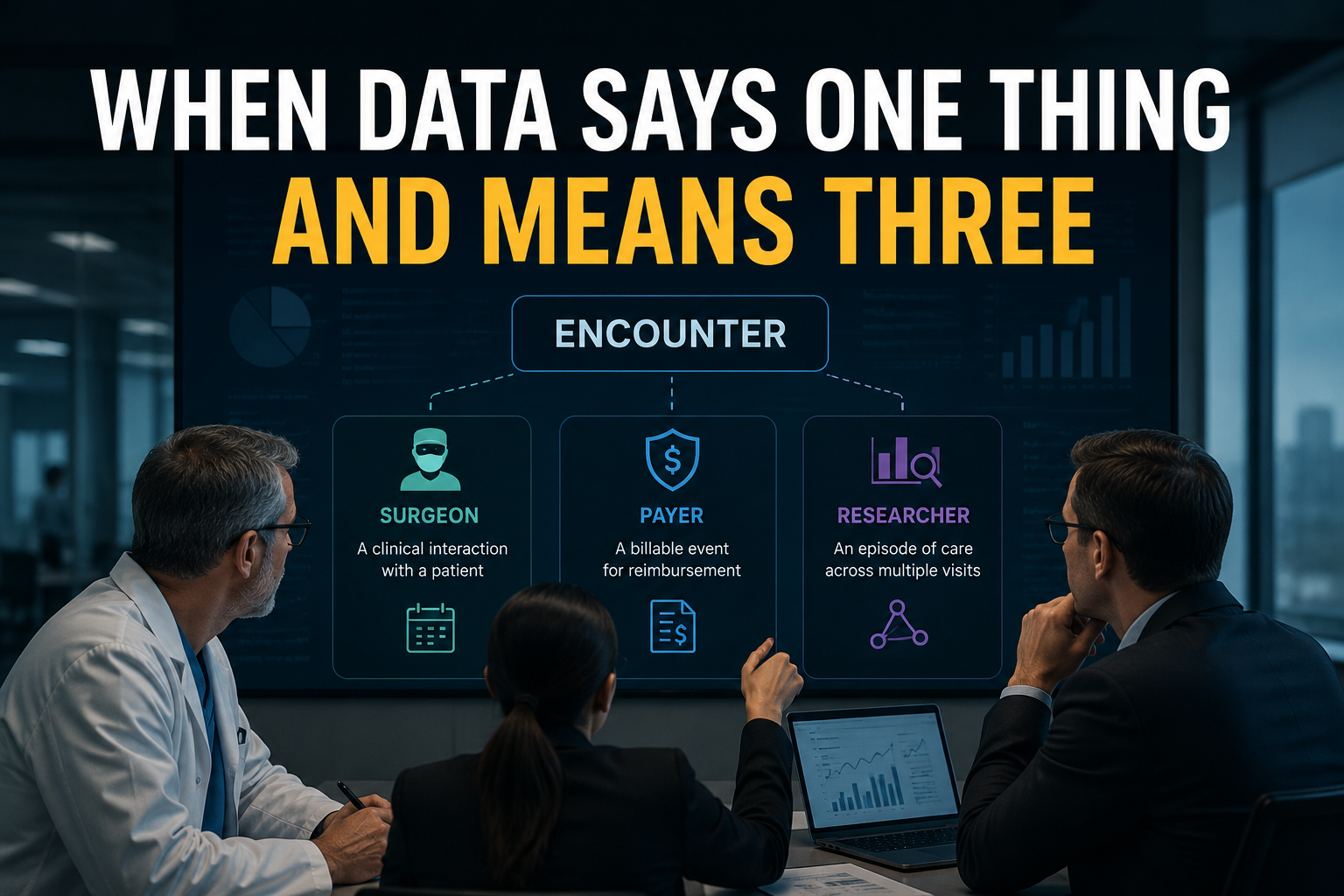
A surgeon, a payer, and a life sciences researcher walk into a data meeting. They all use the word “encounter.” They all mean something different. Nobody realizes it until the analysis is complete, the decisions are made, and the outcomes do not match expectations.
This is not an edge case. It is the default condition of most organizations that rely on data generated across multiple disciplines, departments, or institutional boundaries. The words look the same. The fields match. The queries run clean. And the answers are wrong.
Terminology drift is one of the most consequential and least visible risks in enterprise decision-making today. It compounds silently. And in an era where organizations are layering AI on top of data systems that were never designed for analytical consistency, it has become the barrier most implementations never see coming.
The Invisible Architecture of Misalignment
Healthcare is the clearest example of this pattern, but it is not the only one. Any industry where data is generated at multiple points of origin, aggregated by intermediaries, and then used for purposes beyond its original design faces the same structural risk.
In healthcare specifically, the data infrastructure was built for billing. Claims data, procedure codes, encounter records: these were optimized to ensure providers get paid. The definitions embedded in that infrastructure serve reimbursement logic. When a surgeon logs an “encounter,” it refers to a clinical interaction. When a payer processes it, the same word refers to a billable event. When a researcher queries it, they may mean an episode of care spanning multiple visits. Same word. Three different meanings. One database.
Research from Kythera Health demonstrates how severe this gap can be. When their team tested LLM performance on raw claims data, they found that basic business questions returned zero correct answers. A significant factor was this semantic layer: the data’s terminology and structure reflected billing logic, not the analytical logic being applied to it.
A 2025 systematic review published in Frontiers in Health Services examined 161 studies on digital health data integration and found that semantic inconsistencies remain a persistent barrier, even where standardized systems like FHIR, HL7, and SNOMED CT are deployed. The codes exist. The mappings are incomplete. The terms drift.
Terminology Drift as Operational Variance
In the EdgeFinder lens, variance is signal, not error. It is the most valuable intelligence available because it reveals where the system’s actual behavior has diverged from its designed behavior.
Terminology drift is a form of Operational Variance: a deviation in how work actually flows versus how it is designed to work. The organization assumes its terms are consistent across functions. They are not. The system assumes its data fields carry a single, shared meaning. They do not.
What makes this form of variance particularly dangerous is that it compounds across the Pack. The Pack is the smallest complete set of interdependent capabilities and handoffs that must move together to reliably keep a customer promise. The Pack is not the team. The team operates the Pack. When terminology drifts at the data layer, it does not stay contained there. It propagates through every handoff that depends on that data: clinical decisions, operational reports, strategic dashboards, AI model outputs.
Each handoff amplifies the drift. A clinical team uses the data to plan care. An analytics team uses it to measure quality. A leadership team uses the analytics to set strategy. By the time the original terminology gap reaches the strategy layer, it has been laundered through enough intermediary steps that it looks clean. The signal is hidden inside something that appears to work.
Sensing the Drift, Fusing the Resolution
Detecting terminology drift before it corrupts downstream decisions requires a specific organizational capability. In the EdgeFinder system, this maps to two of the five Strategic Meta Skills that act on the Pack.
The first is Sensing: the ability to detect and interpret meaningful variance before it becomes visible failure. Sensing’s filter is pattern recognition. In the context of terminology drift, Sensing means noticing when the same word produces different outcomes depending on who is using it, when the same data field answers different questions depending on the query, when reports from different departments tell conflicting stories despite drawing from the same source.
The second is Fusing: the ability to synthesize insights across diverse sources into coherent decisions. Fusing’s filter is synthesis. It is the capability that resolves what Sensing detects. Where Sensing sees that “encounter” means different things to different functions, Fusing builds the explicit mapping: this term, in this context, means this. Not a single definition imposed from above, but a shared translation layer that makes cross-functional communication reliable.
Both capabilities act on the Pack, not on individuals in isolation. A single analyst can notice a terminology gap. But making that detection systematic, making it part of how the organization operates, requires Sensing and Fusing to be embedded in the Pack’s handoffs.
The Find Without Fortify Pattern
Many organizations have, at some point, recognized that they have a data consistency problem. They have invested in data governance initiatives, master data management platforms, or terminology standardization projects. And then the initiative stalls.
Think of it like a home inspection. You find a leaky lead pipe in the basement. You fix the leak. But do you also check whether the rest of the house has lead pipes? Because if you do not, the same problem is waiting in the walls, and it is affecting your long-term health whether you see it or not.
In the EdgeFinder lens, this maps to a continuous loop of Find, Advance, Fortify. Find is the discipline of slowing down to examine what is actually happening in the organization: reviewing where terms have drifted, where gaps have opened, where the data no longer means what people assume it means. Advance is doing something about it: committing resources, choosing a direction, launching the governance initiative. Fortify is making sure the entire organization adopts the advance so you never have to go back and do it again. It is thoroughness, speed, and closure. Fortify turns a local fix into an organizational standard so the whole Pack moves forward together.
The most common failure is Find and Advance without Fortify. The organization spots the leaky pipe and fixes it, but never checks the rest of the house. The standardization project produces a document. The document does not change how people actually use terms in their daily work. The master data management platform is deployed. But the semantic mappings are incomplete, and nobody is accountable for maintaining them. The pilot succeeds. The scale-up does not.
The data tells this story at scale. 77% of organizations rate their data quality as average or worse, according to Precisely’s 2025 Data Integrity Trends Report. 64% cite data quality as their top data integrity challenge. These numbers have not meaningfully improved despite years of investment in data governance, which suggests that the problem is not a lack of awareness. It is a Fortify failure. Organizations keep finding and advancing without making the gain hold across the entire organization.
What This Means for Organizations Deploying AI
AI makes the semantic gap more consequential, not less. Every traditional reporting system was at least mediated by human analysts who could catch obvious inconsistencies. AI models do not catch them. They learn from the data as given, encode the terminology drift into their outputs, and serve those outputs with the confidence of a system that does not know it is wrong.
Consider the scale of the problem. Corporate databases capture approximately 20% of business-critical information in structured formats. The remaining 80% lives in unstructured data: email threads, call transcripts, meeting notes, contracts, and external sources. AI systems are increasingly designed to process both. When the structured 20% already suffers from terminology drift, adding unstructured data into the model’s training set introduces a second layer of semantic inconsistency. The drift does not just double. It compounds geometrically across every source the model touches.
For healthcare organizations, where 81% of hospitals have not adopted AI at all and only 16% have system-wide governance frameworks, the window to address this is now, before AI adoption scales terminology drift into every automated decision in the system.
The organizations that will get this right are the ones that treat terminology as a strategic capability within the Pack, not a documentation exercise managed by IT. That means:
1. Explicit cross-functional term mapping.
Not a glossary that sits on a shared drive. A living translation layer maintained at every handoff where disciplines exchange data.
2. Regular testing of data output against intended meaning.
Kythera’s approach of comparing model outputs across data preparation levels is a model for how organizations should continuously test whether their data says what they think it says.
3. Accountability for semantic integrity at the leadership level.
If nobody in the C-suite is responsible for ensuring that the organization’s data means the same thing to everyone who uses it, the drift will continue.
The Bottom Line
The most expensive data problem in most organizations is not missing data or dirty data. It is data that looks correct but means different things to different people. Terminology drift is a form of Operational Variance that compounds across every handoff in the Pack. It is detectable through Sensing, resolvable through Fusing, and sustainable only through Fortify. Organizations that treat semantic consistency as infrastructure maintenance will keep building AI on a foundation that silently distorts every decision it informs.
If you suspect your organization’s data means different things to the people who depend on it, that suspicion is worth testing. Get in touch and let’s explore where the terminology gaps live and what they are costing you.