
Why Organizations Fail to Adapt
June 16, 2026
Most organizations invest in capability before they establish clarity. They fund leadership programs, innovation initiatives, process improvements, and ambitious AI projects long before they build a shared understanding of what the organization is trying to accomplish, how success will be measured, and how decisions should be made when conditions change.
The result is predictable, and the evidence is unforgiving. Research associated with Harvard Business School has found that roughly 90 percent of organizations fail to execute their strategies successfully. The cause is rarely a shortage of talent. Robert Kaplan and David Norton, writing in Harvard Business Review, found that only 5 percent of employees understand their company’s strategy. MIT Sloan research places the figure near 7 percent who fully grasp the strategy and what is expected of them to deliver it. An organization cannot execute what its people cannot articulate.
This is the quiet failure at the center of organizational development. Companies become more capable without becoming more effective. People sharpen their ability to act while losing sight of where they are going and why it matters. Capability without clarity creates motion without direction.
The challenge is not intelligence. It is alignment. The challenge is not effort. It is coherence. The challenge is not execution. It is shared understanding.
The Strategic Storyboard
Every organization has a strategy. Far fewer have a shared picture of how that strategy creates impact. That gap is where execution quietly fails.
One way to close it borrows from a discipline that governments, militaries, and large philanthropies have used for decades: the program logic model. Popularized by the W.K. Kellogg Foundation’s widely cited 2004 development guide, the logic model maps a simple causal chain. Resources lead to activities, activities produce outputs, outputs drive outcomes, and outcomes create impact. Applied to enterprise strategy, this becomes a strategic storyboard, a visual map that connects investment to impact and answers one demanding question: what must be true for us to achieve the future we want?
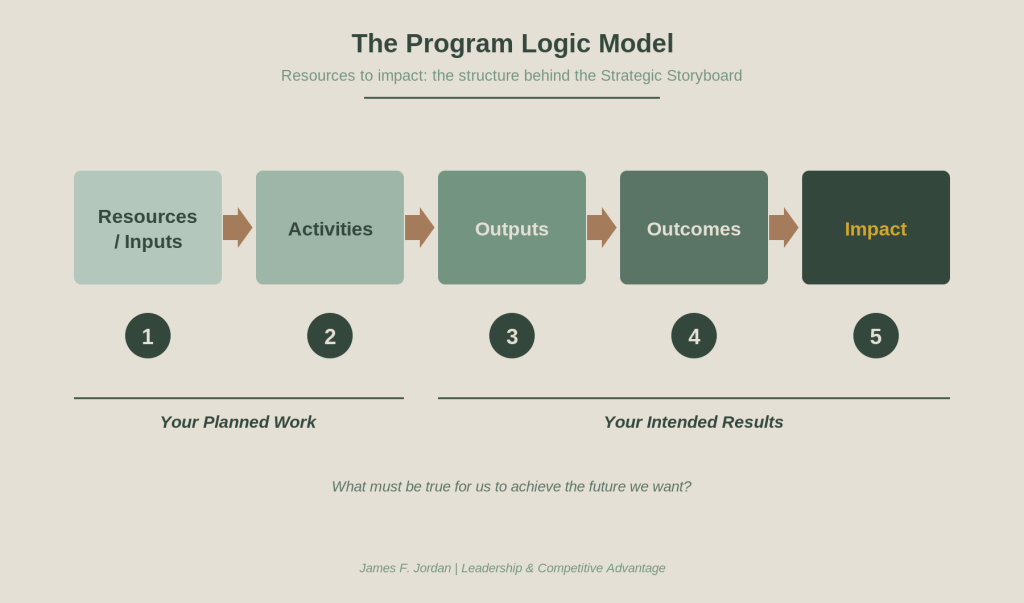
Figure 1. The program logic model. The first two stages describe the planned work; the final three describe the intended results. Every outcome and impact on the right carries a requirement on the left.
The strategic storyboard forces leaders to make the relationship between investment and impact explicit. It surfaces a truth that strategy decks routinely hide. Organizations agree on outcomes and then negotiate resources as though the two were independent. They are not. Every outcome carries requirements. Every ambition carries cost. Every promise carries obligation.
When those relationships are visible, debate changes character. Instead of arguing about whether a goal is worthy, leaders examine whether the assumptions beneath it actually hold. The storyboard becomes the organization’s shared picture of reality, and shared reality is the precondition for everything that follows.
Why Mission Comes Before Capability
Militaries learned a hard lesson long ago. Training alone does not create effectiveness. A highly trained force without mission clarity is a collection of capable individuals moving in different directions.
Before capability is developed, military organizations establish the mission, the commander’s intent, the governing principles, the priorities, and the boundaries within which people may decide. Only then do they train people to execute. The logic traces back to nineteenth-century Prussian doctrine and the principle, often attributed to Helmuth von Moltke the Elder, that no plan survives first contact with the enemy. Plans change. Conditions shift. Communications break. The unexpected arrives on schedule.
Commander’s intent exists precisely for that moment. It is a short, plain statement of what success looks like and why the mission matters, and it lets people adapt when the detailed plan no longer fits without losing the thread of the mission. When the situation diverges from the plan, people are expected to adjust on their own, provided they remain aligned to the commander’s purpose.
Organizations face the same physics. Markets shift. Competitors move. Technology evolves. Customers change. No strategic plan survives a year unchanged. The question is never whether change will occur. The question is whether people can adapt without losing direction.
The Missing Layer: Decision Architecture
Between mission and capability sits an element most organizations never deliberately build: decision architecture. It is the standing set of references people actually consult when the plan and the situation disagree. Vision, mission, principles, values, strategic priorities, and clear decision rights.
Under uncertainty, people rarely reach for the annual strategy document. They rely on principles, priorities, and culture. They rely on what they understand the organization to stand for. Decision architecture answers a question the strategy deck cannot: how should we decide when the plan no longer matches the situation?
Without it, capability becomes hazardous. People can act quickly without acting wisely. They can innovate without innovating in the right direction. They can execute with precision toward the wrong outcome. Speed without a decision architecture simply helps an organization reach the wrong destination faster.
This is also the layer where a lens matters more than a procedure. The EdgeFinder lens treats variance as signal rather than error, and it gives decision architecture something to point at. When a metric drifts, a handoff frays, or a customer behaves unexpectedly, the question is not only who missed the number but what the variance is telling us and what move it calls for. Before a team can respond well, it needs a shared language for naming what kind of signal it is seeing. Five diagnostic variances, operational, behavioral, strategic, market, and pattern, serve exactly that purpose. They are not an analytical framework and they do not prescribe action. They are a speed tool that compresses the time a leadership team spends arguing about what the problem is, so it can move faster to what matters next.
Strategic Meta Skills: Building the Capability to Respond
Once mission clarity and decision architecture are in place, an organization has to develop the capability to operate inside them. This is the role of Strategic Meta Skills.
Strategic Meta Skills are not technical competencies and they are not individual talents. They are an integrated capability that helps an organization interpret, adapt, align, and respond together when reality changes. They act on the Pack, the set of capabilities and handoffs that must move together to keep a promise, not on individuals in isolation. Individual brilliance does not scale. Shared capability does.
It helps to see the five skills not as a list but as a single decision flow. It begins with Sensing, the discipline of reading variance as intelligence to investigate rather than deviation to suppress. Once a signal is sensed, the organization reaches a decision point: Tuning or Innovating. Tuning optimizes a system that fundamentally works and only needs to be faster, sharper, or better aligned. Innovating accepts that the current system cannot meet the moment and something must be transformed rather than refined. Choosing wrong is expensive in both directions. Tuning when you should innovate means polishing a system that needs replacing. Innovating when you should tune means tearing up something that only needed adjustment.
From there the flow moves to execution through Fusing and Resonance. Fusing synthesizes insight, war-games scenarios, and designs solutions built to be woven into how the organization actually works, not recommendations that sit in a report waiting to be retrofitted. This is where artificial intelligence belongs in strategic work. AI is a powerful accelerator for Fusing because it speeds discovery and deepens scenario planning, but Fusing is the human capability and AI amplifies it. Resonance then takes what Fusing produced and builds the shared conviction that turns a decision into coordinated movement, so teams anticipate one another without constant top-down control.
Organizations rarely fail for lack of a plan. They fail because reality changes faster than their ability to interpret and respond. Strategic Meta Skills build that adaptive capacity into the organization itself.
Find, Advance, Fortify: Turning Adaptation Into a Habit
Picture a home inspection. The inspector finds a leaking lead pipe in the basement and you have it repaired. The leak is gone. But unless someone checks whether the rest of the house was plumbed with the same lead pipe, the identical failure is waiting inside the walls, quietly affecting your health whether you can see it or not.
Most organizations manage change exactly like the homeowner who fixes only the visible leak. They find a problem, they fix it, and they move on, never asking whether the same problem is hiding everywhere else. The EdgeFinder lens operates through a continuous loop built to prevent precisely that: Find, Advance, Fortify.
Find is the discipline of slowing down to look honestly at what is actually happening, where work has drifted, where gaps have opened, where the next opportunity or threat is forming, rather than assuming everything works as designed. Advance is doing something about it: committing resources, choosing a direction, acting on what was found. Fortify is making sure the entire organization adopts the advance so the gain holds and nobody has to solve the same problem again. Fortify is thoroughness, speed, and closure. It turns a local fix into an organizational standard.
All three are required, and here is the pattern every leader has lived through. The most common failure is Find and Advance without Fortify. The organization spots the leak and repairs it, but never checks the rest of the house. The pilot succeeds and the scale-up does not. One team solves a problem that three other teams still have. The reason is almost always the same: nobody did the Fortify work to make the gain hold across the whole organization. This is also where Fusing earns its place, because it is the connective tissue between Advance and Fortify, designing each local solution for organization-wide adoption from the start.
Find, Advance, Fortify is not a project you complete. It is an ongoing discipline, closer in spirit to continuous improvement than to a one-time initiative. Strategic Meta Skills supply the capability to run that rhythm well. Together they convert adaptation from an occasional event into an organizational habit. The two reinforce each other without being rigidly mapped. Sensing sharpens Find. Fusing bridges Advance and Fortify. Find, Advance, Fortify is the spirit of how the organization operates, and Strategic Meta Skills are the muscle that lets it run without the founder in the room.
EdgeShift: Making Adaptive Behavior Permanent
A capability that lives in a few talented leaders is fragile. To make adaptive behavior permanent, an established organization needs a way to install it across strategy, operations, and people. That is the work of EdgeShift, the methodology for enterprise pattern shift.
EdgeShift aligns three domains that most organizations manage separately. The Strategic Compass provides direction and the judgment to know when to pivot and when to hold. Mission Ready People are leaders and teams who understand the strategy beyond their task list and can contribute insight, not just labor. Frictionless Adaptive Operations deliver reliably while flexing to external change. Where the three integrate sits The Edge, both a state in which strategy, people, and operations move as one system and a diagnostic zone where leaders can see gaps and opportunities most clearly because all three are visible at once. The Edge is not a destination an organization reaches and holds. It is a continuous discovery zone.
Importantly, EdgeShift does not replace anything above it. The lens, the diagnostic language, the Strategic Meta Skills, and the Find, Advance, Fortify loop all operate inside it. The methodology is the scaffolding through which they express themselves in a specific context.
What This Means for Leaders
The sequence matters because each layer answers a different question, and skipping any one leaves the others exposed. The strategic storyboard answers what we are trying to accomplish. Mission and decision architecture answer why it matters and how we should decide. Strategic Meta Skills answer what capability we need. Find, Advance, Fortify answers how we respond when reality changes. EdgeShift answers how we make the whole pattern permanent.
Most organizations invert this. They start with capability because capability is purchasable. You can buy a training program, hire a consultant, or stand up an AI initiative this quarter. Clarity, alignment, and decision architecture are harder because they cannot be bought, only built. So leaders fund the visible layer and skip the foundational ones, then wonder why a capable organization keeps moving in too many directions.
There is a cost to getting the order wrong, and it is not only inefficiency. When an organization commits people and resources to a direction it later abandons under crisis, it spends trust. Repeated often enough, those broken promises leave cultural scars that quietly distort how the organization senses and responds to the next shift. Getting the sequence right is, in the end, a way of protecting trust.
Related Video: How To Gain Competitive Advantage
The Bottom Line
Organizations do not become adaptive by accident. They become adaptive when mission, decision-making, capability, and execution reinforce one another. The strategic storyboard creates clarity. Mission and principles create alignment. Strategic Meta Skills develop capability. Find, Advance, Fortify creates adaptation. EdgeShift makes it permanent.
The payoff is sustained competitive advantage, which is something more durable than a winning quarter. It is the ability to convert emerging variance into durable gain, again and again, while holding direction through the troughs between wins. That durability compounds into a trust loop. Employees invest in their careers because the direction holds. Vendors commit capacity because demand is stable. Customers integrate and stay because they believe the organization will keep improving. Training alone cannot produce that. Only an organization that keeps its mission while continuously adapting can.
If your organization is investing in capability faster than it is building clarity, it may be worth examining the sequence before the next initiative. Get in touch and let’s discuss how mission, decision architecture, and adaptive capability can be built to reinforce one another in your context.